Best Coffee Creamers of 2026
Q Grader Clara Bennett ranks the 9 best coffee creamers of 2026, all shelf-stable, on curdling behavior, label honesty, cost per serving and real dairy content.
Updated
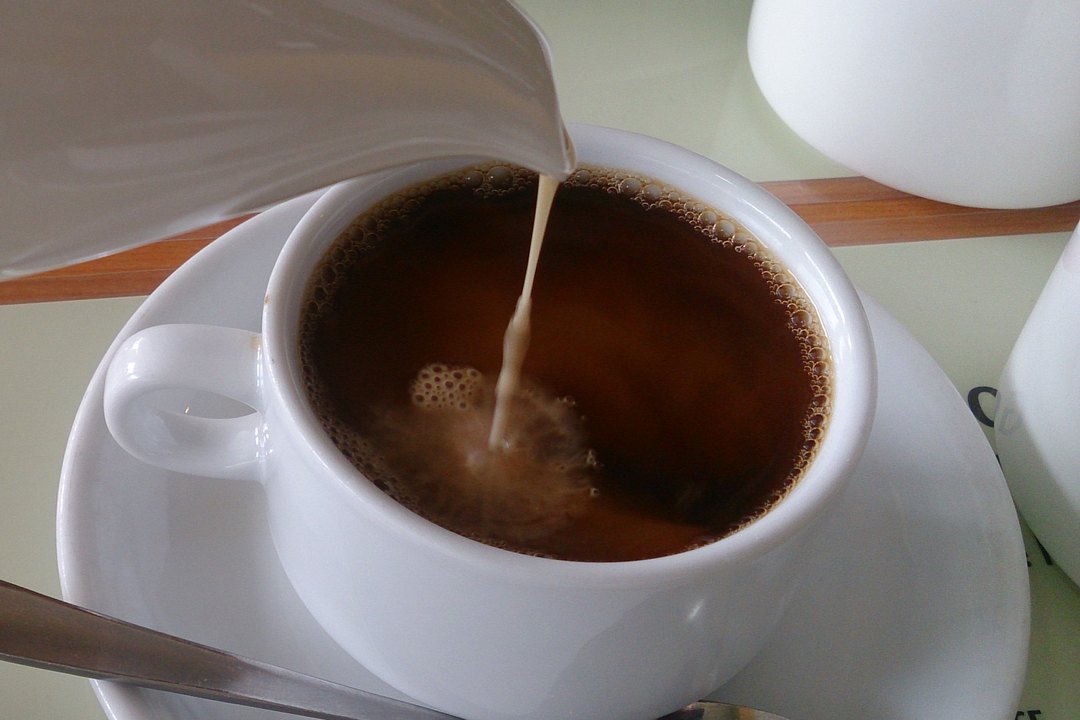
I taste coffee for a living, which means I drink most of it black, and for years that made me the wrong person to ask about creamer. Then I started paying attention to what actually happens when people ruin a good cup: it is almost never the beans. It is a creamer that curdled into grey flecks, or clumped into wet sand at the bottom of an iced glass, or was so sweet that a coffee somebody chose carefully might as well have come out of a gas station urn. Choosing the best coffee creamer turns out to be a technical decision with real chemistry behind it, and almost nobody explains that part. So for 2026 I looked at 29 candidates on Amazon and narrowed them to the nine below.
The first thing that research turned up was not a taste finding, it was an availability one. Of those 29 candidates, 13 could not actually be bought. Every single refrigerated liquid creamer failed, without exception, and several of the ones that looked available turned out to be listed through Amazon’s grocery-delivery storefronts, which is a separate checkout with its own delivery windows rather than something you add to a normal order. That is worth stating plainly because it reshapes the whole question: refrigerated creamer is a grocery run, not a shipment. The creamer you can actually order and have arrive at your door is shelf-stable, which is why every product on this page is a powder, an aseptic liquid, or a sealed single tub. If you came here looking for the dairy-case cartons, buy those at the store.
The second thing worth knowing before you scroll is that the word non-dairy on the front of a package is a legal labeling term, not an allergen statement. Several products here say non-dairy and contain sodium caseinate, a milk protein. One says plant-based in its Amazon category and says Contains: Milk on its own label. That distinction genuinely matters to some readers, so I have flagged it on every product where it applies. I am a CQI-licensed Q Grader and an SCA-certified roaster, so my starting point is always what a creamer does to the cup, but label honesty and whether the thing will curdle in your mug turn out to matter just as much. If you want the coffee underneath to be worth protecting, start with the best coffee beans and work down from there.
| Product | Price | Buy |
|---|---|---|
| Coffee Mate Original Powder Creamer, 35.3 OzBest Overall | $6.79 | View on Amazon |
| Amazon Saver French Vanilla Powdered Coffee Creamer, 15 OzBudget Pick | $3.56 | View on Amazon |
| nutpods Unsweetened Original Dairy-Free Coffee Creamer, 32 oz 3-PackPremium Pick | $29.95 | View on Amazon |
| Nestle Coffee mate Original Non-Dairy Creamer Singles, 180-PackRunner-Up | $12.99 | View on Amazon |
| Coffee Mate French Vanilla Liquid Creamer, 16 Fl Oz, 6 PackRunner-Up | $12.62 | View on Amazon |
| Nestle Carnation Coffee Creamer Half and Half, Real Dairy Singles, 360-CountRunner-Up | $37.21 | View on Amazon |
| Laird Superfood Non-Dairy Coconut Powder Creamer, 16 oz BagRunner-Up | $18.98 | View on Amazon |
| KOS Organic Coconut Milk Powder, 12.6 ozRunner-Up | $22.25 | View on Amazon |
| SPLENDA Sugar Free Sweet Cream Coffee Creamer, 32 Fl OzRunner-Up | $6.49 | View on Amazon |
Find the Best Coffee Creamer for Your Need
Creamer is not one product, it is four or five different jobs depending on whether your coffee is hot or iced, whether it lives near a fridge, and what you need off the ingredient panel. Jump to yours:
- Best coffee creamers overall
- Best creamer for iced coffee
- Best flavored coffee creamer
- More use cases: organic, coconut, sugar-free, half-and-half
How We Chose These Coffee Creamers
I started with 29 candidates and checked every one for real availability before I looked at a single ingredient panel, and 13 of them failed that first gate. The pattern was consistent enough to be a finding rather than a fluke: every refrigerated liquid creamer I checked was unbuyable as a normal order, and several of the near-misses ran through Amazon’s grocery-delivery storefronts instead, which is a separate checkout with its own delivery windows. Refrigerated creamer is a cart-and-checkout product, not a ship-it-to-me product. That is why the nine picks here are exclusively shelf-stable formats, and it is also why this page is more useful than a taste-panel roundup that recommends cartons you cannot order.
From the survivors I weighed four things. First, label honesty: I read the ingredient panel on every product rather than the front of the pack, which is how the sodium caseinate in the non-dairy powders and the milk in the plant-based-filed budget pick both surfaced. Second, behavior in the cup, meaning whether a creamer curdles, separates or clumps under the conditions people actually brew in, hot and iced. Third, cost per serving rather than shelf price, because container sizes here run from a 12.6-ounce bag to 360 individual tubs and the sticker price tells you almost nothing. Fourth, the depth and shape of the owner review base, including the star distribution, because a 4.0 average made of 60 percent five stars and 13 percent one stars is a very different product from a 4.0 made of consistent fours. I deliberately spread the final nine across formats, dietary needs and price tiers so that a vegan, an office manager and someone who just wants a big cheap canister each find a clear answer.
Best Coffee Creamers Overall
These are the nine creamers I would put in a cupboard in 2026, each reviewed once below with its real strengths and its real problems. The use-case sections further down regroup these same products by what you are actually trying to do with them.
Best Overall: Coffee Mate Original Powder Creamer
Coffee mate Original Powder takes the top spot for a boring reason and a technical one. The boring reason is that owners have rated it more highly than any other creamer on this page, and they have been doing so for years. When a product that cheap and that widely distributed holds a rating like that, you are not gambling, you are joining a consensus.
The technical reason is that it physically cannot curdle. Brewed coffee sits at around pH 5, and the combination of acid and heat is what makes an intact dairy protein network destabilise and flocculate into those grey specks that float on the surface of a cup you were looking forward to. Spray-drying has already broken that network apart, so there is nothing left to curdle. Pour boiling water over a light roast with bright acidity, add this powder, and it disperses cleanly. That single property is why powder remains the default in break rooms and hotel lobbies worldwide, and it is a real advantage in a home kitchen too if you brew hot and drink immediately.
The honest limitations are two. The first is the label: non-dairy here is the legal term, and the panel lists sodium caseinate, a milk protein. That makes it lactose-free, which covers most lactose intolerance, but it is not vegan and it is not appropriate for anyone avoiding milk protein. The second is cold coffee, where the fat coating on each powder particle refuses to wet out and you get lumps and grit. Dissolve a spoonful in a splash of hot water first and the problem disappears entirely. Do that, keep it in a dry cupboard, and one canister of roughly 500 servings will outlast several bags of beans.

Coffee Mate Original Powder Creamer, 35.3 Oz
by Coffee mate
The creamer I would tell almost anyone to buy first: it cannot curdle, it keeps for months in a cupboard, it doses to the teaspoon, and 26,000 owners at 4.8 stars agree it does the job.
Pros
- One of the longest verified track records on this page, and the highest average star rating of any creamer I looked at, which is the reason it is the safe recommendation rather than the interesting one
- Powder cannot curdle, and that is a chemistry advantage rather than a marketing line. Coffee sits at roughly pH 5, and heat plus acid is what makes an intact dairy protein network flocculate into those grey specks on the surface. A spray-dried powder has no intact protein network left to break, so it disperses cleanly into a cup straight off the boil or into a mug of stubbornly acidic light roast
- Roughly 500 servings from one resealable canister that lives in a cupboard rather than a fridge, which is what makes it the practical default for a household that goes through creamer daily and does not want to think about it again for months
- You control the dose by the teaspoon rather than by a glug, so a level spoon lightens a cup and a heaped one turns it properly creamy. Liquid creamers and sealed tubs both take that adjustment away from you
Cons
- The words non-dairy on the front of this canister are a legal labeling term, not an allergen statement. The ingredient panel lists sodium caseinate, which is a milk protein. That makes it lactose-free and fine for most lactose intolerance, but it is not vegan and it is not safe for anyone avoiding milk protein
- It clumps badly if you dump it into cold coffee. Powder needs heat to wet out properly, so for iced coffee you have to dissolve it in a splash of hot water first or accept grit at the bottom of the glass
- The flavor is a neutral, faintly sweet creaminess rather than dairy character. It softens a cup competently but it will not give you the round, milky sweetness real half-and-half does
Budget Pick: Amazon Saver French Vanilla Powdered Coffee Creamer
This is the pick for keeping a flavored creamer permanently in the house without thinking about it. It costs a small fraction of what the specialty coconut powders here do while performing the same mechanical job, and with more than 10,400 ratings at 4.4 it has a track record most store brands never accumulate. The French vanilla is more restrained than the category norm, reading as a soft bakery vanilla rather than the candied note heavier flavored powders push, which means it lightens a medium roast without erasing it.
There is one thing about this product I want to be direct about, because it is the reason it earns a mention beyond its price. Amazon files it under Plant-Based Creamers. Its own label says Contains: Milk. Those cannot both be right, and the label is the one that counts. If you are shopping for a plant-based creamer and you filter by that category, this product will appear and it is not one. That is a browse-category error rather than a manufacturer claim, but the practical result is the same: someone avoiding dairy could buy it by mistake. Read the ingredient panel, always, and treat the category badge as decoration.
Beyond that, its weaknesses are the ordinary ones. At 72 percent five-star it has the softest reception of the three powders on this page, with complaints landing on a faint chemical edge to the vanilla and on clumping once the canister has been open a while in a humid kitchen. And 72 servings is a small container next to the big Coffee mate tub, so a household drinking two cups a day will reorder it often. As a low-cost way to have flavored creamer on hand, though, it does the job well.

Amazon Saver French Vanilla Powdered Coffee Creamer, 15 Oz
by Amazon Saver
The value pick for a flavored powder, with one important caveat: it is filed as plant-based on Amazon and its own label says it contains milk, so treat the category badge as wrong and the panel as right.
Pros
- It costs a small fraction of what the specialty coconut powders on this page do while doing the same mechanical job, which makes it the low-friction way to keep a flavored creamer permanently stocked instead of rationing an expensive one
- More than 10,400 owner ratings at 4.4 is a genuinely deep track record for a store brand, and it tells you the formulation is consistent from canister to canister rather than a one-off batch that happened to taste right
- The French vanilla is restrained by the standards of the category. It reads as a soft bakery vanilla rather than the candied, almost floral note that heavier flavored powders push, so it lightens a medium roast without erasing it
- Same powder advantages as any other: it disperses into hot coffee without curdling, it stores in a cupboard, and it doses by the spoon so you can dial the sweetness down on a coffee you actually want to taste
Cons
- Amazon files this under Plant-Based Creamers and its own label says Contains: Milk. That is a straightforward mislabeling of the browse category, and it matters, because a shopper filtering for plant-based products will land on a product that is neither vegan nor dairy-free. Read the panel, not the category
- At 72 percent five-star reviews it has the softest reception of the three powders here, and the recurring complaints are a faint chemical edge on the vanilla and clumping when the canister has been open a while in a humid kitchen
- 72 servings is a small canister next to the big Coffee mate tub, so a two-cup-a-day household will be reordering it regularly
Upgrade Pick: nutpods Unsweetened Original Dairy-Free Creamer
nutpods is the one product here that is dairy-free in the way most people mean the phrase rather than the way the label law defines it. The base is almond and coconut, there is no caseinate anywhere on the panel, and that makes it the right answer for a vegan household or anyone avoiding milk protein rather than just lactose. If you have been buying non-dairy powder assuming it was plant-based, this is the product you were actually looking for.
What earns it the upgrade slot from my side of the cupping table is that it is unsweetened, at 0 g sugar on the label. Sweetened creamer does not lighten a coffee, it covers it. An unsweetened creamer adds fat and body while leaving whatever the roaster built underneath intact, which is the only way a good single-origin survives being lightened at all. It has real weight too: coconut fat gives it enough emulsified body to change the mouthfeel, where thin almond and oat products just make a cup watery. The cartons are shelf-stable until opened, so a three-pack sits in a cupboard and only the working carton takes fridge space.
Two caveats, and one of them is important. It carries only 120 ratings, against 26,000 and 36,000 for the two Coffee mate lines here. The 4.6 average and 79 percent five-star rate are genuinely encouraging, but that is a thin sample and you should read it as early evidence rather than a settled verdict. It is still the pick I stand behind for dairy-free, because nothing else here has the ingredient panel to compete. The second caveat is physical: nut and coconut emulsions break more readily than dairy does, so a cold carton poured into a cup straight off the boil, or into a very acidic light roast, can separate into flecks. Shake it hard and give the coffee thirty seconds to come off the boil first.

nutpods Unsweetened Original Dairy-Free Coffee Creamer, 32 oz 3-Pack
by nutpods
The genuinely dairy-free upgrade: almond and coconut, no caseinate, no sugar, and enough fat to give a cup real body without burying the coffee underneath it.
Pros
- This is the only creamer here that is dairy-free in the plain-English sense rather than the labeling sense. The base is almond and coconut, there is no caseinate, and that makes it the pick for a vegan household or anyone avoiding milk protein rather than just lactose
- Unsweetened, with 0 g sugar on the label, and that is the reason I rate it as the upgrade. Sweetened creamer covers a coffee. An unsweetened one adds fat and body while leaving the origin character underneath intact, which is the only way a good single-origin survives being lightened at all
- Coconut fat gives it genuine weight in the cup. Thin almond and oat products disappear into a mug and leave it watery, while this one carries enough emulsified fat to change the mouthfeel the way real cream does
- The cartons are shelf-stable until you open them, so a three-pack goes in a cupboard and only the one in use takes fridge space, which is what makes buying in threes practical rather than a storage problem
Cons
- It carries only 120 ratings, against 26,000 and 36,000 for the two Coffee mate lines here. The 4.6 average and 79 percent five-star rate are encouraging, but that is a thin sample and you should read it as early evidence rather than settled consensus
- Nut and coconut emulsions break more readily than dairy does. Poured straight from the fridge into a cup fresh off the boil, or into a very acidic light roast, it can separate into flecks. Shake the carton hard and let the coffee sit for thirty seconds first
- It costs several times more per serving than either powder here, which is the honest price of a clean ingredient list and an unsweetened formulation
Coffee mate Original Non-Dairy Creamer Singles, 180-Pack
The single tub is the format that solves the actual problem most people have with creamer, which is that it needs a refrigerator and they do not have one where they drink coffee. Each of these 180 tubs is sealed and shelf-stable before and after purchase, which means tub number 180 tastes exactly like tub number one. An opened bottle of liquid creamer begins degrading from the day you break the seal; a sealed single simply does not have that clock running.
It also has the largest review base on this page, 36,271 ratings at 4.7 with 83 percent of them five stars. For a product whose entire purpose is to be boringly predictable in a break room a thousand miles from a fridge, that scale of agreement is precisely the evidence you want. This is the format for offices, hotel rooms, a desk drawer, a glove box or a camping bin, and the fixed 0.375 fl oz dose that feels restrictive at home is quietly useful in a shared kitchen, where everybody gets the same cup and nobody empties the bottle.
The tradeoffs follow from the same design. At home that fixed dose is a genuine limitation, and if you like a properly pale cup you will open two or three tubs per mug, which makes the true cost per cup obvious in a hurry. It is also a lot of plastic for the volume of creamer delivered. And the non-dairy claim on this label carries the same asterisk as everywhere else in the line: lactose-free, which is what most people actually need, but check the panel yourself if milk protein specifically is what you are avoiding. If your creamer has to live somewhere without a fridge, this is still the format that wins.
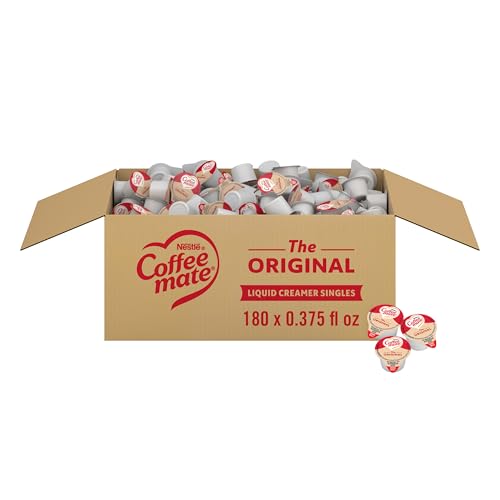
Nestle Coffee mate Original Non-Dairy Creamer Singles, 180-Pack
by Coffee mate
The format that solves creamer away from a fridge: 180 sealed single tubs, the deepest review base here, and a last cup that tastes exactly like the first.
Pros
- 36,271 ratings at 4.7 with 83 percent five stars is the largest review base on this page, and for a product whose entire job is to be predictable in a break room a thousand miles from a refrigerator, that scale of agreement is exactly the evidence you want
- Each tub is individually sealed and shelf-stable both before and after you buy it, so tub number 180 tastes the same as tub number one. An opened bottle of liquid creamer starts degrading the day you break the seal; a sealed single simply does not
- 180 tubs is the right format for the places creamer actually gets used badly: office break rooms, hotel rooms, a desk drawer, a glove box, a camping bin. Nothing needs a fridge and nothing spoils if the room gets warm
- The dose is fixed at 0.375 fl oz, which sounds like a limitation and works as a feature in a shared kitchen. Everyone gets the same cup and nobody empties the bottle
Cons
- That fixed dose cuts the other way at home. If you like a properly pale, creamy cup you will be opening two or three tubs per mug, and the pile of empties makes the true cost obvious fast
- 180 individual plastic tubs is a lot of packaging for the volume of creamer delivered, which is the trade you accept for shelf stability and portion control
- Non-dairy on this label is the same legal term it is everywhere else. It is lactose-free, which is what most people actually need, but check the panel yourself if milk protein specifically is the thing you are avoiding
Coffee Mate French Vanilla Liquid Creamer
This is the reference version of the flavor most people mean when they say flavored creamer, and it is also the product I reach for when the coffee is cold. Being a fully emulsified liquid, it blends into iced coffee as readily as into hot, which sounds trivial until you have tried to stir powder into a glass of ice and produced a layer of wet sand at the bottom. The factory has already done the emulsifying work that powder asks you to do with a splash of hot water.
The flavor lands where it should. At 5 g of sugar per tablespoon on the label, it delivers a recognisable French vanilla at a modest pour rather than demanding you drown the cup to taste anything, and its 4.6 average across 4,668 ratings with 81 percent five stars is a strong reception for a flavored product, where taste disagreement usually drags an average down harder than it does on a neutral creamer. The bottles are shelf-stable unopened, so a six-pack lives in the cupboard and only the working bottle takes fridge space.
Where it needs care is at both ends of its life. Once opened it wants refrigeration and use within about two weeks, and six 16-ounce bottles is a real commitment for one person, so buy the multipack for a family rather than a desk. And a vanilla this assertive will bury a delicate coffee. On a good washed Ethiopian it flattens the florals into generic sweetness, which is a shame if you paid for those florals. Keep the pour small on light roasts and let it run free on a dark roast or an iced coffee, where it does its best work. It carries the same non-dairy label as the rest of the line, so read the panel if that matters to you.

Coffee Mate French Vanilla Liquid Creamer, 16 Fl Oz, 6 Pack
by Coffee mate
The default flavored creamer, and the best liquid here for iced coffee, because it emulsifies cold where every powder on this page clumps.
Pros
- It is a fully emulsified liquid, which means it blends instantly into cold coffee as readily as hot. That single property is why it wins the iced coffee section outright while every powder on this page needs pre-dissolving first
- 4,668 ratings at 4.6 with 81 percent five stars, which is a strong reception for a flavored product where taste disagreement usually drags the average down harder than it does on a neutral creamer
- The French vanilla is the reference version of the flavor most people mean when they say flavored creamer. At 5 g of sugar per tablespoon on the label it delivers that flavor at a modest pour rather than requiring you to drown the cup
- The bottles are shelf-stable unopened, so a six-pack lives in the cupboard and only the working bottle takes fridge space, which makes buying in bulk actually workable
Cons
- Once opened it needs refrigeration and wants using within roughly two weeks, and six 16-ounce bottles is a real commitment for a one-person household. Buy the six-pack for a family, not for a desk
- Vanilla this assertive will bury a delicate light roast. On a good washed Ethiopian it flattens the florals into generic sweetness, so keep the pour small on coffee you actually want to taste
- It carries the same non-dairy label as the rest of the Coffee mate line, which is a legal term rather than an allergen statement, so read the ingredient panel if milk protein matters to you
Carnation Coffee Creamer Half and Half, Real Dairy Singles
This is the only real dairy product on the page, and the engineering behind it is more interesting than it looks. Ultra-pasteurization plus aseptic filling into sealed tubs is what allows genuine Grade A half-and-half to sit in a cupboard rather than a fridge, which is a combination you almost never get. If what you actually want is cream in your coffee and not a formulation that imitates it, this is the shelf-stable way to have it.
On the cupping table it has an advantage nothing else here shares: it is unflavored and unsweetened. Half-and-half contributes dairy sweetness, fat and body without layering a flavoring on top, so a coffee you chose deliberately still tastes like itself with the sharp edges rounded off. That is exactly what I want a creamer to do to a well-roasted coffee, and it is why I recommend this format to people who have spent money on beans and then wondered why the cup tastes like vanilla. At 360 tubs it is a serious bulk supply, sensible for an office, a rental property or anywhere creamer needs to survive being ignored for months. 4,731 ratings at 4.4 with 75 percent five stars is solid agreement for real dairy being asked to sit at room temperature.
It is also the one product here that can genuinely curdle, and now you know why: it is the only one with an intact dairy protein network to destabilise. Cold cream hitting a cup fresh off the boil is the classic way to get flecks, especially in a bright, acidic light roast. Let the coffee rest for half a minute, or warm the tub in your hand, and the problem largely goes away. Being real dairy it contains both lactose and milk protein, so it is the wrong pick if you are avoiding either, and the tubs are small enough at 0.304 fl oz that a creamy mug takes two or three.

Nestle Carnation Coffee Creamer Half and Half, Real Dairy Singles, 360-Count
by Carnation
Actual half-and-half that lives in a cupboard, unflavored and unsweetened, for the drinker who wants real dairy in the cup and nothing else added to it.
Pros
- Real Grade A dairy that does not need a refrigerator, which is a genuinely unusual combination. Ultra-pasteurization plus aseptic filling into sealed tubs is what makes shelf-stable cream possible at all, and it is the only way to keep actual half-and-half in a cupboard
- It is unflavored, and on the cupping table that matters more than anything else here. Half-and-half contributes dairy sweetness, fat and body without adding a flavoring on top, so a good coffee still tastes like itself with the edges rounded off
- 360 tubs is a serious bulk supply, the sort of quantity that makes sense for an office, a rental property, a church hall or anywhere the creamer has to survive being ignored for months
- 4,731 ratings at 4.4 with 75 percent five stars, which is solid agreement for a real dairy product being asked to sit at room temperature
Cons
- It is the one product on this page that can genuinely curdle, because it is the only one with an intact dairy protein network. Coffee is acidic and heat accelerates the reaction, so a cold tub hitting a cup straight off the boil is the classic way to get flecks. Let the coffee rest a moment before you pour
- Real dairy means both lactose and milk protein, so it is the wrong pick for anyone avoiding either one
- The tubs are tiny at 0.304 fl oz, so a creamy mug takes two or three of them and the 360 count disappears faster than the number suggests
Laird Superfood Non-Dairy Coconut Powder Creamer
Laird is the clean-label powder on this page and the only powdered option here that is genuinely vegan. The ingredient list is short enough to read in one breath, built on coconut milk powder rather than caseinate, which puts it in a different category from the mass-market powders even though it sits on the same shelf. It also delivers something most non-dairy powders do not: real body. Coconut fat carries enough weight that the cup changes texture rather than just changing color, which is what people are usually chasing when they say a creamer tastes rich.
I have to flag a contradiction on the listing, though, because it is the sort of thing that makes people feel misled after the fact. The bullets claim no sugar additives while the ingredient list includes organic coconut sugar. Both statements cannot be true, and the ingredient list is the one that governs. Buy this as a lightly sweetened coconut creamer and you will be happy with it. Buy it expecting an unsweetened product and you will taste the sweetness immediately and feel cheated. If unsweetened is the requirement, the KOS powder below or the nutpods above are the honest choices.
Its ratings reflect a product people either love or find frustrating: 4.0 with 62 percent five-star, the softest reception of the three powders here, and the complaints cluster tightly on grit and incomplete dissolving, especially in coffee that has already cooled. Coconut powders need heat and agitation to dissolve properly. And at 30 servings per bag, the reorder cycle is fast and the cost per serving is high. For a vegan drinker who wants a powder with a readable panel and genuine richness, it is still the best-executed option in that narrow lane.

Laird Superfood Non-Dairy Coconut Powder Creamer, 16 oz Bag
by Laird Superfood
The clean-label coconut powder, genuinely vegan and genuinely rich, held back by an ingredient panel that contradicts its own no-sugar-additives claim.
Pros
- The ingredient list is short enough to read in one breath and built on coconut milk powder rather than caseinate, which makes it the clean-label powder on this page and the only powdered option here that is genuinely vegan
- Coconut fat gives it real body. Where most non-dairy powders dissolve into a thin, slightly chalky cup, this one carries enough fat to change the texture, which is what people are usually chasing when they say a creamer tastes rich
- It comes in a resealable bag and stores at room temperature, so it travels and stores exactly like any other powder while delivering a plant-based result
- 6,199 owner ratings is a substantial track record for a specialty brand, several times the sample behind most clean-label creamers you will find in this category
Cons
- The listing bullets claim no sugar additives while the ingredient list includes organic coconut sugar. Those two statements cannot both be true. Treat this as a lightly sweetened creamer and do not buy it expecting an unsweetened one
- A 4.0 average with 62 percent five-star reviews is the softest reception of the three powders here, and the complaints cluster tightly on grit and incomplete dissolving, particularly in coffee that has already cooled
- 30 servings from a 16-ounce bag is a short run compared with the big canisters, so the per-serving cost is high and the reorder cycle is fast
KOS Organic Coconut Milk Powder
KOS is the certified-organic pick and the one I would hand to someone whose first filter is the certification rather than the flavor description. It is organic, vegan, unflavored and lists 0 g sugar, which makes it the cleanest formulation on this page next to the nutpods, and it is the powdered version of that idea rather than a liquid.
It is also the best illustration on this page of why the servings figure matters more than the bag size. A 12.6-ounce bag looks small next to a 35-ounce canister until you notice it yields 179 servings, because dense coconut milk powder goes a long way per spoon. Divide the current price on the card by that servings number and it stops looking like a specialty splurge, which is exactly the arithmetic I want readers doing on every product here rather than comparing sticker prices across wildly different container sizes. Being unflavored and unsweetened, it is also not locked to coffee: the same bag whitens a morning cup, thickens a curry, or goes into a smoothie, which is not true of anything else in this roundup.
Two honest limits. Its 64 percent five-star rate is middling, and the recurring complaint is clumping, which is inherent to coconut milk powder rather than a defect. It needs to be whisked or blended into hot liquid; spooning it onto the surface of a cooling cup guarantees lumps. And it is genuinely unsweetened and unflavored, so if what you actually want is a sweet creamer this will taste thin and disappointing. The coconut note is clean rather than artificial, but it is distinct, and on a chocolatey dark roast it can read as slightly out of place. Pair it with a fruit-forward light roast and it works beautifully.
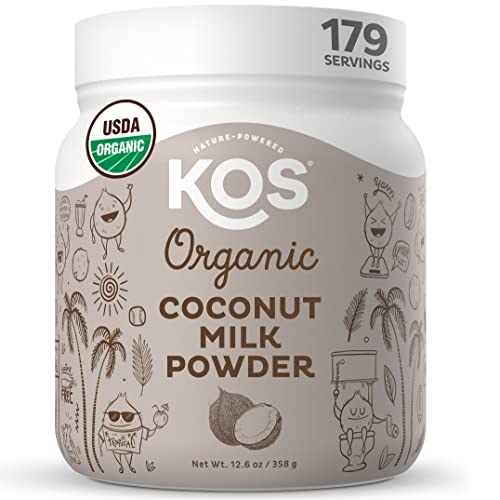
KOS Organic Coconut Milk Powder, 12.6 oz
by KOS
The certified-organic option, unflavored and unsweetened, with a servings count high enough that the small bag stretches much further than it looks.
Pros
- Certified organic, vegan and unflavored with 0 g sugar on the label, which makes it the pick for the shopper whose first filter is the certification rather than the flavor description
- 179 servings out of a 12.6-ounce bag, because dense coconut milk powder goes a long way per spoon. That servings count is what makes it far better value than the small bag size suggests, and it is exactly why you should always divide price by the servings figure rather than by the ounces
- Being unflavored and unsweetened, it is not locked to coffee. The same bag whitens a cup in the morning and thickens a curry or a smoothie later, which is not true of anything else on this page
- 5,182 ratings at 4.2 gives it a real track record, and the coconut note itself is clean rather than the artificial coconut flavoring that shows up in cheaper products
Cons
- 64 percent five-star is a middling result and the recurring complaint is clumping. Coconut milk powder needs to be whisked or blended into hot liquid, and spooning it onto the surface of a cooling cup will leave lumps
- It is unsweetened and unflavored, so if what you actually want is a sweet creamer this will taste thin and disappointing. Buy it for the coffee, not for the sugar
- The coconut character is distinct rather than neutral, and on a chocolatey dark roast it can read as slightly out of place
SPLENDA Sugar Free Sweet Cream Coffee Creamer
Splenda Sweet Cream exists to do one specific thing: taste sweet while listing 0 g of added sugar, using sucralose to get there. It does that, and 9,560 owner ratings say so. It has two practical advantages beyond the sweetener question. It is a liquid, so it emulsifies into iced coffee without the pre-dissolving step every powder here demands, which makes it the sugar-free option that actually works over ice. And the sweet cream profile is a vanilla-adjacent dairy flavor rather than a specific flavoring, so it sits more comfortably across different roast levels than a declared French vanilla does.
I have to be straight about its reception, because it is the softest on this page by a clear margin. A 4.0 average sounds unremarkable until you look at the shape of it: 60 percent five-star and 13 percent one-star. That is not a product people mildly tolerate, it is one that roughly one buyer in eight actively dislikes, and the one-star reviews are almost entirely about the sucralose aftertaste. High-intensity sweeteners are genuinely polarising, and the population that perceives that metallic finish strongly is large enough that you should treat this as a try-it-and-see purchase rather than a safe default.
Two smaller notes. The label does not state servings per container, which makes it the one product here you cannot honestly cost out per cup without measuring a pour yourself. And it is marketed as non-dairy without the casein status being confirmed on the listing, so if you are avoiding milk protein rather than lactose, verify the panel before buying. If sucralose agrees with you, though, this is the most convenient sugar-free liquid in the category.

SPLENDA Sugar Free Sweet Cream Coffee Creamer, 32 Fl Oz
by Splenda
The sugar-free liquid that works in iced coffee, with the honest caveat that its sucralose aftertaste is the single most divisive thing on this page.
Pros
- 0 g added sugar on the label while still tasting distinctly sweet, achieved with sucralose, which is the specific thing this product exists to do and the reason it has 9,560 ratings behind it
- It is a liquid, so it emulsifies into cold coffee without clumping. That makes it the sugar-free option that actually works over ice, where every powder on this page needs dissolving in hot water first
- A single 32-ounce bottle is a large format for the category and it is shelf-stable until opened, so it stores in a cupboard rather than occupying fridge space from the day it arrives
- The sweet cream flavor is a vanilla-adjacent dairy profile rather than a specific flavoring, which makes it more versatile across roast levels than a French vanilla is
Cons
- This has the softest reception on the page by a clear margin: 60 percent five-star and 13 percent one-star, and those one-star reviews cluster almost entirely on the artificial-sweetener aftertaste. Sucralose is genuinely polarising and roughly one buyer in eight actively dislikes it here
- The label does not state servings per container, which makes this the one product here you cannot honestly cost out per cup without measuring a pour yourself
- It is marketed as non-dairy but the casein status is not confirmed on the listing, so if you are avoiding milk protein rather than lactose you should verify the panel before buying
Best Creamer for Iced Coffee
Iced coffee reverses every rule that governs a hot cup. Powder is the problem rather than the solution: the fat coating on each particle will not wet out in cold liquid, so it gels on the outside, traps dry powder inside, and settles as grit at the bottom of the glass. If you want to use a powder over ice, dissolve it in a small splash of hot water first and pour the slurry in. A liquid creamer skips that entirely because it arrives pre-emulsified. The second thing that matters is flavor concentration, because melting ice dilutes everything, so a creamer that tastes right in a hot mug can taste like nothing at all twenty minutes later.
| Product | Price | Buy |
|---|---|---|
| Coffee Mate French Vanilla Liquid Creamer, 16 Fl Oz, 6 PackBest for iced coffee Pre-emulsified liquid that blends into cold coffee instantly, with enough vanilla concentration to survive ice-melt dilution | $12.62 | View on Amazon |
| Nestle Carnation Coffee Creamer Half and Half, Real Dairy Singles, 360-CountBest real-dairy option over ice Real half-and-half emulsifies cold without curdling, since the acid-plus-heat reaction that causes curdling needs the heat | $37.21 | View on Amazon |
| Nestle Coffee mate Original Non-Dairy Creamer Singles, 180-PackBest portioned option for iced Sealed liquid tubs mix straight into a cold glass and need no fridge, which is what makes them work at a desk or on the road | $12.99 | View on Amazon |
Best Flavored Coffee Creamer
Flavored creamer is where I have the strongest professional opinion and the least authority to impose it. The Coffee mate liquid line covers the three flavors that account for most of the category, French vanilla, hazelnut and caramel, and French vanilla is the reference point the others are judged against. My one rule is that the flavor should balance the coffee’s bitterness rather than bury it. A dark roast has enough bitter structure to carry an assertive vanilla and come out balanced. A delicate light roast does not, and the same pour flattens it into generic sweetness. Match the intensity of the flavoring to the intensity of the roast and start with less than you think.
| Product | Price | Buy |
|---|---|---|
| Coffee Mate French Vanilla Liquid Creamer, 16 Fl Oz, 6 PackBest flavored creamer The reference French vanilla, strong enough to balance a dark roast and best kept to a small pour on anything delicate | $12.62 | View on Amazon |
| Amazon Saver French Vanilla Powdered Coffee Creamer, 15 OzBest budget flavored option A restrained bakery vanilla in powder form for a fraction of the specialty price, though its label says it contains milk | $3.56 | View on Amazon |
| SPLENDA Sugar Free Sweet Cream Coffee Creamer, 32 Fl OzBest sugar-free flavored option Sweet cream flavor with no added sugar, useful if sucralose agrees with you and divisive if it does not | $6.49 | View on Amazon |
Best Coffee Creamers by Use Case
A few buyers arrive with one specific requirement that the sections above do not headline, so here is the best pick on this page for each of them.
| Product | Price | Buy |
|---|---|---|
| KOS Organic Coconut Milk Powder, 12.6 ozBest organic coffee creamer Certified organic, vegan and unflavored, with 179 servings from a deceptively small bag | $22.25 | View on Amazon |
| Laird Superfood Non-Dairy Coconut Powder Creamer, 16 oz BagBest coconut coffee creamer Coconut milk powder with a short, readable panel and enough fat to give a cup real body | $18.98 | View on Amazon |
| Nestle Coffee mate Original Non-Dairy Creamer Singles, 180-PackBest non-refrigerated coffee creamer 180 sealed single tubs that never need a fridge before or after opening | $12.99 | View on Amazon |
| Nestle Carnation Coffee Creamer Half and Half, Real Dairy Singles, 360-CountBest shelf-stable half-and-half Real Grade A half-and-half, unflavored and unsweetened, made shelf-stable by aseptic filling | $37.21 | View on Amazon |
| SPLENDA Sugar Free Sweet Cream Coffee Creamer, 32 Fl OzBest sugar-free coffee creamer 0 g added sugar via sucralose in a liquid that emulsifies cold, with a polarising aftertaste | $6.49 | View on Amazon |
| Coffee Mate Original Powder Creamer, 35.3 OzBest powdered coffee creamer The most-reviewed powder in the category, and a format that dissolves cleanly into hot coffee instead of feathering the way a cold liquid creamer can | $6.79 | View on Amazon |
Buyer's Guide
I taste coffee professionally, which means I mostly drink it black, but I also know that most people do not and that a badly chosen creamer can undo a good bag of beans. These are the six things that actually decide whether a creamer suits you, in the order I would weigh them.
Shelf-Stable vs Refrigerated
This is the first fork in the road and it decides most of the rest. Refrigerated creamer, the kind in the dairy case next to the milk, is a grocery-store purchase. It does not travel well and it is close to unbuyable online, which is why every product on this page is shelf-stable in one form or another. Shelf-stable creamer comes in three shapes: powder in a canister, aseptic liquid in a carton or bottle that only needs refrigeration once opened, and individually sealed single tubs that never need it at all. If your creamer lives in an office, a hotel room, a camper or a desk drawer, shelf-stable is not a compromise, it is the only format that works. If you are buying online rather than pushing a cart, it is effectively the whole market.
Reading the Non-Dairy Label
Non-dairy on the front of a package is a legal labeling term, not an allergen statement, and the gap between those two things catches people out constantly. A product can say non-dairy and still contain sodium caseinate, a protein derived from milk. Coffee mate Original is exactly that case: lactose-free, which is what most people with lactose intolerance need, but not vegan and not safe for a milk-protein allergy. The reverse trap exists too, since one product here is filed on Amazon under Plant-Based Creamers while its own label reads Contains: Milk. The rule is simple and it never fails you: ignore the front of the pack and the browse category, and read the ingredient panel. If you need genuinely no dairy-derived ingredients, look for an almond, coconut or oat base with no caseinate anywhere on the list.
Cost Per Serving, Not Price Per Bottle
Container sizes in this category are wildly inconsistent, running from a 12.6-ounce bag to 360 individual tubs, which makes the shelf price almost useless as a comparison. The number that actually matters is cost per serving, and you can calculate it in five seconds: take the current price on the product card and divide it by the Servings per Container figure in the spec table. That one division reorders the whole page. A small organic bag with 179 servings can work out cheaper per cup than a large-looking bag with 30, and a big canister of powder is in a different league from anything sold in single tubs. One product here does not state servings on the label at all, which is itself worth knowing before you buy.
Powder vs Liquid vs Singles
Each format solves a different problem and fails in a different way. Powder is the most shelf-stable, the cheapest per serving, and the only format that cannot curdle, because spray-drying leaves no intact protein network to break. Its weakness is cold coffee, where the fat coating on each particle refuses to wet out and you get lumps. Liquid creamer is pre-emulsified, so it blends instantly into hot or iced coffee, but it needs refrigerating once opened and starts degrading from that day. Single tubs are the format for anywhere without a fridge, since each one is sealed until the moment of use and the last one tastes like the first, at the cost of a fixed dose you cannot adjust and a lot of packaging. Pick the format that matches where the creamer will actually live.
Sugar and Sweetener Type
Most creamer is sweetened, and how much varies more than people expect. The flavored liquids here list around 5 g of sugar per tablespoon on the label, while the unsweetened options list 0 g. Sugar-free products replace it with a high-intensity sweetener, usually sucralose, and that swap is genuinely polarising: the sugar-free pick on this page has the softest reception here, at 60 percent five-star with 13 percent one-star, and those one-star reviews are almost entirely about aftertaste. From a tasting standpoint, sweetness is the thing most likely to bury a coffee you paid attention to buying, so if you drink good beans, start with an unsweetened creamer and add sugar separately if you want it. That way you control the two variables independently.
Brand: Mass Market vs Specialty
This category has two very different halves and they compete on different things. Coffee mate and International Delight dominate it by sales volume, and that scale buys you the thing scale always buys: consistency, distribution and enormous review bases running to tens of thousands of ratings, which is real evidence that a product performs the same way every time. The specialty brands, nutpods, Laird Superfood and KOS among them, do not compete on price and cannot win on review volume. They compete on the ingredient list, offering shorter panels, genuine plant bases, organic certification and unsweetened formulations. Neither half is the right answer for everyone. Decide first whether your priority is a proven product at a low cost per serving or a specific ingredient standard, and the brand question answers itself.
How to Choose the Best Coffee Creamer
Work through it in this order and the decision collapses quickly. First, decide where the creamer will live. If there is no fridge, you want a powder or sealed singles and the choice is already down to four products. Second, read the ingredient panel rather than the front of the pack, because non-dairy is a labeling term and several products here carry sodium caseinate despite it. If you need genuinely no dairy-derived ingredients, that narrows you to the almond and coconut options.
Third, work out cost per serving by dividing the current price on the card by the Servings per Container figure, because container sizes here range from a small bag to 360 tubs and the sticker price tells you almost nothing. Fourth, match the format to how you drink: powder for hot coffee and long storage, liquid for iced coffee and instant blending, singles for anywhere shared or mobile. Fifth, decide how sweet you want it, and if you drink good beans, consider an unsweetened creamer with sugar added separately so you control both variables. That last one is the choice that most changes what your coffee tastes like, and it is the one people think about least. If you want texture rather than sweetness, a milk frother will do more for your cup than any creamer on this page.
Final Verdict
Coffee mate Original Powder is my best overall pick for 2026, and it wins on a combination of consensus and chemistry. It carries the strongest average owner rating here, it stores in a cupboard for months, it doses to the teaspoon, and as a spray-dried powder it has no intact protein network left to curdle, so it holds up in a hot, acidic cup where real dairy can fail. Just know what the label means: it is lactose-free but it contains milk-derived casein, so it is not vegan. If you want a flavored creamer for less, the Amazon Saver French Vanilla powder does the job for a fraction of the specialty price, with the caveat that Amazon files it as plant-based while its own label says it contains milk. And if dairy-free is a hard requirement rather than a preference, nutpods Unsweetened Original is the genuine article, thin review base and all.
The larger point is one I would make about any of these. Creamer can absolutely mask a bad cup, and that is a legitimate thing to want. But if you find yourself needing a lot of it just to make the coffee drinkable, the creamer is treating a symptom. That flat, ashy bitterness is usually stale or over-roasted beans, and no amount of vanilla fixes it. Start with fresher coffee beans, brew them properly on a drip machine that holds temperature, and you may find you want much less creamer than you thought. For the mornings when you want convenience over ceremony, our instant coffee picks pair well with any of the shelf-stable creamers above.
Frequently Asked Questions
What is the best coffee creamer?
What is the best coffee creamer for lactose intolerance?
What can I use as a coffee creamer substitute?
Why does powdered creamer clump in iced coffee?
How long does coffee creamer last after opening?
Related Articles
About the Reviewer

Clara Bennett, CQI Q Grader, SCA Roaster
B.S. Food Science, UC Davis
Clara Bennett is a Coffee Quality Institute (CQI) licensed Q Grader and SCA-certified roaster with over a decade in specialty coffee — from competition barista to production roaster and green-coffee buyer. She has cupped thousands of coffees to CQI protocol and dialed in espresso on everything from $90 entry machines to commercial three-group setups. She founded Brew Gazette in 2026 to turn cupping-table standards into plain-English buying advice.