10 Best Cold Brew Coffee Makers of 2026
Q Grader Clara Bennett ranks the 10 best cold brew coffee makers of 2026 — judged on filtration clarity, fridge fit, material safety, and how clean the concentrate actually tastes.
Updated
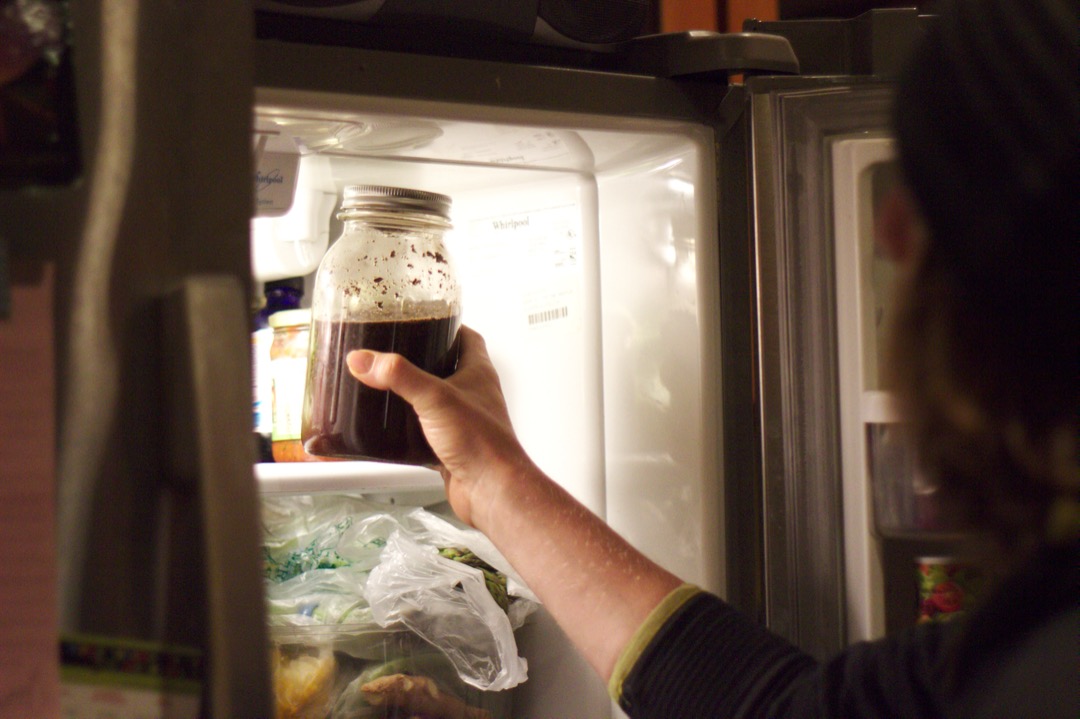
I taste coffee for a living, and cold brew is the method that most rewards understanding what is actually happening in the vessel. As a CQI-licensed Q Grader and an SCA-certified roaster, I spend my days on the cupping table with hot water, where extraction is fast, aggressive, and largely indiscriminate. Cold water is the opposite: it is a slow, selective solvent that pulls caffeine and sugars out efficiently while leaving behind much of the chlorogenic acid and the bitter compounds that only become soluble under heat. That selectivity is the entire reason cold brew tastes rounder, sweeter, and dramatically less acidic than the same beans brewed hot — it is chemistry, not marketing.
What that means practically is that a cold brew maker has a narrower job than an espresso machine or a pour-over cone. It has to hold the grounds in even contact with cold water for 12 to 24 hours, and then separate them cleanly at the end. Everything that distinguishes a good brewer from a bad one comes down to how well it does those two things, plus a set of very ordinary practical questions: does the lid actually seal, will it fit in your refrigerator, and can you get the filter clean. Nearly every complaint I read in owner reviews across this category is about one of those three, not about coffee quality.
The single biggest variable is not the brewer at all — it is the grind. Over a day-long steep, fine particles over-extract into harshness and slip through any mesh as silt, which is what people actually mean when they say their homemade cold brew tastes muddy. A coarse, even grind from a proper burr grinder will make a fifteen-dollar pitcher outperform a hundred-dollar one, and medium to medium-dark coffee beans extract more reliably in cold water than dense light roasts do. Once you have a brewer, our step-by-step guide to making cold brew coffee covers ratios, steep times, and dilution. Let’s get into the brewers.
| Product | Price | Buy |
|---|---|---|
| Takeya Deluxe Cold Brew Coffee Maker, 1 QuartBest Overall | $24.98 | View on Amazon |
| County Line Kitchen 64oz Cold Brew Coffee Maker, Wide-Mouth Glass Mason JarRunner-Up | $29.99 | View on Amazon |
| KitchenAid 38 oz Cold Brew Coffee Maker (KCM5912)Premium Pick | — | View on Amazon |
| Zulay 1 Gallon / 128oz Cold Brew Coffee Maker, Thick GlassRunner-Up | $36.99 | View on Amazon |
| Hario "Mizudashi" Cold Brew Coffee Maker, 1000mlRunner-Up | $20.75 | View on Amazon |
| OXO Good Grips Cold Brew Coffee Maker, 32 ozRunner-Up | $49.99 | View on Amazon |
| Bodum 34oz Brazil French Press Coffee Maker, Borosilicate GlassBudget Pick | $19.99 | View on Amazon |
| VINCI Express Electric Cold Brew Coffee Maker, 47ozRunner-Up | $99.99 | View on Amazon |
| OVALWARE Airtight Cold Brew Coffee Maker, 1.5L / 51oz Borosilicate GlassRunner-Up | $46.99 | View on Amazon |
| asobu Cold Brew Coffee Maker, 40oz Insulated Stainless SteelRunner-Up | $78.00 | View on Amazon |
Find the Best Cold Brew Coffee Maker for Your Need
The right brewer depends on what constrains you — fridge space, material preference, batch size, patience, or whether it needs to survive a camping trip. Jump to your use case:
- Overall best cold brew coffee makers
- Best mason jar cold brew coffee maker
- Best glass cold brew coffee maker
- Best portable cold brew coffee maker
- Best French press cold brew coffee maker
- Best electric cold brew coffee maker
- Best large cold brew coffee maker
- Best compact cold brew coffee maker
- More use cases: hot-and-cold, commercial, concentrate
How We Tested and Evaluated These Cold Brew Makers
Every brewer here was selected against a consistent set of criteria: a verified, currently-active Amazon listing with the buy box intact; genuine owner review depth rather than a thin or inflated rating; real differentiation in filtration, capacity, material, or brew mechanism; and materials that are inert over a day-long cold steep. I evaluated each on the variables that actually govern the cup — whether the design keeps the entire bed of grounds evenly saturated rather than letting water channel past a packed plug, how finely the filter separates the fines that cause silt, how completely the grounds can be removed once the steep is done, and whether the seal holds well enough to keep aromatics in the finished concentrate. I weighed those engineering facts against what owners consistently report over years of use, and deliberately spread the picks across price tiers, capacities, materials, and fridge footprints so that an apartment dweller, a family, a camper, and someone who simply wants the cleanest possible cup each find a clear answer. Brewers from unverified sellers, and any with review patterns that did not hold up to scrutiny, were excluded.
Best Cold Brew Coffee Makers Overall
These are the ten brewers I would put in a fridge without hesitation in 2026, each reviewed once below with its real strengths and tradeoffs. The best overall pick leads because it solves the practical problems most reliably; the use-case sections further down regroup these same ten by what actually constrains you.
Best Overall: Takeya Deluxe Cold Brew Coffee Maker, 1 Quart
The Takeya Deluxe is the cold brew maker I recommend before any other, and the reason is unglamorous: it solves the practical failures that ruin this category rather than chasing a feature nobody needs. The lid genuinely seals. That sounds trivial until you have had a jar weep coffee down a fridge door, and it means you can lay this on its side to save space or shake it hard mid-steep to redistribute the grounds — agitation that meaningfully improves extraction evenness and that most brewers here simply cannot survive.
The filter basket is the part that earns it the top spot on brewing merit. It is a full-length cylinder running the height of the pitcher rather than a shallow cup sitting at the bottom, so the grounds stay distributed through the whole column of water instead of compacting into a dense plug that water channels around. Even saturation across a long steep is the single mechanical thing a cold brew maker can do to improve the cup, and this design does it better than anything at the price. The Tritan body then removes the failure mode that ends most cold brew makers — it does not shatter when a fridge door slams.
The honest limitations are real. Tritan is a plastic, and a minority of long-term owners report it picking up a faint coffee-oil smell after a year or two of heavy use; a deep clean resolves it, but glass never develops the problem. The mesh is fine rather than micron-fine, so it punishes an over-fine grind with visible silt more than the OXO does. And one quart means rebrewing every two or three days if cold brew is your daily coffee. Against those, it costs less than three cafe cold brews and carries more than 67,000 reviews at 4.6 — by a wide margin the deepest track record in the category. For most people, this is simply the right answer.

Takeya Deluxe Cold Brew Coffee Maker, 1 Quart
by Takeya
The cold brew maker I recommend before any other -- a genuinely leakproof lid, a full-length mesh basket that keeps the grounds evenly saturated, and an unbreakable body, all for about the price of four cafe cold brews.
Pros
- The airtight, genuinely leakproof lid is the feature that separates a cold brew pitcher you use daily from one you resent -- you can lay this on its side in a packed fridge, shake it hard to agitate the grounds mid-steep, and nothing weeps out, which is the single most common failure in this whole category
- The built-in fine-mesh filter basket is a full-length cylinder rather than a shallow cup, so the grounds stay suspended through the full column of water instead of packing into a dense plug at the bottom -- that even saturation is what produces consistent extraction across a 12 to 24 hour steep
- It is Tritan copolyester rather than glass, which means it survives the one thing that kills more cold brew makers than anything else: being dropped, or knocked off a fridge door shelf by a slamming door
- Backed by more than 67,000 owner reviews at a 4.6 average -- by a wide margin the deepest track record of any cold brew maker sold, and the clearest evidence that the design works over years of daily use rather than one summer
Cons
- Tritan is a plastic, and while it is BPA-free and inert enough for cold extraction, a minority of long-term owners report it picking up a faint coffee-oil smell after a year or two of heavy use -- a deep clean fixes it, but glass never develops the problem at all
- The mesh is fine but not micron-fine, so an over-fine grind will push visible silt into the cup; this brewer rewards a properly coarse grind more than the pricier filters do
- One quart is the right size for one or two drinkers but means rebrewing every two to three days in a household that drinks cold brew daily
Best Mason Jar: County Line Kitchen 64oz Glass Mason Jar Cold Brew Maker
The County Line Kitchen jar is the rare value pick that is not a compromise on anything that matters. At 4.8 stars across nearly 25,000 owners it is the highest-rated cold brew maker in this entire roundup at any price — and that is not a small-sample artifact, it is a quarter of the review base of the category leader arriving at a higher score.
What you get for under thirty dollars is real glass rather than plastic, which settles the material question that dominates buyer questions in this category, and 64 ounces of capacity, which is double the standard quart pitcher. That combination is genuinely unusual at this price: the dedicated glass carafes here cost substantially more for less volume. The stainless mesh filter is a straight cylinder that lifts out whole and rinses clean in seconds, with no multi-part assembly to misalign — the simplest cleaning experience of any brewer here except the French press.
The tradeoffs are shape and fragility. The wide-mouth mason jar body is short and broad, so it will not fit a fridge door shelf and needs genuine main-shelf clearance — if your refrigerator is already full, buy the Hario instead. The pour-spout lid drips when you tip it quickly, so pour deliberately. And 64 ounces of glass is heavy and unforgiving when full. Accept those and this is the most glass, and the best owner rating, you can buy per dollar on this page.

County Line Kitchen 64oz Cold Brew Coffee Maker, Wide-Mouth Glass Mason Jar
by County Line Kitchen
The best-rated cold brew maker here and the cheapest purpose-built glass brewer of the group -- double the usual capacity, a filter that rinses clean in seconds, and no plastic anywhere near the coffee.
Pros
- At 4.8 stars across nearly 25,000 owners it is the highest-rated cold brew maker in this roundup at any price, which is a remarkable result for the cheapest purpose-built glass brewer here and not something you can dismiss as a small sample
- It is real glass, not plastic, so nothing porous ever touches the coffee -- the material question that dominates this category is simply answered here, for appreciably less than the dedicated glass carafes cost
- Sixty-four ounces is double the capacity of the standard quart pitcher, so a single steep covers most of a week for one drinker or a couple of days for two, which changes cold brew from a chore into a routine
- The stainless mesh filter is a straight cylinder that lifts out whole and rinses clean under a tap in seconds, with no multi-part assembly to lose, misalign, or trap grounds in
Cons
- The wide-mouth mason jar body is short and fat rather than tall and narrow, so it will not fit most refrigerator door shelves -- you need genuine main-shelf space for it
- The pour-spout lid drips if you tip it fast; pour deliberately and it is fine, but it is not the sealed-tight experience the Takeya's lid gives
- Glass at 64 ounces is heavy when full and unforgiving if it slips, which makes it the wrong choice for a chaotic kitchen or anyone with wrist trouble
Upgrade Pick: KitchenAid 38 oz Cold Brew Coffee Maker
The KitchenAid is the only brewer here whose premium buys you something that changes daily behaviour rather than just cup quality. The built-in tap means you dispense straight from the fridge shelf with one hand — no lifting a full carafe, no tilting, no pouring. That sounds like a small thing and it is not: the practical difference between drinking the cold brew you made and letting it sit until it goes flat is usually friction, and the tap removes all of it.
The brewing side is genuinely good rather than incidental. The stainless steeper basket seals the grounds off completely and lifts out as one unit, so the concentrate left behind is essentially sediment-free without any secondary straining or paper filter. And it brews a true concentrate rather than ready-to-drink strength, which is the correct design decision — you dilute at the glass, so the same batch serves someone who wants it strong over ice and someone who wants it cut with milk, without brewing twice.
Be clear about what you are paying for. KitchenAid sells this one under a minimum-advertised-price agreement, so Amazon shows the figure only once it is in your cart — worth knowing before you click, because you cannot compare it against anything else on this page until it is already in your cart. It sits at the premium end of this group, and what that money buys is the tap and the build, not better coffee — the extraction chemistry is no different from a well-made pitcher. The tap is also the one part with something to go wrong, and worn seals are the top recurring complaint in owner reviews. It is not dishwasher safe, and the valve needs hand-cleaning to stop oils building up inside. If you want a counter-worthy piece that makes cold brew effortless to serve, though, nothing else here does it.

KitchenAid 38 oz Cold Brew Coffee Maker (KCM5912)
by KitchenAid
The countertop showpiece of cold brew -- a one-handed tap that makes you actually drink what you brewed, a steeper basket that leaves zero sediment, and a true dial-to-taste concentrate.
Pros
- The built-in tap is the one convenience feature in this category that genuinely changes daily behaviour -- you dispense straight from the fridge shelf with one hand and never lift, tilt, or pour a full carafe, which is the difference between drinking your cold brew and letting it sit
- The stainless steeper basket seals the grounds off completely and lifts out as a single unit, so the concentrate that stays behind is essentially sediment-free without any paper filter or secondary straining
- It brews a true concentrate rather than ready-to-drink strength, which is the right design choice -- you dilute to taste at the glass, so one batch serves both the person who wants it strong over ice and the person who wants it cut with milk
- The glass carafe and brushed stainless housing are built to sit on a counter rather than hide in a fridge, and the fit and finish match the rest of the KitchenAid line if that matters to your kitchen
Cons
- Amazon lists this one under a minimum-advertised-price agreement, so the figure only appears once you add it to your cart -- which means you cannot compare it against anything else on this page until you are most of the way to buying it, and what you are buying is the tap and the build quality rather than better coffee, since the extraction itself is no different from a well-made pitcher
- The tap mechanism is the single most common complaint in owner reviews: seals wear and can seep after heavy use, and it is the one part of the design with something to go wrong
- It is not dishwasher safe, and the tap assembly in particular needs hand-cleaning to stop coffee oils building up inside the valve
Zulay 1 Gallon Cold Brew Coffee Maker
The Zulay exists to answer one question: what if you simply do not want to brew again this week. A full gallon is four times a standard quart pitcher, and it is the only capacity here that covers a family, an office kitchen, or a genuinely heavy daily drinker without rebrewing every few days. At under forty dollars it is also by far the cheapest cost-per-ounce brewer in this roundup, which is the whole argument for going big.
The execution supports the size. The glass is noticeably thicker than the thin-walled budget jars, which matters enormously at a gallon — that much liquid puts real stress on a carafe, and owners consistently describe this one as feeling solid. The stainless spout lets you pour without lifting the lid or disturbing the filter, so the remaining batch stays sealed and undisturbed rather than being exposed every time someone wants a glass.
The costs are physical and, honestly, unavoidable. A gallon carafe realistically takes a full refrigerator shelf, so measure before you order. Full, it is heavy enough that several owners report the handle feeling strained — support the base when lifting. And there is a flavour cost to batch size: the last of a gallon is a week or more old by the time you reach it, and it will taste noticeably flatter than the first pour. Brew big only if you will genuinely drink it.
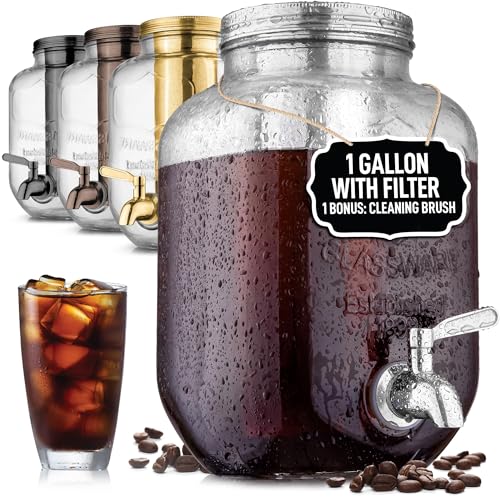
Zulay 1 Gallon / 128oz Cold Brew Coffee Maker, Thick Glass
by Zulay Kitchen
The batch brewer for households and offices -- a real gallon of glass, the lowest cost per ounce here, and a spout that pours without ever breaking the seal on the grounds.
Pros
- A genuine full gallon in one steep, which is four times the standard quart pitcher and the only capacity here that covers a family, an office kitchen, or a heavy daily drinker without rebrewing twice a week
- The glass is noticeably thicker than the thin-walled budget jars, which matters at this size -- a gallon of liquid puts real stress on a carafe, and owners consistently describe this one as feeling solid rather than fragile
- The stainless spout lets you pour without removing the lid or disturbing the filter, so the grounds stay sealed and the remaining batch keeps steeping or resting undisturbed
- At well under forty dollars for a gallon of capacity it is by far the cheapest cost-per-ounce brewer in this roundup, which is the whole argument for buying big
Cons
- A gallon carafe takes serious refrigerator real estate -- realistically a full shelf -- and there is no way around that; measure before you buy
- Full, it is heavy enough that several owners report the handle feeling strained; support the base when you lift it rather than trusting the handle alone
- Brewing a gallon at once means the last of it is a week or more old by the time you finish, so the tail end of the batch will taste flatter than the first pour
Hario Mizudashi 1000ml Cold Brew Coffee Maker
The Hario Mizudashi is the design that made Japanese-style cold brew mainstream, and it wins on a spec most roundups do not even list: shape. It is tall and narrow rather than short and wide, which means it stands upright in a refrigerator door shelf where every mason jar and large carafe here simply cannot go. For an apartment fridge, a dorm fridge, or a shared kitchen, that is not a nice-to-have — it is the deciding factor.
The narrow column has a brewing benefit too. Hario specifies an 8 hour steep rather than the usual 24, because the tall, thin geometry keeps every ground in contact with water throughout rather than letting a wide bed pack down. Practically, that means you can start a batch after dinner and drink it at breakfast, which is a materially different routine from committing a full day. The stainless filter basket is a single piece that lifts straight out with the spent grounds inside — the cleanest, least messy disposal of any design here.
The disappointment is the material. The beaker is AS resin, not glass, which is a genuine surprise from a company whose reputation was built on glassware, and it is why the all-glass pick goes to the OVALWARE instead. One litre is also a two-day supply at most for a daily drinker, and the same narrow neck that makes it fit a door shelf makes it awkward to scrub properly by hand. If fridge space is your constraint, none of that outweighs the fit.

Hario "Mizudashi" Cold Brew Coffee Maker, 1000ml
by Hario
The most fridge-friendly cold brew maker made -- a tall, narrow litre that stands in a door shelf, a lift-out filter basket, and a genuinely faster 8 hour steep.
Pros
- The tall, narrow one-litre profile is the best refrigerator footprint of any brewer here -- it stands in a door shelf where the mason jars cannot go at all, which for apartment and dorm fridges is the deciding spec
- Hario specifies an 8 hour steep rather than the usual 24, because the narrow column keeps every ground in contact with moving water; that shorter window means you can start a batch after dinner and drink it at breakfast
- The stainless filter basket is a single piece that lifts straight out with the spent grounds inside, which is the cleanest, least messy disposal method of any design in this roundup
- It is the design that made Japanese-style cold brew mainstream, and at nearly 12,000 reviews it has the track record to match the reputation
Cons
- The beaker is AS resin, not glass -- a genuine surprise from a company famous for its glassware, and the reason it loses the all-glass pick to the OVALWARE
- One litre is a two-day supply at most for a daily drinker, so you will be rebrewing constantly if cold brew is your main coffee
- The narrow neck that makes it fit a door shelf also makes it awkward to scrub the interior properly by hand
OXO Good Grips 32 oz Cold Brew Coffee Maker
The OXO is the only brewer in this category with a genuine extraction innovation rather than a convenience feature, and as a Q Grader it is the one whose engineering I find most interesting. The Rainmaker lid disperses water evenly across the entire bed of grounds instead of letting it channel straight down one side — and channelling is precisely the reason so much home cold brew tastes simultaneously weak and harsh, because part of the bed is over-extracted while part is barely touched.
The filtration is the other half of the argument. It runs a two-stage path: a coarse steeping filter holds the bed during the steep, then a much finer mesh catches fines as the concentrate drains out. The result is the most consistently silt-free cup of any reusable-filter brewer here, without ever touching a paper filter. It is also the only brewer in this roundup that is fully dishwasher safe including the carafe, which quietly removes the most tedious part of ownership, and the switch-activated release means the concentrate drains on your schedule rather than the instant you tilt something.
The price is the honest objection: roughly two and a half times the Takeya for the same 32 ounces, so you are paying entirely for filtration quality and cleaning convenience. The two-part filter also takes a moment to reassemble correctly, and several owners report seating it wrong at first and letting grounds past. And because it brews concentrate, 32 ounces is not 32 ounces of drinkable coffee — plan on diluting roughly one to one. If silt is the thing that bothers you about cold brew, this is the fix.
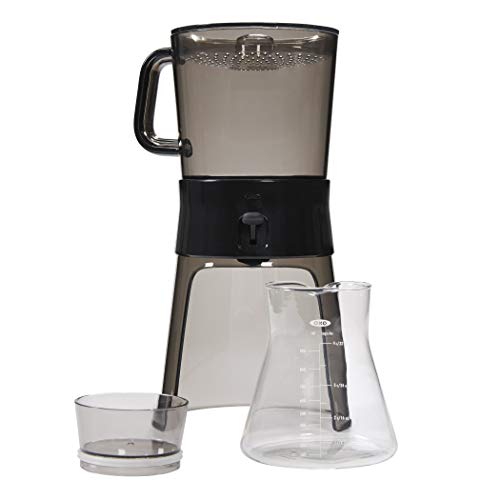
OXO Good Grips Cold Brew Coffee Maker, 32 oz
by OXO
The cleanest cup a reusable filter can produce -- a Rainmaker lid that saturates the bed evenly, two-stage filtration that catches the fines, and the only fully dishwasher-safe brewer here.
Pros
- The Rainmaker lid is the only genuine extraction innovation in this category -- it disperses water evenly across the whole bed of grounds instead of channelling straight down one side, which is exactly the saturation problem that makes home cold brew taste weak and uneven
- It runs a two-stage filtration path: the coarse steeping filter holds the bed, then a much finer mesh catches fines on the way out, and the result is the most consistently silt-free cup of any reusable-filter brewer here
- It is the only brewer in this roundup that is fully dishwasher safe including the carafe, which removes the single most tedious part of owning a cold brew maker
- The switch-activated release means the concentrate drains on your schedule rather than the moment you tilt something, so you can stop mid-pour without a mess
Cons
- It is roughly two and a half times the price of the Takeya for the same 32 ounces, so you are paying purely for filtration quality and dishwasher convenience
- The two-part filter system takes a moment to reassemble correctly, and several owners report seating it wrong the first few times, which lets grounds past
- It brews concentrate only, so 32 ounces is not 32 ounces of drinkable coffee -- plan on diluting roughly one to one
Budget Pick: Bodum Brazil 34oz French Press
The Bodum Brazil is on this list because a French press is a legitimately excellent cold brew maker, and it is the only brewer here that earns its counter space year-round. The same vessel makes hot French press coffee in four minutes and cold brew concentrate overnight, which means it is not a summer gadget that lives in a cupboard from October to May. At twenty dollars it is the least expensive brewer on this page, and buying it as a dual-purpose vessel effectively makes one of the two methods free.
Mechanically it is the simplest device in this entire roundup. The plunger is the filter — there is no separate basket to buy, lose, misassemble, or clean, and there is nothing to seat incorrectly. You add coarse grounds and cold water, steep 12 to 24 hours in the fridge, and press down. Borosilicate glass is chemically inert and completely transparent, so you can watch the bed settle and judge whether your grind and agitation are actually working, which is feedback none of the opaque or basket-based brewers give you.
Its weaknesses are the ones inherent to the design. A single mesh screen passes noticeably more fines than a purpose-built cold brew filter, so if you want a truly clean concentrate you will want to strain it once more through paper or cloth. The glass beaker is the most fragile body here and cracked carafes are the top recurring complaint, so it is wrong for a rough household. And the plunger does not seal perfectly, meaning grounds left in contact keep extracting — decant the concentrate off the bed rather than storing it in the press. For our full take on the method, see our French press picks.
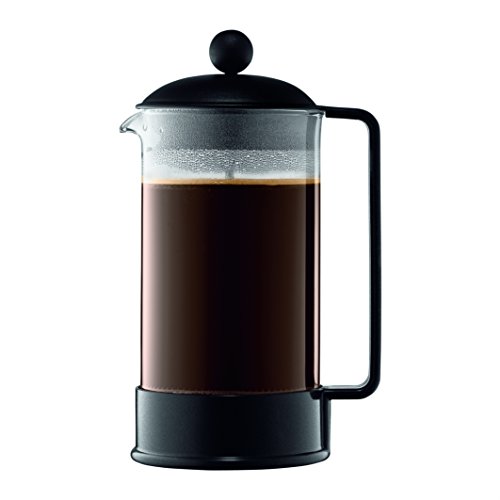
Bodum 34oz Brazil French Press Coffee Maker, Borosilicate Glass
by Bodum
The least expensive brewer here, and one vessel that brews hot French press in four minutes and cold brew concentrate overnight -- with a plunger that doubles as the filter.
Pros
- It is the only genuinely dual-purpose brewer in this roundup: the same vessel makes hot French press coffee in four minutes and cold brew concentrate overnight, so it earns its counter space year-round rather than sitting in a cupboard from October to May
- The plunger is the filter, which means there is no separate basket to buy, lose, misassemble, or clean -- you press down and the grounds are sealed at the bottom, which is the simplest mechanism in this entire category
- Borosilicate glass is chemically inert and completely transparent, so you can watch the bed settle and judge whether your grind and agitation are working -- feedback none of the opaque or basket-based brewers give you
- At twenty dollars with nearly 20,000 reviews behind it, it is the least expensive brewer on this list and the cheapest credible way into cold brew, and because it also makes hot coffee you are effectively getting one of the two methods free
Cons
- A single mesh screen passes noticeably more fines than a purpose-built cold brew filter, so the concentrate needs a second strain through a paper filter or cloth if you want it truly clean
- The glass beaker is the most fragile body here, and cracked-carafe reports are the top recurring complaint -- it is the wrong brewer for a household that is rough on glassware
- The plunger does not seal perfectly, so grounds left in contact after pressing will keep extracting; decant the concentrate off the bed rather than storing it in the press
VINCI Express Electric Cold Brew Coffee Maker
The VINCI Express answers the one genuine objection to cold brew: that you have to decide about it a day in advance. It compresses a 12 to 24 hour steep into roughly ten minutes by cycling water through the bed under pressure rather than waiting on passive diffusion, and it is the only brewer here that lets you want cold brew and have cold brew in the same hour.
For a rapid brewer it is well executed. Three selectable strength settings vary the cycle count rather than forcing you to change your dose, so you can move between mild and concentrate without re-measuring anything. The forced circulation runs through a proper stainless basket rather than the loose steeping that fast methods often rely on, which is why it produces genuinely low sediment for its class. And the self-clean cycle handles the maintenance step people actually skip, which matters more on an electric unit you cannot simply put in a sink.
I have to be honest about the coffee, though. Forced circulation in ten minutes is not chemically the same process as a twenty-hour cold steep. Rapid extraction under pressure pulls a broader range of compounds than slow cold diffusion does, and the result sits closer to a very smooth flash-chilled coffee than to true cold brew — a trained palate can tell, and if the rounded, low-acid character is specifically what you want, a passive brewer gets you there better. The electronic base also cannot be submerged, and if it fails the whole unit is dead with no manual fallback. Buy this if the wait is genuinely what has stopped you.
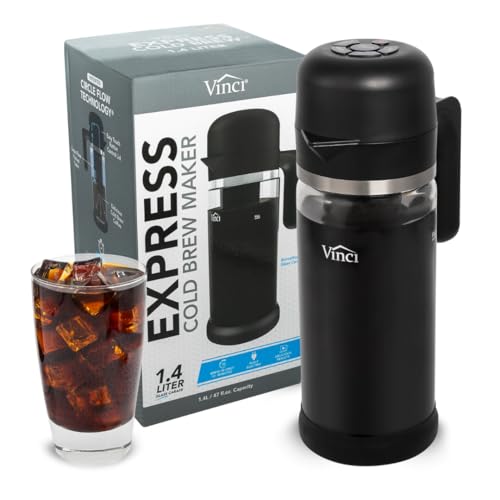
VINCI Express Electric Cold Brew Coffee Maker, 47oz
by VINCI
Cold brew in ten minutes instead of overnight -- forced circulation through a proper stainless basket, three strength settings, and a self-clean cycle.
Pros
- It compresses a 12 to 24 hour steep into roughly 10 minutes by cycling water through the bed under pressure rather than waiting on passive diffusion -- the only brewer here that answers 'I want cold brew today' rather than 'I want cold brew tomorrow'
- Three selectable strength settings mean the machine varies cycle count rather than forcing you to change your dose, so you can move between mild and concentrate without re-measuring anything
- For a rapid brewer it produces genuinely low sediment, because the forced circulation runs through a proper stainless basket rather than the loose steeping that fast methods usually rely on
- The self-clean cycle handles the part of ownership people actually skip, which matters more on an electric unit where you cannot simply put the whole thing in a sink
Cons
- The forced-circulation cycle is not chemically identical to a long cold steep -- it extracts fast enough that the result is closer to a very smooth flash-chilled coffee than to a true 20-hour cold brew, and a trained palate can tell
- The electronic base cannot be submerged or put in a dishwasher, and if the base fails there is no manual fallback -- the whole unit is dead, unlike every passive brewer here
- At a hundred dollars it is among the most expensive picks here and the only one with electronics to break
OVALWARE Airtight 1.5L Borosilicate Glass Cold Brew Maker
The OVALWARE is the answer to a question a surprising number of readers ask directly: which cold brew maker has no plastic touching the coffee. It is the only brewer in this roundup where the honest answer is none at all — borosilicate glass and stainless steel are the only two materials in contact with the brew, with no Tritan carafe, no AS resin beaker, and no plastic lid liner sitting in the coffee for twenty hours.
That matters more in cold brew than in any other method, simply because of contact time. A pour-over touches its vessel for three minutes; a cold brew sits in it for a full day. The filter is also better than the price suggests: a laser-cut stainless strainer with genuinely finer apertures than the stamped mesh on the budget jars, which holds back more fines without needing a secondary strain. And the airtight seal actually holds, so the finished concentrate keeps its aromatics for days rather than going flat and papery after 48 hours the way a loosely-lidded jar does. The same carafe and filter work properly as a cold-steep tea infuser, which is a real second use rather than a marketing line.
The cost of all that glass is that it is glass. A litre and a half of borosilicate is heavy and genuinely breakable, with no protective frame — treat it as glassware, not equipment. The filter unscrews into pieces for a proper clean, which is more disassembly than the lift-out baskets on the Hario or County Line. And the tall carafe and handle need real shelf clearance; it will not go in a fridge door.

OVALWARE Airtight Cold Brew Coffee Maker, 1.5L / 51oz Borosilicate Glass
by OVALWARE
The cleanest material story in cold brew -- only borosilicate glass and stainless touch the coffee, behind a genuinely airtight seal and a laser-cut filter finer than any budget mesh.
Pros
- It is the only brewer here where nothing but borosilicate glass and stainless steel ever touches the coffee -- no Tritan, no AS resin, no plastic lid liner sitting in the brew for 20 hours, which is the specific thing readers asking for a glass cold brew maker actually want
- The laser-cut stainless filter is finer than the stamped mesh used on the budget jars, so it holds back more fines without needing a secondary strain
- The airtight seal genuinely holds, so the finished concentrate keeps its aromatics for days instead of going flat and cardboardy after 48 hours the way a loosely-lidded jar does
- The same filter and carafe work perfectly as a cold-steep tea infuser, which is a real second use rather than a marketing claim
Cons
- A litre and a half of borosilicate glass is heavy and genuinely breakable, and it has no protective frame -- treat it as glassware, not kitchen equipment
- The filter unscrews into pieces for a proper clean, which is more disassembly than the lift-out baskets on the Hario or County Line
- The tall carafe and its handle need real shelf clearance; it will not go in a fridge door
asobu 40oz Insulated Stainless Steel Cold Brew Coffee Maker
The asobu is the only cold brew maker here built for somewhere other than a kitchen. There is no glass and nothing fragile anywhere on it — a double-wall stainless body that goes into a backpack, a cooler, or a truck bed and comes out intact. Every other brewer on this page would be a bad idea on a camping trip; this one was designed for it.
The vacuum insulation is what actually makes that work. It keeps a finished batch cold for roughly 24 hours with no refrigeration at all, which means you can brew at home the night before and still have properly cold coffee at a campsite the next day — the enabling feature, not a bonus. Stainless is also the most chemically inert material in this roundup and completely non-porous, so unlike a plastic body it will never pick up the faint coffee-oil smell that develops after a couple of years of heavy use. The lid is properly leakproof for transport rather than merely splash-resistant, so it travels on its side in a bag without soaking your gear.
The tradeoffs are price and blindness. It sits among the most expensive brewers here per ounce of capacity, and you are paying for ruggedness and insulation rather than a better-tasting cup — the extraction is ordinary immersion. The opaque body means you cannot see the bed, the sediment line, or how much is left, so you brew entirely by clock and weight. And the insulated seal means hand washing rather than a dishwasher. If your coffee needs to leave the house, though, this is the only real option — pair it with a proper travel mug for the drinking end.

asobu Cold Brew Coffee Maker, 40oz Insulated Stainless Steel
by asobu
The only cold brew maker built to survive a trip -- unbreakable double-wall stainless that keeps a batch cold for a day without a fridge and travels on its side without leaking.
Pros
- It is the only brewer here with no glass and no fragile parts at all -- a double-wall stainless body that goes in a backpack, a cooler, or a truck bed and comes out intact, which no other pick can claim
- The vacuum insulation keeps a finished batch cold for around 24 hours with no refrigeration, which is the actual enabling feature for camping: you brew at home, and it is still cold at the campsite the next day
- Stainless is the most chemically inert material in this roundup and completely non-porous, so it never picks up the coffee-oil smell that plastic bodies eventually develop
- The lid is properly leakproof for transport rather than just splash-resistant, so it travels on its side in a bag without soaking your gear
Cons
- It sits among the most expensive brewers here per ounce of capacity, and you are paying for ruggedness and insulation rather than a better-tasting cup
- The opaque steel body means you cannot see the bed, the sediment line, or how much is left -- you brew entirely by the clock and by weight
- The insulated seal means it should be hand washed, not put through a dishwasher, which is the tradeoff for the vacuum wall
Best Mason Jar Cold Brew Coffee Maker
Mason jar brewers are the cheapest way to brew a large batch of cold coffee in real glass, and the format has a genuine advantage beyond price: a wide mouth means you can reach in and actually clean it, which is more than can be said for narrow-necked carafes. The tradeoff is always shape — a wide jar will not fit a fridge door shelf. These are the two mason-jar-style brewers worth buying.
| Product | Price | Buy |
|---|---|---|
| County Line Kitchen 64oz Cold Brew Coffee Maker, Wide-Mouth Glass Mason JarBest mason jar overall The highest-rated brewer in this roundup at any price -- 64 ounces of real glass, a lift-out stainless cylinder filter, and a wide mouth you can actually scrub | $29.99 | View on Amazon |
| Zulay 1 Gallon / 128oz Cold Brew Coffee Maker, Thick GlassBest mason jar for big batches The same wide-mouth glass format scaled to a full gallon, with a thicker wall and a spout that pours without opening the lid | $36.99 | View on Amazon |
Best Glass Cold Brew Coffee Maker
If you want nothing porous touching coffee that sits for a full day, glass is the answer — and the distinction that matters is whether the lid and filter are also plastic-free, since those sit in the brew just as long as the carafe does. These three run from a true all-glass-and-steel build to the cheapest credible glass options.
| Product | Price | Buy |
|---|---|---|
| OVALWARE Airtight Cold Brew Coffee Maker, 1.5L / 51oz Borosilicate GlassBest all-glass (no plastic contact) Only borosilicate glass and stainless steel touch the coffee, behind a seal that genuinely holds the aromatics for days | $46.99 | View on Amazon |
| County Line Kitchen 64oz Cold Brew Coffee Maker, Wide-Mouth Glass Mason JarBest glass value Real glass for appreciably less than a dedicated carafe costs, and the highest owner rating of anything here | $29.99 | View on Amazon |
| Zulay 1 Gallon / 128oz Cold Brew Coffee Maker, Thick GlassBest large glass A full gallon of thick glass for households that would rather brew once a week than twice | $36.99 | View on Amazon |
Best Portable Cold Brew Coffee Maker
Away from a kitchen, two things matter and neither is filtration: the brewer has to survive being knocked around, and the coffee has to stay cold without a refrigerator. That rules out every glass carafe here and rewards insulated steel and shatterproof plastic.
| Product | Price | Buy |
|---|---|---|
| asobu Cold Brew Coffee Maker, 40oz Insulated Stainless SteelBest for camping and travel Unbreakable double-wall stainless that keeps a batch cold for 24 hours with no fridge and travels on its side without leaking | $78.00 | View on Amazon |
| Takeya Deluxe Cold Brew Coffee Maker, 1 QuartBest for a commute or office A shatterproof Tritan body with a lid that genuinely seals, light enough to live in a bag or a desk drawer | $24.98 | View on Amazon |
| Hario "Mizudashi" Cold Brew Coffee Maker, 1000mlBest for a small shared fridge A narrow litre that stands upright in a crowded shared fridge where wider brewers cannot go | $20.75 | View on Amazon |
Best French Press Cold Brew Coffee Maker
A French press is a genuinely good cold brew maker because the plunger is a built-in filter — steep coarse grounds in cold water for 12 to 24 hours, then press and pour. What you give up is filtration fineness, since a single mesh screen passes more silt than a purpose-built cold brew filter. Here is the dedicated press alongside the two brewers people usually compare it against.
| Product | Price | Buy |
|---|---|---|
| Bodum 34oz Brazil French Press Coffee Maker, Borosilicate GlassBest French press for cold brew The only true dual-use pick -- hot French press in four minutes, cold brew concentrate overnight, with the plunger doing the filtering | $19.99 | View on Amazon |
| OXO Good Grips Cold Brew Coffee Maker, 32 ozBest purpose-built alternative If you like immersion but hate the sediment a press passes, the two-stage filter gives a far cleaner concentrate for the same steep | $49.99 | View on Amazon |
| County Line Kitchen 64oz Cold Brew Coffee Maker, Wide-Mouth Glass Mason JarBest jar alternative The same simple steep-and-strain approach in real glass, with double the capacity and a filter that lifts straight out | $29.99 | View on Amazon |
Best Electric Cold Brew Coffee Maker
Electric cold brew makers exist to remove the overnight wait, forcing water through the bed under pressure in minutes rather than relying on passive diffusion for a day. Only one brewer here is genuinely electric, so this section is honest about the alternatives: if what you actually want is effortless serving rather than speed, a tap does more for you than a motor.
| Product | Price | Buy |
|---|---|---|
| VINCI Express Electric Cold Brew Coffee Maker, 47ozBest electric rapid brewer Ten minutes instead of overnight, with three strength settings and a self-clean cycle -- the only true electric brewer here | $99.99 | View on Amazon |
| KitchenAid 38 oz Cold Brew Coffee Maker (KCM5912)Best powered-convenience alternative No motor, but the built-in tap removes the real daily friction: you dispense one-handed straight from the fridge | — | View on Amazon |
| Takeya Deluxe Cold Brew Coffee Maker, 1 QuartBest manual alternative If you can plan a day ahead, a passive steep gives the rounder, lower-acid cup a rapid cycle cannot fully replicate | $24.98 | View on Amazon |
Best Large Cold Brew Coffee Maker
Brewing for a household, an office, or a heavy daily habit means one steep should last days rather than hours — and the constraint is never the brewer, it is your refrigerator shelf. These three are the big-batch picks, in descending order of how much fridge you need to give up.
| Product | Price | Buy |
|---|---|---|
| Zulay 1 Gallon / 128oz Cold Brew Coffee Maker, Thick GlassBest for a full gallon A genuine gallon in thick glass and the lowest cost per ounce here -- for families and office kitchens | $36.99 | View on Amazon |
| County Line Kitchen 64oz Cold Brew Coffee Maker, Wide-Mouth Glass Mason JarBest 64oz value Half a gallon of real glass for about thirty dollars, and the highest-rated brewer in this roundup | $29.99 | View on Amazon |
| OVALWARE Airtight Cold Brew Coffee Maker, 1.5L / 51oz Borosilicate GlassBest large all-glass 51 ounces behind a truly airtight seal, so the tail of a large batch stays aromatic instead of going flat | $46.99 | View on Amazon |
Best Compact Cold Brew Coffee Maker
In a small kitchen the deciding spec is not capacity but shape, because the brewer occupies fridge space for a full day every time you use it. Tall and narrow fits a door shelf; short and wide does not. These three are the small-footprint picks.
| Product | Price | Buy |
|---|---|---|
| Hario "Mizudashi" Cold Brew Coffee Maker, 1000mlBest compact overall A tall, narrow litre that stands in a fridge door and finishes in 8 hours instead of 24 | $20.75 | View on Amazon |
| Takeya Deluxe Cold Brew Coffee Maker, 1 QuartBest compact value The same door-shelf footprint with a leakproof lid you can lay on its side to save even more space | $24.98 | View on Amazon |
| OXO Good Grips Cold Brew Coffee Maker, 32 ozBest compact filtration 32 ounces of concentrate in a door-friendly carafe, with the cleanest filtration of any small brewer | $49.99 | View on Amazon |
Best Cold Brew Coffee Makers by Use Case
A few buyers want something the sections above do not headline — a brewer that handles hot coffee too, one big enough for a small business, a dedicated concentrate machine, an all-steel body, or the classic Japanese design. Here is the best pick on this list for each.
| Product | Price | Buy |
|---|---|---|
| Bodum 34oz Brazil French Press Coffee Maker, Borosilicate GlassBest hot and cold brew coffee maker The one vessel that brews hot French press in four minutes and cold brew overnight | $19.99 | View on Amazon |
| Zulay 1 Gallon / 128oz Cold Brew Coffee Maker, Thick GlassBest for commercial or office volume A full gallon per steep -- the closest thing here to a small-business batch without commercial equipment | $36.99 | View on Amazon |
| KitchenAid 38 oz Cold Brew Coffee Maker (KCM5912)Best cold brew concentrate maker Brews true concentrate you dilute at the glass, dispensed one-handed from a built-in tap | — | View on Amazon |
| asobu Cold Brew Coffee Maker, 40oz Insulated Stainless SteelBest stainless steel cold brew maker Double-wall 18/8 stainless with no glass or plastic anywhere in the coffee path | $78.00 | View on Amazon |
| Hario "Mizudashi" Cold Brew Coffee Maker, 1000mlBest Japanese-style cold brew maker The Mizudashi design that defined Japanese cold brew, with a lift-out filter and an 8 hour steep | $20.75 | View on Amazon |
How to Choose the Best Cold Brew Coffee Maker
Choosing a cold brew maker comes down to a short list of honest questions: how much fridge space can you give up, how clean do you want the cup, what do you want touching your coffee for a full day, and whether you can wait overnight. Below are the six factors I weigh, each one narrowing the field toward the right brewer for you.
Brewing Method: Immersion, Slow-Drip, or Electric
Nearly every brewer here is full immersion, and for good reason — grounds sitting in cold water for 12 to 24 hours is simple, forgiving, and produces the round, low-acid cup the method is known for. The alternatives are worth understanding first. Slow-drip, or Kyoto-style, towers release cold water onto the bed a drop at a time over several hours, giving a strikingly clean, almost tea-like cup; they are beautiful, expensive, genuinely fragile, and fiddly to dial in, which is why none made this list. Electric rapid brewers finish in about ten minutes but extract fast enough that the result sits closer to a smooth flash-brewed coffee than to a true cold steep. Buy immersion for classic cold brew, and electric only if the overnight wait is the actual thing stopping you.
Filtration and Why Your Cold Brew Is Silty
Every brewer here filters with reusable stainless mesh rather than paper, which is what lets the oils and heavier solubles through and gives cold brew its body — but mesh apertures vary enormously and nobody publishes a micron rating, so you have to judge by design. In practice the hierarchy is clear: OXO’s two-stage system with its fine secondary mesh is the cleanest, OVALWARE’s laser-cut strainer is next, the stamped mesh on the budget jars is middling, and a French press plunger is the loosest. If you find silt at the bottom of the glass, though, the filter is only half the cause — an over-fine grind is usually the other half, because fines physically pass through any mesh regardless of price.
Capacity Versus Fridge Space
This is the tension that produces more buyer’s remorse than anything else here, and it is worth measuring before you order. Cold brew steeps refrigerated, so the brewer occupies fridge space for a full day every time you use it, and shape matters as much as volume. Tall, narrow brewers like the Hario and Takeya stand in a door shelf and cost you almost nothing; wide mason jars and large carafes need real main-shelf clearance. Size to what you actually drink — a quart covers one or two people for two to three days, 64 ounces covers a week for one, a gallon is for a family or an office. Oversizing has a flavour cost too, because the tail of a large batch tastes noticeably flatter than the first pour.
Material: Glass, Plastic, or Stainless Steel
Cold brew steeps for up to a day, which is far longer contact time than any hot method, so what touches your coffee matters more here than elsewhere. Borosilicate glass and food-grade stainless steel are both completely inert and non-porous, and the OVALWARE is the only brewer here where nothing else touches the brew at all. BPA-free Tritan and AS resin, used by the Takeya and Hario, are safe for cold extraction; the practical tradeoff is not toxicity but porosity, since plastic can slowly absorb coffee oils and develop a faint smell after a year or two of heavy use. Against that, plastic and steel do not shatter, which is the failure mode that actually ends most cold brew makers. Choose glass for material purity, plastic or steel for durability.
Grind Size, Ratio, and the Grinder Behind Them
No brewer compensates for a bad grind, and over a day-long immersion the penalty is severe. Fine particles over-extract into harshness and slip straight through any mesh as silt, which is the real cause of the muddy, bitter cold brew people usually blame on their equipment. You want a consistently coarse grind the texture of raw sugar, which only a burr grinder produces — a blade grinder makes dust and boulders at once, guaranteeing grit and bitterness simultaneously. Start at 1 part coffee to 5 parts water by weight for concentrate, or 1 to 8 for ready-to-drink, and weigh rather than scoop, since coarse grounds vary hugely in volume. That ratio decides more than flavour, incidentally — it decides the dose, and a concentrate poured straight can carry several times the caffeine of a café cold brew. Our free cold brew caffeine calculator turns whatever you loaded into the brewer into the milligrams that actually land in the glass. A coarse, even grind in a fifteen-dollar pitcher beats a fine, uneven grind in a hundred-dollar one.
Cleaning, Mold Risk, and Replaceable Parts
Reusable mesh filters are what make cold brew cheap, and they are also the maintenance liability nobody mentions. Damp grounds trapped in fine mesh are close to ideal conditions for mold, so what you want is a filter that comes fully apart, a body you can reach into, and the discipline to rinse immediately after the steep rather than the next morning. The OXO is the only fully dishwasher-safe brewer here including the carafe; the asobu and KitchenAid both need hand washing, for an insulated seal and a tap assembly respectively. This is also the honest case against the DIY jar-and-strainer approach — a purpose-built brewer gives you a filter designed to be removed and cleaned, and a rancid oil film in a neglected mesh will quietly sour every batch that follows.
Buyer's Guide
Cold brew is the most forgiving brewing method there is and the easiest to get quietly wrong. Cold water extracts slowly and selectively, so the brewer's job is narrower than with hot methods -- hold the grounds evenly in contact with water for a long time, then separate them cleanly. These are the six specs that decide whether a brewer does that well, ranked the way I weigh them on the cupping table.
Brewing Method: Immersion, Slow-Drip, or Electric
Nearly every brewer here is full immersion -- grounds sit in cold water for 12 to 24 hours -- and for good reason: it is simple, forgiving, and produces the round, low-acid cup the method is known for. The two alternatives are worth understanding before you buy. Slow-drip, or Kyoto-style, towers release cold water onto the bed one drop at a time over several hours, producing a strikingly clean, tea-like cup; they are beautiful, expensive, fiddly to dial in, and genuinely fragile, which is why none made this list. Electric rapid brewers like the VINCI force water through the bed under pressure and finish in about ten minutes -- extremely convenient, but chemically closer to a very smooth flash-brewed coffee than to a true cold steep. If you want classic cold brew, buy immersion; buy electric only if the wait is the thing actually stopping you.
Filtration and Why Your Cold Brew Is Silty
Every brewer here filters with reusable stainless mesh rather than paper, which is what lets the oils and heavier solubles through and gives cold brew its body -- but mesh apertures vary enormously, and nobody publishes a micron rating. In practice the hierarchy is clear: OXO's two-stage system with its fine secondary mesh is the cleanest, OVALWARE's laser-cut strainer is next, the stamped mesh on the budget jars is middling, and a French press plunger is the loosest of all. If your cold brew has silt at the bottom of the glass, the filter is only half the cause -- an over-fine grind is usually the other half, because fines physically pass through any mesh. If you want genuine clarity, pair a fine filter with a coarse grind, or strain the finished concentrate once through a paper filter.
Capacity Versus Fridge Space
This is the tension that produces more buyer's remorse than anything else in the category, and it is worth measuring before you order. Cold brew has to steep refrigerated, so the brewer occupies fridge space for a full day every time you use it -- and the shape matters as much as the volume. Tall, narrow brewers like the Hario and Takeya stand in a door shelf and cost you almost nothing; wide mason jars like the County Line and large carafes like the Zulay gallon need real main-shelf space. Size to what you actually drink: a quart covers one or two people for two to three days, 64 ounces covers a week for one, and a gallon is for a family or an office. Oversizing has a flavour cost too, since the tail of a large batch is noticeably flatter than the first pour.
Material: Glass, Plastic, or Stainless Steel
Cold brew steeps for up to a day, which is far longer contact time than any hot method, so the material touching your coffee matters more here than elsewhere. Borosilicate glass and food-grade stainless steel are both completely inert and non-porous; the OVALWARE is the only brewer here where nothing else touches the coffee at all. BPA-free Tritan and AS resin, used by the Takeya and Hario, are safe for cold extraction, and the practical tradeoff is not toxicity but porosity -- plastic can slowly absorb coffee oils and develop a faint smell after a year or two of heavy use, where glass and steel never will. Against that, plastic and steel do not shatter, which is the actual failure mode that ends most cold brew makers. Choose glass if material purity is your priority, plastic or steel if durability is.
Grind Size, Ratio, and the Grinder Behind Them
No brewer compensates for a bad grind, and over a 12 to 24 hour immersion the penalty is severe. Fine particles over-extract into harshness and slip straight through any mesh as silt, which is the real cause of the muddy, bitter cold brew people usually blame on equipment. You want a consistently coarse grind the texture of raw sugar, which only a burr grinder produces -- a blade grinder makes dust and boulders at once, guaranteeing grit and bitterness simultaneously. On ratio, start at 1 part coffee to 5 parts water by weight for a concentrate, or 1 to 8 for ready-to-drink, and weigh rather than scoop, since coarse grounds vary hugely in volume. A coarse, even grind in a fifteen-dollar pitcher beats a fine, uneven grind in a hundred-dollar one every time.
Cleaning, Mold Risk, and Replaceable Parts
Reusable mesh filters are what make cold brew cheap, and they are also the maintenance liability nobody mentions. Damp grounds trapped in a fine mesh are close to ideal conditions for mold, so the practical requirements are a filter that comes fully apart, a body you can reach into, and the discipline to rinse immediately after each steep rather than the next morning. The OXO is the only fully dishwasher-safe brewer here, including the carafe; the asobu and KitchenAid both need hand washing because of an insulated seal and a tap assembly respectively. This is also the honest argument against the DIY jar-and-strainer approach: a purpose-built brewer gives you a filter designed to be removed and cleaned, where an improvised setup usually does not, and a rancid oil film in a neglected mesh will sour every batch that follows.
The Verdict: Which Cold Brew Coffee Maker Should You Buy?
After weighing all ten on the things that actually shape the cup and the routine, the Takeya Deluxe is my best overall pick for 2026. Its full-length filter basket keeps the grounds evenly saturated across a long steep, its lid genuinely seals so you can lay it flat or shake it mid-brew, and its unbreakable body removes the failure mode that ends most cold brew makers — all for about the price of four cafe cold brews, behind the deepest review record in the category. If you want to spend as little as possible, the Bodum Brazil is the cheapest brewer here and makes your hot coffee too. If you want glass instead of plastic, the County Line Kitchen jar buys the most glass per dollar on this page and is the highest-rated brewer here, provided you have the shelf space for a wide jar. And if the friction of pouring is what stops you drinking what you brewed, the KitchenAid’s tap is the one premium feature in this category that genuinely earns its money.
For the specific cases: buy the Hario if your fridge is small, the Zulay if you want to brew once a week, the OXO if silt is what bothers you, the OVALWARE if you want nothing but glass and steel touching your coffee, the VINCI if the overnight wait is genuinely the obstacle, the asobu if your coffee has to leave the house, and the Bodum if you want one vessel that also makes your hot coffee. Whichever you choose, the brewer is only half the system — feed it a coarse, even grind from a real burr grinder and fresh medium-roast beans, and follow our cold brew method guide for ratios and steep times. Get those right and any of these ten will make cold brew better than the cafe down the street.
Frequently Asked Questions
Does cold brew have more caffeine than hot coffee?
What is the difference between cold brew and iced coffee?
What is a nitro cold brew coffee maker, and do I need one?
How do you use a cold brew coffee maker?
What grind size and coffee-to-water ratio should I use for cold brew?
How long does cold brew keep in the fridge?
How do I stop mold growing in a reusable cold brew filter?
Related Articles
About the Reviewer

Clara Bennett, CQI Q Grader, SCA Roaster
B.S. Food Science, UC Davis
Clara Bennett is a Coffee Quality Institute (CQI) licensed Q Grader and SCA-certified roaster with over a decade in specialty coffee — from competition barista to production roaster and green-coffee buyer. She has cupped thousands of coffees to CQI protocol and dialed in espresso on everything from $90 entry machines to commercial three-group setups. She founded Brew Gazette in 2026 to turn cupping-table standards into plain-English buying advice.