8 Best French Presses of 2026
Q Grader Clara Bennett tests the 8 best French presses of 2026 — ranked on filtration clarity, heat retention, build quality, and how clean the cup actually tastes.
Updated
I taste coffee for a living, and of every brewer I own, the French press is the one I find most honest. As a CQI-licensed Q Grader and an SCA-certified roaster, I spend my days on the cupping table, and a French press is the closest a home brewer gets to a cupping bowl: full immersion, a metal filter, and nothing between you and the coffee. There is no pump to fail, no paper to strip out the oils, and nowhere for a lazy grind or a cheap build to hide. That honesty is exactly why it is the method I recommend to anyone who wants to taste what their beans actually are — and why picking the right press, and the right grind to feed it, matters more than people expect.
What a French press does that no paper-filtered method can is let the coffee’s oils and fine soluble solids through the metal mesh into the cup. Those oils carry aroma and give the brew its heavy, rounded body — the signature texture of immersion coffee. The tradeoff comes in the same breath: that open mesh also passes fine sediment, and a four-minute steep punishes an uneven grind by over-extracting the dust into bitterness. So the whole game of a great French press is managing that tradeoff — enough filtration to keep the cup clean, enough openness to keep the body, and a grind coarse and even enough that neither goes wrong.
The single biggest variable is not even the press: it is the grind. A coarse, even grind from a burr grinder will make a budget press taste better than a fine, uneven grind in a premium one, so before you spend on the press, read my coffee grinder picks — a blade grinder is the most common reason French press coffee comes out muddy and harsh. Fresh-roasted coffee beans matter nearly as much, since the method rewards good coffee honestly. And once you have your press, our step-by-step guide on how to use a French press walks through the technique. Let’s get into the presses.
| Product | Price | Buy |
|---|---|---|
| Bodum Chambord 34oz French Press Coffee Maker, Borosilicate GlassBest Overall | $39.69 | View on Amazon |
| Utopia Kitchen 34oz Borosilicate Glass French Press Coffee MakerBudget Pick | $14.23 | View on Amazon |
| Frieling Double-Walled Stainless Steel French Press, 36ozPremium Pick | $139.95 | View on Amazon |
| Secura 34oz Stainless Steel Insulated French Press Coffee MakerRunner-Up | $27.99 | View on Amazon |
| ESPRO P5 French Press with Double Micro-Filter, 32ozRunner-Up | $49.99 | View on Amazon |
| Secura 50oz Stainless Steel Insulated French Press Coffee MakerRunner-Up | $42.99 | View on Amazon |
| Stanley Classic Stay-Hot French Press, 48oz Insulated Stainless SteelRunner-Up | $54.68 | View on Amazon |
| Bodum Brazil 12oz French Press Coffee Maker, Borosilicate GlassRunner-Up | $14.99 | View on Amazon |
Find the Best French Press for Your Need
The right press depends on what matters most to you — classic cup quality, keeping coffee hot, a grit-free brew, brewing for a crowd, or a press that survives a campsite. Jump to your use case:
- Overall best French presses
- Best French press for cold brew
- Best insulated stainless steel French press
- Best large French press for a crowd
- Best French press for camping and travel
- Best budget French press
- Best grit-free French press (no sludge)
- More use cases: single-cup, plastic-free
How We Tested and Evaluated These French Presses
Every press here was selected against a consistent set of criteria: a verified, active Amazon listing; real owner review volume; genuine differentiation in material, filtration, insulation, or capacity; and materials that are safe at brewing temperature. I evaluated each on the variables that actually govern the cup — how thoroughly its filter separates the grounds without stripping the oils that give French press its body, whether the vessel holds brewing heat or sheds it, how safely its materials contact near-boiling coffee, and how easily it comes apart to clean. I weighed those engineering facts against the cup quality owners report and against my own sensory framework for what a balanced, full-bodied immersion brew should taste like, and I deliberately spread the picks across price tiers, materials, capacities, and use cases so a budget buyer, a clarity purist, a camper, and a big household each find a clear answer. Presses from unverified sellers or with suspiciously inflated ratings were excluded.
I re-check this list rather than leave it to age. At the September 2026 review I confirmed all eight presses were still listed, buyable new, and priced as shown, and I refreshed every rating and review count against the live listings. Two things changed: the ESPRO P5 now ships with a pack of paper filters, which makes it the most flexible press here for a clean cup, and its listing now carries far fewer reviews than before, so I’ve noted that below. The lineup and the order held up, so nothing needed swapping.
Best French Presses Overall
These are the eight presses I’d put on a counter or in a pack without hesitation in 2026, each reviewed once below with its full strengths and tradeoffs. The best overall pick leads because it makes the truest French press cup; the use-case sections further down regroup these same presses by what you care about most.
Best Overall: Bodum Chambord 34oz French Press
The Bodum Chambord is the press I reach for first, and it earns the top spot by being the definitive execution of what a French press is supposed to be. Its three-part stainless mesh is the reference standard for full-immersion filtration: it holds the grounds back while letting the coffee’s natural oils and soluble solids through, which is precisely what produces the heavy, rounded body that makes immersion coffee worth brewing. As a Q Grader, that mouthfeel and aromatic richness is the thing I taste for, and the Chambord delivers it as cleanly as anything at any price.
The rest of the design is a lesson in getting the basics right and leaving them alone. The borosilicate glass beaker is chemically inert, so the cup tastes of nothing but the coffee, and it lets you watch the bloom rise and the plunge descend — visual feedback I genuinely use to judge saturation and timing. It has been made in Portugal to the same pattern since the 1980s, which means replacement beakers, filters, and plungers are cheap and everywhere; a shattered carafe is a few-dollar fix, not the death of the press. With more than 28,000 reviews at a 4.6 average, no glass press here has a deeper track record — only the insulated Secura 34oz has more owners behind it.
The honest limitations are the ones inherent to glass. Single-wall glass sheds heat, so the coffee is at its best for the first 20 to 30 minutes — decant it into a thermal mug if you are a slow sipper. It is breakable, so it is the wrong press for a campsite or a chaotic kitchen. And like every single-mesh press, it lets a fine layer of sediment through; that is the style, easily minimized with a coarse grind, but if silt bothers you, the ESPRO further down is your answer. For the buyer who wants the real, classic French press cup, the Chambord is exactly right.

Bodum Chambord 34oz French Press Coffee Maker, Borosilicate Glass
by Bodum
The French press I reach for first and recommend to almost everyone -- the classic three-part mesh delivers the full-bodied, oil-rich cup the method is famous for, and a 40-year-old design means parts are cheap and forever available.
Pros
- The three-part stainless mesh filter is the reference standard for full-immersion brewing -- it holds back the grounds while letting the coffee's natural oils and soluble solids through, which is exactly what gives a French press its heavy, rounded body and is the whole reason you'd choose this method over a paper-filtered drip
- Borosilicate glass is chemically inert and, just as importantly, lets you watch the bloom and the plunge -- I lean on that visual feedback to judge saturation and timing, and it tastes of nothing but the coffee, unlike the faint metallic note a cheap steel beaker can add on the first few brews
- It has been made in Portugal to the same design since the 1980s, so replacement beakers, filters, and plungers are cheap and universally available -- a broken carafe is a five-dollar fix, not a reason to rebin the whole press
- Backed by more than 28,000 owner reviews at a 4.6 average, the deepest track record of any glass press in this roundup and the clearest signal that the design simply works over years of daily use
Cons
- Single-wall glass sheds heat quickly -- the coffee is at its best for the first 20 to 30 minutes, after which you should decant it into a carafe or thermal mug rather than let it sit and cool over the grounds
- Glass is breakable, so it is the wrong choice for camping, a busy shared office, or a household with young kids who empty the dishwasher
- Like every single-mesh press it lets a fine layer of sediment through -- normal for the style and easy to minimize with a coarse grind, but if you want near-pour-over clarity, look at the ESPRO
Budget Pick: Utopia Kitchen 34oz Glass French Press
The Utopia Kitchen glass press is the one I point people to when they want to try the method without spending real money, and its whole case rests on a simple truth: the coffee does not know what you paid for the vessel. The brewing mechanics — a borosilicate beaker and a stainless mesh plunger — are identical to presses costing three times as much, so it produces the same full-immersion, oil-rich cup. For a first French press, that is exactly the point.
It punches above its price in the details that matter. The three-layer filter stacks two mesh screens around a spring plate, which traps meaningfully more fines than the single flimsy screen you might expect at this cost and keeps the cup cleaner than the price implies. The heat-resistant beaker lifts out of its frame for cleaning and is dishwasher safe, so maintenance is effortless. With more than 11,600 reviews at 4.4, it is the most proven full-size budget press here, not an untested unknown.
Be clear-eyed about what the low price buys. The frame and lid are lighter-gauge steel than the Bodum’s, so it feels less substantial and spots more easily with water. Like any glass press it does not hold heat, so drink it promptly or decant. And the plunger rod can bend if you force a too-fine grind down, so keep the grind coarse and press slowly. None of that changes the fact that it makes genuinely good coffee for the price of a couple of bags of beans, which is all a budget pick needs to do.

Utopia Kitchen 34oz Borosilicate Glass French Press Coffee Maker
by Utopia Kitchen
The best way to try a French press without spending real money -- identical brewing mechanics to the premium glass presses, a surprisingly capable three-layer filter, and thousands of happy owners behind it.
Pros
- It brews the same full-immersion, oil-rich cup as presses costing three times as much, because the fundamental mechanics -- a glass beaker and a stainless mesh plunger -- are identical, and coffee does not know what you paid for the vessel
- A three-layer stainless filter stacks two mesh screens with a spring plate, which traps noticeably more fines than a single flimsy screen and keeps the cup cleaner than the price suggests
- The heat-resistant borosilicate beaker lifts out of its frame for cleaning and is dishwasher safe, so upkeep is genuinely effortless -- a real advantage over presses with fixed carafes
- More than 11,600 reviews at 4.4 make it the most proven full-size budget press here, the one I hand to anyone who wants to try the method without committing real money
Cons
- The frame and lid are lighter-gauge steel than the Bodum's, so it feels less substantial in the hand and the finish is more prone to water spotting
- Single-wall glass, like the Bodum, means it does not hold heat -- drink it promptly or decant
- The plunger rod can bend if you force a too-fine grind down, so keep the grind coarse and press slowly
Upgrade Pick: Frieling Double-Walled Stainless Steel French Press
The Frieling is the press I recommend to anyone who has decided a French press is their method for life and wants to buy accordingly. It earns the upgrade spot on one transformative feature: the double-walled 18/10 stainless body is a vacuum-insulated flask, so it holds brewed coffee genuinely hot for one to two hours rather than the 20 minutes a glass press manages. That is the closest a manual, no-electricity press gets to a set-and-forget carafe, and it changes how you use the brewer — a slow morning no longer means cold coffee.
Two more things separate it from ordinary steel presses. Its dual fine-mesh screen filters more thoroughly than a single mesh, so the cup is cleaner and less muddy than most stainless presses while still passing the oils that give the method its body — a real engineering improvement, not just a marketing line. And it is all steel where it counts, with no plastic touching the coffee and no glass to shatter, which is why owners describe it as a lifetime purchase and treat it as an heirloom. If you want a press you will still be using, unchanged, in a decade, this is it.
The caveats are what you would expect of a premium tool. It costs several times what a capable glass press does, and that premium buys heat retention and permanence rather than a better first-pour cup. You cannot see the brew, so you steep by the clock. And because it keeps the coffee so hot, leaving it on the grounds will slowly push it toward bitterness — press and pour on schedule rather than treating it as an all-morning thermos. Accept those, and the Frieling is the finest-built press in this roundup.
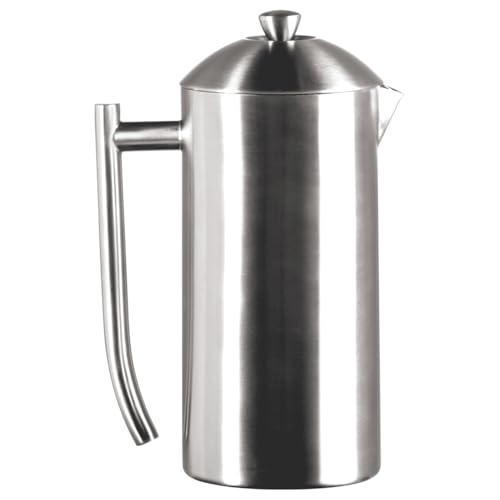
Frieling Double-Walled Stainless Steel French Press, 36oz
by Frieling
The buy-it-for-life press -- a vacuum-insulated all-steel body that keeps coffee hot for hours, a dual screen that pours cleaner than most, and a build owners keep for decades.
Pros
- The double-walled 18/10 stainless body is a vacuum-insulated flask, so it holds brewed coffee genuinely hot for one to two hours instead of the 20 minutes a glass press manages -- it is the closest a manual press gets to a set-and-forget carafe, and the reason it earns the upgrade spot
- A dual fine-mesh screen filters more thoroughly than a single mesh, so the cup is cleaner and less muddy than most steel presses while still passing the oils that give French press its body -- a genuine engineering step up
- It is effectively unbreakable, dishwasher safe, and built to a standard that owners describe as a lifetime purchase -- there is no glass beaker to shatter and no plastic touching the coffee at all
- The all-steel construction means nothing but 18/10 stainless contacts your brew, which matters if you are avoiding plastic or want a press that will look and work the same in a decade
Cons
- It costs several times what a capable glass press does, so the premium is really buying heat retention and near-permanence rather than a better-tasting cup on the first pour
- You cannot see the brew as it steeps, so you lose the visual timing cues a glass press gives -- you brew by the clock instead
- The insulated wall keeps the coffee hot enough that, left with the grounds, it will keep extracting toward bitterness -- press and pour into cups on schedule rather than treating it as an all-morning thermos
Secura 34oz Stainless Steel Insulated French Press
The Secura 34oz is, to my mind, the smartest value in the entire category, because it delivers most of what the Frieling does for roughly a fifth of the price. It shares the core idea — a double-wall 304 stainless body that keeps coffee hot far longer than glass and shrugs off the drops that end a glass press’s life — without the premium price tag. For most people, this is the insulated press to buy, and it is the one I recommend most often.
The numbers behind it are the strongest in this roundup: a 4.7 average across more than 36,000 owners, the deepest review base here by a clear margin and a rating only its 50-ounce sibling matches. That is not a fluke; the build backs it up, with an 18/10 exterior and 18/8 interior that resist rust and take daily abuse, plus two spare filter screens in the box so you can rebuild the filter stack for years. Cool-touch steel makes it forgiving in a busy kitchen or a shared office where a glass carafe would be a liability waiting to happen.
Its compromises are the ordinary ones of a value steel press. The three-layer mesh filters well but passes more fines than the ESPRO’s micro-filter, so the cup carries a touch more body and sediment. You cannot see the brew through steel. And it insulates well enough that coffee left on the grounds keeps extracting, so decant once you plunge for the cleanest flavor. For the money, nothing here does more.
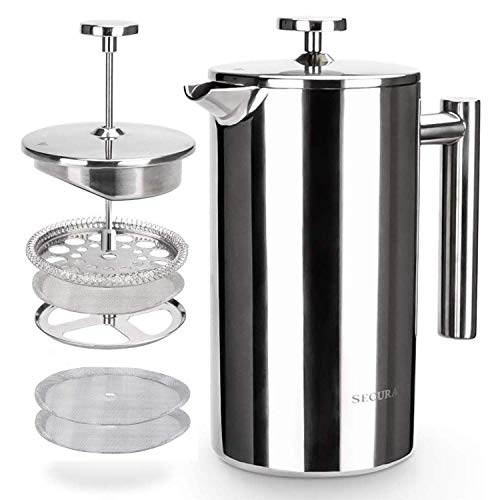
Secura 34oz Stainless Steel Insulated French Press Coffee Maker
by Secura
The value champion of insulated presses -- most of a Frieling's heat retention and durability for a fraction of the price, backed by more owners than any other press here.
Pros
- It delivers most of what the Frieling does -- a double-wall 304 stainless body that keeps coffee hot far longer than glass -- at roughly a fifth of the price, which makes it the single best value in insulated presses and the one I recommend most often
- The deepest review base of any press here, and a 4.7 average that only its 50-ounce sibling matches: more than 36,000 owners, a level of proven satisfaction that is genuinely rare and hard to argue with
- The 18/10 exterior and 18/8 interior are rust-resistant and durable, and it ships with two extra filter screens, so you can rebuild the filter stack for years without hunting for parts
- Cool-touch steel and an unbreakable body make it far more forgiving than glass in a busy kitchen, a shared office, or anywhere a press gets knocked around
Cons
- A three-layer mesh filters well for a steel press but still passes more fines than the ESPRO's double micro-filter, so the cup has a little more body and sediment
- You cannot see the brew through steel, so you lose the visual cue for saturation and timing
- It insulates well enough that coffee left on the grounds keeps extracting -- decant once you plunge for the cleanest flavor
ESPRO P5 French Press with Double Micro-Filter
The ESPRO P5 exists to solve the one complaint people have about French press coffee — the sludge — and it solves it more completely than anything else here. Its patented double micro-filter filters an order of magnitude finer than a standard mesh, so the cup pours with near-pour-over clarity and almost none of the silt that normally settles in the bottom of an immersion brew. If you love the body of a French press but have always wished it were cleaner, this is the press that squares that circle.
There is a second, subtler advantage that I value as much as the clarity. The filter works as a sealed basket: the moment you plunge, it closes the grounds off from the water, so extraction effectively stops. An ordinary press keeps steeping the coffee on its grounds and slowly slides toward bitterness; the ESPRO does not, which means the last cup from the beaker tastes like the first. That same fine filtration also makes it an outstanding cold-brew maker, giving a remarkably clean concentrate. It now comes with 10 paper filters that sit in the basket, so on the days you want a light, oil-free cup you can have one without buying a second brewer. The extra-thick borosilicate beaker is held in a polished stainless frame with a twist-lock latch, so it is sturdier than a bare glass press.
The tradeoffs are focused and fair. It costs more than a standard glass press, and the fine filter is the entire premium — if sediment does not bother you, you may not need it. The tighter filter takes more force to plunge and can trap grounds if you grind too fine, so a properly coarse grind matters even more here. And its 4.2 rating trails the field slightly, mostly on reports that the two-part filter needs careful cleaning to keep sealing well. For the clarity-focused drinker, none of that outweighs what it does to the cup.
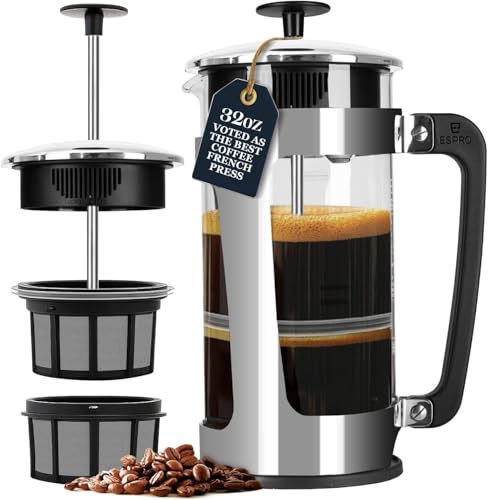
ESPRO P5 French Press with Double Micro-Filter, 32oz
by ESPRO
The press for anyone who loves immersion body but hates the silt -- a patented double micro-filter delivers near-pour-over clarity and stops extraction the moment you plunge.
Pros
- The patented double micro-filter is the reason to buy this press -- it filters an order of magnitude finer than a standard mesh, so the cup comes out with near-pour-over clarity and almost none of the silt that pools in the bottom of an ordinary French press
- Because the filter acts as a basket that seals the grounds off the moment you plunge, extraction effectively stops -- the coffee does not keep stewing toward bitterness while it sits, which is a real, tastable advantage over every single-mesh press here
- It is genuinely the grit-free answer for people who love the body of immersion coffee but hate the sludge, it doubles as a superb cold-brew maker for the same reason, and it now ships with 10 paper filters you can drop into the basket for a pour-over-clean, oil-free cup
- The extra-thick borosilicate beaker is held in a polished stainless frame with a twist-lock latch, so it is sturdier than a bare glass press while still letting you see the brew
Cons
- It is pricier than a standard glass press, and the fine filter is the entire premium -- if sediment does not bother you, you are paying for clarity you may not need
- The tighter filter takes more force to plunge and can trap grounds if you grind too fine, so a properly coarse grind matters more here than on a loose mesh
- Its 4.2 rating trails the field slightly, mostly on reports of the two-part filter needing careful cleaning to keep sealing well, and the current listing carries the thinnest review base here, a few hundred owners
Secura 50oz Stainless Steel Insulated French Press
The Secura 50oz is the answer when one press has to serve a full table. Its 50-ounce capacity brews roughly six mugs in a single plunge, so a family breakfast, a weekend brunch, or an office pot happens in one go instead of a tedious sequence of back-to-back batches. When you are brewing for a group, that capacity is the entire point, and few presses this well-built go this large.
Crucially, the scale-up costs you nothing in quality. It carries the same double-wall 304 stainless construction and the same stellar 4.7 rating as its smaller sibling, so the extra volume comes with no drop in heat retention, durability, or owner satisfaction. The larger thermal body holds a big batch hot for about an hour — which matters most precisely when a press is large, because you want the sixth mug to taste as good as the first. Unbreakable steel and cool-touch handling make it the sensible choice for the higher-traffic kitchens where a big press earns its keep.
The limits are simply the flip side of its size. For a single drinker it is overkill, and a big batch will cool before one person finishes it, so buy the volume you truly brew. The three-layer mesh passes more fines than a micro-filter press, and full of coffee it is genuinely heavy to pour one-handed. For a household or office that goes through real coffee, though, it is the press that keeps up.
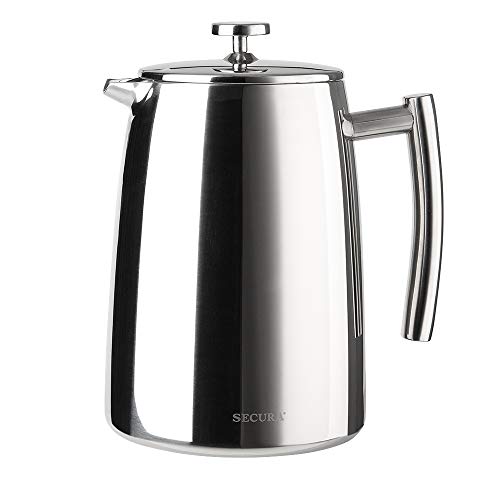
Secura 50oz Stainless Steel Insulated French Press Coffee Maker
by Secura
The press for a full table -- 50 insulated ounces in a single plunge, with the same top-rated build and heat retention as Secura's smaller model, sized for families and offices.
Pros
- A full 50-ounce capacity brews for a crowd in one plunge -- roughly six mugs -- so you are not running back-to-back batches for a family breakfast, a brunch, or an office pot
- It carries the same double-wall 304 stainless build and 4.7 rating as its smaller sibling, so the extra volume comes with no drop in heat retention, durability, or owner satisfaction
- The larger thermal body holds a big batch hot for about an hour, which is exactly when a large press matters most -- you want the last mug to taste like the first
- Unbreakable steel and cool-touch handling make it the sensible large press for shared and higher-traffic kitchens where a big glass carafe would be a liability
Cons
- A 50-ounce press is oversized and slow to heat-stabilize for a single drinker -- buy the volume you actually brew, or a big batch cools before you finish it
- The three-layer mesh, like the 34-ounce model, passes more fines than a micro-filter press
- Full of coffee it is heavy, so it is less nimble to pour one-handed than a small glass press
Stanley Classic Stay-Hot French Press
The Stanley Classic is the press I would throw in a pack without a second thought, because it is built for exactly the conditions that destroy other presses. It sits on Stanley’s legendary double-wall vacuum insulation, which keeps coffee hot for around four hours — the longest of anything here — so it still pours a genuinely hot mug at a campsite or a job site an hour after you brewed. For coffee away from a kitchen, that heat retention is transformative.
Everything about it is engineered for the outdoors. The all-steel, BPA-free body is effectively indestructible; it shrugs off drops, packs, and truck beds that would shatter a glass beaker instantly, which is why it is the default press for camping, RVs, and overlanding. A wide, stable base makes it far more spill-resistant on uneven ground than a top-heavy glass press, and at 48 ounces it brews enough for a group around a fire in one plunge. When water is scarce, it cleans up with a quick rinse.
Its compromises are the reasonable price of that ruggedness. The mesh filter is coarser than a kitchen-focused press, so the cup carries more sediment and body — perfectly acceptable in the field, less ideal if you are chasing a refined morning cup at home. The steel body is heavier and bulkier than glass, and you brew by the clock since you cannot see inside. If your coffee needs to survive the trip, none of that matters; this is the one to pack.

Stanley Classic Stay-Hot French Press, 48oz Insulated Stainless Steel
by Stanley
The press for the outdoors -- Stanley's four-hour vacuum insulation and a near-indestructible steel body make it the one to throw in a pack, an RV, or a truck without a second thought.
Pros
- It is built on Stanley's legendary double-wall vacuum insulation, which keeps coffee hot for around four hours -- longer than any other press here -- so it is the one that still pours a hot mug at a campsite an hour after you brewed it
- The all-steel, BPA-free body is effectively indestructible and shrugs off drops, packs, and truck beds, which is exactly why it is the default press for camping, RVs, and the outdoors
- A wide, stable base and a naturally non-slip build make it far more spill-resistant on uneven ground than a top-heavy glass press
- At 48 ounces it brews enough for a group around a fire or a tailgate in one press, and it cleans up with a rinse when water is scarce
Cons
- Its mesh filter is coarser than a kitchen-focused press, so the cup carries more sediment and body -- acceptable in the field, less ideal if you want a refined morning cup at home
- The rugged steel body is heavier and bulkier than a glass press, which is the trade for its durability and heat retention
- You cannot see the brew, so you steep by the clock -- easy enough once you learn its timing
Bodum Brazil 12oz French Press
The Bodum Brazil 12oz is the right press for a party of one, and it earns its place by solving a problem people rarely think about until their coffee tastes off: ratio. A single-cup brew in a large press leaves the grounds under-submerged and the coffee-to-water balance wrong, but the 12-ounce Brazil is sized so one mug’s worth of coffee and water fills the beaker properly, which makes hitting the right ratio effortless. For a solo drinker, that alone justifies buying small.
It brews the same full-bodied cup as the flagship Chambord, through the same style of three-part mesh, simply scaled down — and it costs about as much as two bags of beans. The compact borosilicate beaker heats fast, cleans in seconds, and tucks into a cupboard corner, which makes it ideal for a dorm, a small kitchen, a desk drawer, or anyone who only ever brews for themselves. With more than 17,000 reviews at 4.4, it is the most proven small press here, and its glass-and-steel build keeps plastic away from the coffee itself.
The tradeoffs are all about its size. Twelve ounces is one mug, so it is the wrong press the moment you brew for two — size up to a 34-ounce model for company. Single-wall glass loses heat quickly, and a small volume cools even faster, so drink it right away. And the plastic frame and lid feel less premium than the Chambord’s polished steel, which is part of how the price stays this low. For one person who wants a proper cup without a big press taking over the counter, it is exactly right.

Bodum Brazil 12oz French Press Coffee Maker, Borosilicate Glass
by Bodum
The right press for one -- a 12-ounce Bodum that nails the coffee-to-water ratio for a single mug, brews the same full-bodied cup as its big sibling, and costs about as much as two bags of beans.
Pros
- At 12 ounces it is sized for exactly one drinker, so a single-cup brew fills the beaker properly instead of leaving grounds under-submerged in a too-big press -- the right ratio of coffee to water is far easier to hit in a small vessel
- It brews the same full-bodied Bodum cup as the flagship Chambord through the same style of three-part mesh, just scaled down, and costs about as much as two bags of beans
- The compact borosilicate beaker heats fast, cleans in seconds, and stores in a cupboard corner -- ideal for a dorm, a small kitchen, a desk, or a one-person morning
- More than 17,000 reviews at 4.4 make it the most proven small press here, and the glass-and-steel build tastes clean with no plastic near the coffee itself
Cons
- 12 ounces is one mug -- it is the wrong press if you ever brew for two, so size up to a 34-ounce model for company
- Single-wall glass loses heat quickly, and a small volume cools even faster, so drink it right away
- The plastic frame and lid feel less premium than the Chambord's polished steel, which is part of how the price stays this low
Best French Press for Cold Brew
A French press is one of the best cold brew makers you already own, because the plunger is a built-in filter — steep coarse grounds in cold water for 12 to 24 hours, then press and pour a clean concentrate. What matters for cold brew is capacity to make a worthwhile batch and a filter fine enough to keep the concentrate clean; a finer filter is the standout advantage here.
| Product | Price | Buy |
|---|---|---|
| ESPRO P5 French Press with Double Micro-Filter, 32ozBest for the cleanest concentrate The double micro-filter yields a strikingly clean, silt-free concentrate and stops over-extraction the moment you plunge | $49.99 | View on Amazon |
| Secura 50oz Stainless Steel Insulated French Press Coffee MakerBest for big cold brew batches 50 insulated ounces make a large batch of concentrate in one steep for a week of iced coffee | $42.99 | View on Amazon |
| Bodum Chambord 34oz French Press Coffee Maker, Borosilicate GlassBest classic cold brew press The reference three-part mesh and a see-through beaker make dialing in a first cold brew easy | $39.69 | View on Amazon |
For the full method — ratios, steep times, and dilution — follow our guide on how to make cold brew coffee.
Best Insulated Stainless Steel French Press
If you want your coffee to stay hot past the first few minutes, an insulated double-wall stainless press is the answer — it traps a vacuum or air gap between two steel walls, exactly like a thermos, and is unbreakable in the bargain. These three are the insulated picks, from lifetime-build premium to best value to most rugged.
| Product | Price | Buy |
|---|---|---|
| Frieling Double-Walled Stainless Steel French Press, 36ozBest premium insulated A vacuum-insulated all-steel body with a dual fine screen, built to last decades | $139.95 | View on Amazon |
| Secura 34oz Stainless Steel Insulated French Press Coffee MakerBest value insulated Most of the premium heat retention for a fraction of the price, with the most owners behind it | $27.99 | View on Amazon |
| Stanley Classic Stay-Hot French Press, 48oz Insulated Stainless SteelBest rugged insulated Four-hour Stanley insulation in a near-indestructible body for the outdoors | $54.68 | View on Amazon |
Best Large French Press for a Crowd
Brewing for a family, a brunch, or an office means one plunge should fill several mugs — and in a large press, heat retention matters even more, because a big batch left in single-wall glass goes cold before it is gone. These are the presses that brew big and, being insulated, keep the last mug hot.
| Product | Price | Buy |
|---|---|---|
| Secura 50oz Stainless Steel Insulated French Press Coffee MakerBest large for daily use 50 insulated ounces -- about six mugs -- in a single plunge, top-rated and unbreakable | $42.99 | View on Amazon |
| Stanley Classic Stay-Hot French Press, 48oz Insulated Stainless SteelBest large for the outdoors 48 rugged ounces that hold heat for four hours for a group around a fire | $54.68 | View on Amazon |
| Frieling Double-Walled Stainless Steel French Press, 36ozBest large premium 36 insulated ounces in a lifetime-build body for a household that wants the best | $139.95 | View on Amazon |
Best French Press for Camping and Travel
Away from a kitchen, a press has to survive the trip and keep coffee hot without a burner — which rules out glass and rewards insulated steel. These three take the outdoors best, led by the one built expressly for it.
| Product | Price | Buy |
|---|---|---|
| Stanley Classic Stay-Hot French Press, 48oz Insulated Stainless SteelBest for camping and rugged use Near-indestructible steel and four-hour heat retention, purpose-built for packs and truck beds | $54.68 | View on Amazon |
| Secura 34oz Stainless Steel Insulated French Press Coffee MakerBest value for travel Unbreakable, cool-touch, and top-rated -- a durable press that travels for far less | $27.99 | View on Amazon |
| Frieling Double-Walled Stainless Steel French Press, 36ozBest premium for travel The lightest-handling premium steel press, built to last a lifetime of trips | $139.95 | View on Amazon |
Best Budget French Press
You do not need to spend much for a genuinely good cup — you need identical brewing mechanics and enough filter to keep it clean, which the cheapest presses here deliver. These three give the most coffee per dollar at the bottom of the range.
| Product | Price | Buy |
|---|---|---|
| Utopia Kitchen 34oz Borosilicate Glass French Press Coffee MakerBest cheapest overall A full 34-ounce glass press with a capable three-layer filter for the price of two bags of beans | $14.23 | View on Amazon |
| Bodum Brazil 12oz French Press Coffee Maker, Borosilicate GlassBest budget single-cup A 12-ounce Bodum sized for one, brewing the same full body for a rock-bottom price | $14.99 | View on Amazon |
| Secura 34oz Stainless Steel Insulated French Press Coffee MakerBest budget insulated The lowest-cost way into an unbreakable, heat-holding steel press, and it is the most-reviewed press here | $27.99 | View on Amazon |
Best French Press for Grit-Free Coffee (No Sludge)
Sediment is inherent to a metal mesh, but the finer the filter, the cleaner the cup. If you love immersion body but hate the silt at the bottom of the mug, filtration is the only spec that matters — and these three run from near-pour-over clarity to the best a standard mesh does.
| Product | Price | Buy |
|---|---|---|
| ESPRO P5 French Press with Double Micro-Filter, 32ozBest for zero sludge A patented double micro-filter delivers near-pour-over clarity and seals the grounds off when you plunge | $49.99 | View on Amazon |
| Frieling Double-Walled Stainless Steel French Press, 36ozBest low-sediment steel press A dual fine-mesh screen pours cleaner than most steel presses while keeping the body | $139.95 | View on Amazon |
| Bodum Chambord 34oz French Press Coffee Maker, Borosilicate GlassBest clean cup from a classic mesh The reference three-part mesh gives the cleanest cup a classic press can, especially with a coarse grind | $39.69 | View on Amazon |
Best French Presses by Use Case
A few buyers want something the sections above don’t headline — a true single-serve press, or one with no plastic anywhere near the coffee. Here is the best pick on this list for each.
| Product | Price | Buy |
|---|---|---|
| Bodum Brazil 12oz French Press Coffee Maker, Borosilicate GlassBest single-serve A 12-ounce Bodum that nails the ratio for exactly one mug | $14.99 | View on Amazon |
| Frieling Double-Walled Stainless Steel French Press, 36ozBest plastic-free An all-steel body with no plastic touching the coffee at all | $139.95 | View on Amazon |
| Bodum Chambord 34oz French Press Coffee Maker, Borosilicate GlassBest classic design The iconic Chambord shape with cheap, forever-available replacement parts | $39.69 | View on Amazon |
How to Choose the Best French Press
Choosing a French press comes down to a handful of honest questions: do you want to see the brew or keep it hot, how clean a cup do you want, and how many mugs you brew at a time. Below are the six factors I weigh, each a lens that narrows the field toward the right press for you.
Glass vs. Stainless Steel (and Insulation)
This is the first fork, and it is really about heat rather than flavor, because the vessel does not change the cup on the first pour. Borosilicate glass, as on the Bodum Chambord, is inert, lets you watch the brew, and costs the least, but single-wall glass loses drinking heat in 20 to 30 minutes and can shatter. Double-wall stainless steel, as on the Secura and Frieling, is a vacuum flask that holds coffee hot for one to four hours and is effectively unbreakable, at a higher price and with no view of the brew. Choose glass if you drink promptly and like to watch it work; choose insulated steel if you want it to stay hot, brew slowly, or need it to survive a drop, a campsite, or a shared office.
Filtration: Why Your Cup Is Gritty
Every French press filters with metal, not paper, and that is deliberate — the mesh lets the coffee’s oils and solubles through, producing the method’s heavy body. The tradeoff is sediment: a standard single or three-layer mesh always passes some fine silt. If that bothers you, a finer filter is the fix. The ESPRO P5’s patented double micro-filter traps far more fines and seals the grounds off the instant you plunge, giving near-pour-over clarity and stopping the over-extraction that turns a sitting press bitter. Decide how much body versus clarity you want, because the filter is the spec that controls it.
Grind Size and the Grinder Behind It
No press rescues a bad grind, and this factor decides your cup more than any other. Full immersion steeps the grounds for about four minutes, and fine particles over-extract into bitterness and slip through the mesh as sludge in that time. You want a coarse, even grind the texture of sea salt, which only a burr grinder makes — a blade grinder produces dust and boulders that are bitter and gritty at once. A coarse, even grind in a budget press beats a fine, uneven grind in a premium one, so budget for a decent burr grinder alongside the press. It is the highest-leverage upgrade you can make to French press coffee, and the fastest fix if your current cup is muddy.
Capacity and How Many Cups You Actually Brew
Buy the size you brew, not the size that looks generous. A 12-ounce press like the Bodum Brazil fills properly for one mug, where a big press would leave the grounds under-submerged and the ratio off. A 34-ounce press suits most one-to-two-person homes, and a 48-to-50-ounce press like the Secura 50oz or Stanley handles a family or an office in one plunge. Oversizing has a real cost: a big batch in single-wall glass cools before you finish it, and even in an insulated press the coffee keeps extracting on the grounds, so match capacity to a batch you will drink promptly.
Material Safety and Plastic Contact
French press coffee steeps near boiling, so what touches it matters. Borosilicate glass and food-grade 304 stainless steel are both inert and safe at brewing heat — the Secura models and the Frieling are all-steel where it counts, and the Frieling has no plastic touching the coffee at all. Where a press uses plastic, as in the Bodum Brazil’s frame and many budget lids, look for BPA-free material positioned so hot coffee does not sit against it. If avoiding plastic entirely matters to you, an all-steel insulated press is the clean answer; if not, any glass-and-steel press here keeps plastic away from the brew itself.
Cleaning, Durability, and Replaceable Parts
A press you clean easily is a press you keep using, and grounds and coffee oils build up fast in a filter stack. Look for a fully removable filter that comes apart to rinse, a dishwasher-safe beaker or body, and cheap, available replacement parts — the spec people forget. The Bodum’s four-decade-old design makes a broken beaker or a worn filter an inexpensive swap, and Secura ships spare screens in the box; all-steel presses like the Stanley and Frieling trade breakage risk for sheer longevity. Whichever you choose, deep-clean the filter regularly, because trapped oils go rancid and quietly sour the cup.
Buyer's Guide
I taste coffee for a living, and a French press is the most honest brewer there is -- there is no pump, no paper, and nowhere for a bad grind or a cheap build to hide. These are the six things that actually decide whether a press makes a rich, clean cup or a muddy, lukewarm one, ranked the way I weigh them on the cupping table.
Glass vs. Stainless Steel (and Insulation)
This is the first decision, and it is really a decision about heat, not flavor -- the vessel does not change the cup on the first pour. Borosilicate glass, as on the Bodum Chambord, is chemically inert, lets you watch the brew, and costs the least, but single-wall glass loses drinking heat in 20 to 30 minutes and can shatter. Double-wall stainless steel, as on the Secura and Frieling, is a vacuum flask that holds coffee hot for one to four hours and is effectively unbreakable, at a higher price and with no view of the brew. Choose glass if you drink your coffee promptly and like to see it work; choose insulated steel if you want it to stay hot, brew for a slow morning, or need it to survive a drop, a campsite, or a shared office.
Filtration: Why Your Cup Is Gritty
Every French press filters with metal, not paper, and that is the point -- a metal mesh lets the coffee's oils and soluble solids through, which is what produces the method's signature heavy body. The tradeoff is sediment: a standard single or three-layer mesh, as on most presses here, always passes some fine silt into the cup. If that bothers you, the fix is a finer filter. The ESPRO P5's patented double micro-filter traps an order of magnitude more fines and seals the grounds off the instant you plunge, giving near-pour-over clarity and stopping the over-extraction that makes a sitting press turn bitter. Decide how much body versus clarity you want, because the filter is the spec that controls it.
Grind Size and the Grinder Behind It
No press can rescue a bad grind, and this is the factor that most determines your cup. Full immersion steeps the grounds for around four minutes, and fine particles over-extract into bitterness and slip through the mesh as sludge in that time. You want a coarse, even grind the texture of sea salt, which only a burr grinder produces -- a blade grinder makes a mix of dust and boulders that is bitter and gritty at once. A coarse, even grind in a budget press beats a fine, uneven grind in a premium one every time, so if you are buying a press, budget for a decent burr grinder alongside it. It is the highest-leverage upgrade you can make to French press coffee.
Capacity and How Many Cups You Actually Brew
Buy the size you brew, not the size that looks generous. A 12-ounce press like the Bodum Brazil fills properly for a single mug, where a large press would leave the grounds under-submerged and the ratio off. A 34-ounce press covers most one-to-two person households, and a 48-to-50-ounce press like the Secura 50oz or Stanley is right for a family, a brunch, or an office in a single plunge. Oversizing has a real cost beyond counter space: a big batch in a single-wall glass press cools before you finish it, and even in an insulated press the coffee keeps extracting on the grounds, so match the capacity to a batch you will actually drink promptly.
Material Safety and Plastic Contact
French press coffee steeps at near-boiling temperature, so the materials that touch it matter. Borosilicate glass and food-grade 304 (18/8 or 18/10) stainless steel are both inert and safe at brewing heat -- the two Secura models and the Frieling are all-steel where it counts, and the Frieling has no plastic touching the coffee at all. Where presses use plastic, as in the Bodum Brazil's frame and many budget lids, look for it to be BPA-free and, ideally, positioned so hot coffee does not sit against it. If avoiding plastic entirely is a priority, an all-steel insulated press is the clean answer; if not, any glass-and-steel press here keeps plastic away from the brew itself.
Cleaning, Durability, and Replaceable Parts
A press you clean easily is a press you will actually use, and spent grounds and coffee oils build up fast in a filter stack. Look for a fully removable filter that comes apart to rinse, a beaker or body that is dishwasher safe, and -- the spec people overlook -- cheap, available replacement parts. The Bodum's four-decade-old design means a broken glass beaker or a worn filter is an inexpensive, easy-to-find swap rather than a reason to replace the whole press, and Secura ships spare screens in the box. All-steel presses like the Stanley and Frieling trade the risk of breakage for sheer longevity. Whichever you choose, descale and deep-clean the filter regularly, because trapped oils go rancid and quietly sour the cup.
The Verdict: Which French Press Should You Buy?
After weighing all eight on the things that actually shape the cup, the Bodum Chambord is my best overall pick for 2026. Its three-part mesh delivers the full-bodied, oil-rich cup the method exists for, its inert glass beaker tastes of nothing but the coffee, and a design unchanged since the 1980s means parts are cheap and forever available — backed by the deepest track record of any glass press here. If your budget is tighter, the Utopia Kitchen glass press brews the same cup for the price of two bags of beans. And if you want your coffee to stay hot, the Secura 34oz is the value I recommend most, delivering most of the premium Frieling’s insulation and durability for a fraction of the price — step up to the Frieling itself only if you want a genuine buy-it-for-life press.
Whichever you choose, remember the press is only half the system. Feed it a coarse, even grind from a good burr grinder, pour freshly roasted beans through it, and dial in exactly how much coffee your press needs with our free French press coffee ratio calculator — because the best French press is the one matched to how you actually drink your coffee, and any of these eight, paired with the right grind, will earn its place on your counter.
Frequently Asked Questions
Is a glass or stainless steel French press better?
What grind size should I use for a French press?
How do I keep my French press coffee from being gritty or muddy?
Can you make cold brew in a French press?
What is the right coffee-to-water ratio for a French press?
Do double-wall French presses actually keep coffee hot longer?
Is French press coffee bad for your cholesterol?
Related Articles
About the Reviewer

Clara Bennett, CQI Q Grader, SCA Roaster
B.S. Food Science, UC Davis
Clara Bennett is a Coffee Quality Institute (CQI) licensed Q Grader and SCA-certified roaster with over a decade in specialty coffee — from competition barista to production roaster and green-coffee buyer. She has cupped thousands of coffees to CQI protocol and dialed in espresso on everything from $90 entry machines to commercial three-group setups. She founded Brew Gazette in 2026 to turn cupping-table standards into plain-English buying advice.