14 Best Water Filters for Coffee of 2026
By Clara Bennett, CQI Q Grader, SCA Roaster Updated
Jump to our top picks ↓
Brewed coffee is roughly 98 percent water, and water is the part of the recipe most people never think about. On the cupping table I can taste chlorine in a cup before I can name the origin, and I can tell when a sample was brewed with water so soft it had nothing to extract with. The best water filter for coffee is the one that fixes your tap’s specific problem without creating a new one, and that depends far more on what comes out of your faucet than on any brand name.
I am a CQI Q Grader and an SCA-certified roaster, so my working days are spent judging cups brewed to a water standard. For this 2026 guide we compared 14 options across four kinds of water treatment: carbon pitchers, reverse osmosis, mineral packets for building water from scratch, and the cartridges that sit inside specific coffee makers and espresso machines. If you are shopping for a brewer at the same time, our guides to the best drip coffee maker and the best espresso machine cover the machines themselves.
Here is the full lineup at a glance. The first column tells you what each one is for, which matters more with water filters than with almost any other coffee gear, because a filter built for one problem can make another one worse.
Find the Best Water Filter for Coffee for Your Need
Most readers arrive with a specific machine or a specific water problem. Jump straight to yours:
- Best water filters for coffee overall
- Best water filter pitcher for coffee
- Best water filter for Cuisinart coffee maker
- Best water filter for Keurig coffee maker
- Best water filter for Breville coffee machine
- Best water filter for Mr. Coffee coffee makers
- Best water filter for coffee machines
- Best water filter for De’Longhi coffee machine
- More use cases: Jura, Hamilton Beach, RO, distilled and TDS testing
How We Chose These Water Filters
We did not run lab tests for this guide, and I will not pretend otherwise. We compared each product’s filter type, published certifications, rated filter life and machine compatibility, then read owner reports for the problems that keep coming up: leaks, poor fit, and filters that quit early. Every listing was confirmed live and buyable on Amazon before it made the list. Then each pick was weighed against what water chemistry predicts it will do to a cup.
The yardstick is the Specialty Coffee Association’s water standard, which targets roughly:
- Total dissolved solids (TDS) around 150 mg/L, with 75 to 250 mg/L acceptable
- Calcium hardness around 68 mg/L as CaCO3
- Total alkalinity near 40 mg/L
- pH near 7
- Sodium near 10 mg/L
- Chlorine at zero
A filter that moves your water toward those numbers earns a place here. One that pushes water to an extreme, such as near-zero TDS, only makes the list paired with a way to put minerals back.
Best Water Filters for Coffee Overall
Fourteen products, each reviewed once below. The pitchers, the RO system and the mineral packets come first because they work with any brewer. The machine cartridges follow, brand by brand. The use-case sections further down regroup the same products by machine and by water problem.
Best Overall: Brita Large 10-Cup Elite Water Filter Pitcher
The Brita Elite pitcher is my default recommendation because it fixes the problem I run into most often with American tap water for coffee, chlorine, without touching the part of the water that does the work. Municipal systems disinfect with chlorine, and even a faint residual reads in the cup as a swimming-pool note that buries delicate aromatics. Activated carbon adsorbs it well. What carbon does not do is pull out much calcium and magnesium, and those two minerals are what bind to flavor compounds and carry them out of the grounds. You keep the extraction power and lose the off-taste.
The Elite filter is the reason I pick this pitcher over the Standard version. It is rated for about 120 gallons or six months, which suits a household brewing a full drip carafe every day, and Brita lists WQA certification to NSF/ANSI standards for lead, mercury, cadmium, benzene, asbestos and microplastics. If you live in an older home with uncertain plumbing, that lead certification matters more than anything I could say about flavor.
The limit is scale. Because it leaves hardness in place, the Elite does little to protect a kettle or an espresso boiler in a hard-water area, so pair it with a regular cleaning and descaling routine. Our guide on how to clean a coffee maker walks through it for drip machines. Owners also report the occasional failed indicator and filters that slow down before their rated life, so note the install date yourself.
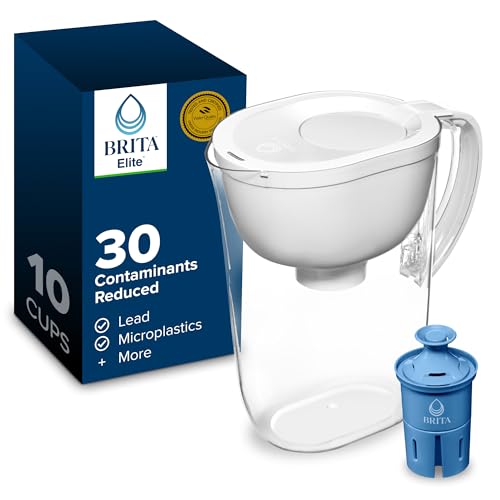
Brita Large 10-Cup Elite Water Filter Pitcher
by Brita
The water filter for coffee I would put in most kitchens first: it fixes chlorine, keeps the minerals, and runs about six months per filter.
Pros
- Activated carbon removes the chlorine taste and odor that a cupper notices first in coffee brewed from city tap water
- Leaves most of the calcium and magnesium in place, so the minerals that drive extraction are still there when the water reaches the grounds
- Elite filter is rated for about 120 gallons or six months, roughly three times the life of a Standard cartridge, with an electronic change indicator
- Brita lists WQA certification to NSF/ANSI standards for lead, mercury, cadmium, benzene, asbestos and microplastics
Cons
- Does not soften hard water, so it does little to slow scale in a kettle or espresso boiler
- Some owners report the electronic indicator failing or the filter slowing before its rated life
- A ten-cup pitcher takes fridge space and needs refilling to fill a large drip carafe
Budget Pick: Brita Large 10 Cup Water Filter Pitcher (Standard Filter)
The Standard-filter version of the same ten-cup pitcher is where I would start if your water is soft, chlorinated and otherwise fine. It removes chlorine taste and odor on the same carbon principle, and Brita lists WQA and NSF/ANSI certification for chlorine, copper, mercury and cadmium. For a pour-over or drip drinker on city water, that single change is often the biggest improvement in the cup for the least effort.
The tradeoffs are filter life and scope. A Standard cartridge is rated for about 40 gallons or two months, so a household brewing a big carafe daily will change it often, and it is not certified for lead. Like the Elite, it leaves hardness in the water, which is good for flavor and does nothing for scale. If you are not sure whether your water is chlorinated or hard, start here, then read your utility’s water quality report before spending more.

Brita Large 10 Cup Water Filter Pitcher (Standard Filter)
by Brita
The entry point to better coffee water: a proven pitcher that strips chlorine and leaves the minerals alone.
Pros
- Removes the chlorine taste and odor that dulls coffee brewed from municipal tap water
- Same ten-cup pitcher body as the Elite, with a simpler filter that drops straight in
- WQA certified to NSF/ANSI standards for chlorine, copper, mercury and cadmium reduction
- Keeps calcium and magnesium in the water, which is what you want for extraction
Cons
- Standard filter lasts about 40 gallons or two months, so a daily drip drinker changes it often
- Not certified for lead; choose the Elite filter if old plumbing is a concern
- Does not soften water or protect a machine from scale
Upgrade Pick: iSpring RCC7AK-BN Alkaline Reverse Osmosis System
Reverse osmosis is the answer when the tap itself is the problem: very hard water, high TDS, or a supply that swings through the year. The iSpring RCC7AK-BN pushes water through a semi-permeable membrane that rejects most dissolved solids, so the output is close to a blank slate. On its own, that blank slate is a coffee problem. Water with almost no minerals extracts poorly and tastes flat, and with no alkalinity to buffer acids, brews can turn sharp and sour. Some espresso machines also sense water level with a probe that relies on dissolved minerals, so near-pure water can trigger empty-tank errors.
That is why I chose this model over a plain RO system. Its sixth stage is an alkaline remineralization filter that adds some calcium and magnesium back before water reaches the dedicated faucet. It will not hit the SCA target to the milligram and you cannot dial it in, but it moves RO water from too empty toward brewable. Owners describe the install as manageable and the water as better than bottled. The recurring complaint is a leaking faucet. Plan for under-sink space, accept that some water goes to the drain while it produces, and you get one tap that serves every brewer in the house.

iSpring RCC7AK-BN 75 GPD Alkaline 6-Stage Reverse Osmosis System
by iSpring
The upgrade for hard or inconsistent water: under-sink RO that strips the problem and puts back some of the minerals coffee needs.
Pros
- Reverse osmosis removes most dissolved solids, so you start from a consistent base whatever your tap does through the year
- Sixth-stage alkaline remineralization filter adds some calcium and magnesium back, avoiding the flat, sour cup that bare RO water tends to brew
- Dedicated faucet puts filtered water on tap for every brewer in the house, plus cooking and drinking
- Owners describe the install as manageable for a handy homeowner and say replacement filter sets are easy to find
Cons
- Needs under-sink space, a faucet hole and some plumbing confidence
- Sends a share of water to the drain while it produces, and some owners report leaks at the faucet
- The remineralization stage cannot be adjusted to a precise hardness or alkalinity
ZeroWater 10-Cup Pitcher
ZeroWater is a different tool from a Brita, and it is easy to buy for the wrong reason. Its five-stage ion-exchange filter removes nearly all dissolved solids, and the included meter reads close to zero on fresh output. That is impressive for drinking water, and the listing shows IAPMO certification for lead, PFOA/PFOS, chromium and mercury. For coffee, though, near-zero TDS is the wrong target. With no calcium or magnesium to pull flavor out, the cup comes out hollow and thin, and stripped water is not what an espresso boiler wants either.
Where ZeroWater earns its place is as a base. Pair it with a mineral packet such as Third Wave Water and you have a repeatable brew recipe with very little equipment. The TDS meter is useful on day one too: read your tap before you buy any filter. Expect filters to run out quickly if your tap is hard, since every milligram of dissolved solids uses up resin.
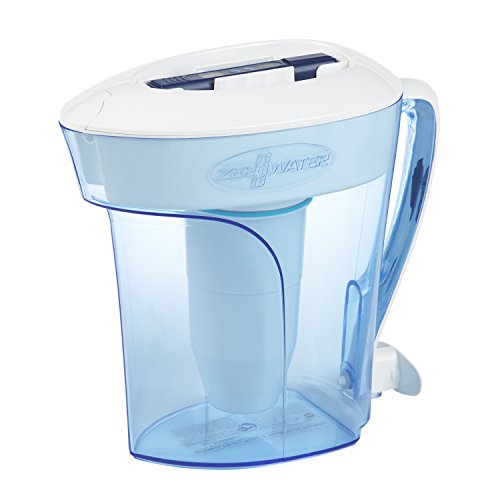
ZeroWater 10-Cup Pitcher
by ZeroWater
A near-zero TDS pitcher that only makes sense for coffee if you plan to add minerals back.
Pros
- Five-stage ion exchange removes nearly all dissolved solids, and the included TDS meter shows when the filter is spent
- IAPMO certified for lead, PFOA/PFOS, chromium and mercury reduction, per the listing
- Near-zero water is a clean base for mineral packets like Third Wave Water, so you can build a repeatable brew recipe
- The meter doubles as a quick way to read your tap water's TDS before you choose any filter
Cons
- On its own, stripped water brews flat, hollow coffee and is a poor fit for espresso boilers
- Filters exhaust quickly in hard-water areas, and owners report slow filtering and some leaks
Third Wave Water Classic Light Roast Profile
Third Wave Water is not a filter at all, which is exactly why it belongs here. Each stick holds a measured blend of calcium and magnesium salts that you stir into a gallon of distilled or RO water, rebuilding the mineral content to a recipe designed for coffee. The Classic Light Roast profile keeps alkalinity low, so acids are less buffered and the fruit in a washed Ethiopian or a bright Kenyan has more room to show. Owners consistently say it makes lighter roasts brighter and smoother.
The honest caveats are cost and effort. You need a steady supply of distilled or RO water, and some owners cannot taste the difference against good filtered tap. If you brew pour-over seriously and your tap is hard or unpredictable, it is a direct route to SCA-style water without a lab scale and a shelf of mineral salts. For espresso machines, look at Third Wave’s separate espresso profile instead, since low-alkalinity water is not meant for boilers.

Third Wave Water Classic Light Roast Profile, 12 Single Gallon Sticks
by Third Wave Water
Build-your-own coffee water: mineral sticks that turn distilled or RO water into a consistent, brew-ready recipe.
Pros
- Adds a measured dose of calcium and magnesium to a gallon of distilled or RO water, so every batch starts from the same chemistry
- Light roast profile keeps alkalinity low, and owners say it lets fruit and acidity show in lighter coffees
- Takes the guesswork out of mineral recipes without buying lab salts and a precision scale
- Works with any brewer, from pour-over to drip to French press
Cons
- Not a filter: you still need distilled water or an RO tap for every gallon
- Some owners cannot taste a difference over good filtered tap water, and the packets are non-returnable
- The light roast profile is built for brewed coffee; Third Wave sells a separate espresso profile for machines
Cuisinart DCC-RWF Replacement Charcoal Water Filters
If you own a Cuisinart drip machine with a small filter holder in the reservoir, this is the part it was designed around. The pouch combines nonwoven polyester with activated charcoal, so water passes through carbon on its way to the heater and shower head. It is a charcoal water filter for coffee maker reservoirs in its simplest form: it reduces chlorine taste and odor and does very little else.
That is still worth doing. A drip machine has no way to remove chlorine on its own, and a filter in the reservoir means you can fill straight from the tap. Replace it about every 60 days or 60 uses, soak it before the first brew as Cuisinart’s instructions describe, and keep descaling on schedule, because charcoal does not soften water. This listing ships from a third-party seller, so check that the packaging matches the DCC-RWF part number when it arrives.

Cuisinart Replacement Charcoal Water Filters (DCC-RWF), Set of 2
by Cuisinart
The OEM charcoal water filter for Cuisinart coffee makers, an easy chlorine fix if your machine has the holder.
Pros
- Genuine Cuisinart part, shaped for the filter holder in Cuisinart drip machines
- Activated charcoal reduces chlorine taste and odor before water reaches the heater and shower head
- Simple change interval: about every 60 days or 60 brew cycles
- A two-pack covers about four months of daily brewing
Cons
- Sold by a third-party seller rather than Amazon or Cuisinart directly
- A small charcoal pouch does not soften water, so descaling stays on the calendar
Pureline Replacement Charcoal Water Filters for Cuisinart
Pureline makes a compatible version of the same Cuisinart charcoal filter in a twelve-pack, and the value case is simple: at a 60-day change interval, twelve filters cover about two years. The listing claims NSF-42 testing, which is the standard for aesthetic effects like chlorine taste and odor. The media works on the same activated-charcoal principle as the OEM pouch.
The one complaint I would take seriously is fit. A few owners say the filter sits loose in the holder, which can let some water bypass the charcoal. Seat the first one carefully and check that the holder closes snugly. If it does, a large pack makes it easy to change filters on time instead of stretching an old one past its useful life, and a spent carbon filter does very little.

Pureline Replacement Charcoal Water Filters for Cuisinart, 12 Pack
by Pureline
A compatible charcoal water filter for Cuisinart coffee makers in a pack that lasts about two years.
Pros
- Twelve filters fit the same Cuisinart holder and cover about two years at a 60-day change interval
- The listing claims NSF-42 testing for chlorine taste and odor reduction
- Activated charcoal media works on the same principle as the OEM pouch
- A large pack makes it easy to change on schedule instead of stretching an old filter
Cons
- A few owners say it sits loose in the holder
- Compatible part rather than Cuisinart-branded, so check the fit on first use
- Like any charcoal pouch, it does nothing for scale
Keurig Tall Handle Water Filter Starter Kit
Keurig brewers keep water in an open reservoir and heat it in small batches, so whatever is in your tap ends up in every pod. The Tall Handle Starter Kit adds a charcoal cartridge to that reservoir: you get the handle and two cartridges, and the handle clips into compatible tall reservoirs. Keurig lists it for its 2.0-style tall-reservoir brewers, including models such as the K-Elite and K-Duo, but reservoir shapes vary, so check yours before buying.
Charcoal handles chlorine taste and odor, which is the main improvement for pod coffee on city water. It does not soften, so Keurig’s descale alert will still come around in a hard-water home. Owners call the plastic handle flimsy, and a few report fit problems with some reservoirs. If you are still choosing a pod machine, our best single-serve coffee maker guide covers the brewers.

Keurig Tall Handle Water Filter Starter Kit
by Keurig
The Keurig water filter starter kit for tall-reservoir brewers: handle plus two charcoal cartridges.
Pros
- Includes the handle and two charcoal cartridges, everything needed to start filtering a tall Keurig reservoir
- Charcoal reduces chlorine taste and odor in the reservoir water that feeds every pod
- Each cartridge runs about two months, and refills drop into the same handle
- Genuine Keurig part sized for the brand's tall reservoirs
Cons
- Owners call the plastic handle flimsy
- Fit depends on reservoir shape; confirm your brewer takes the tall handle before buying
Keurig Water Filter Refill Cartridges, 6 Count
Once you have the handle, these six genuine Keurig cartridges are the ongoing purchase. Each lasts about two months, so a box is roughly a year of filtering. Preparation is a short soak and rinse before the cartridge goes into the handle, per Keurig’s instructions, which washes out loose carbon fines.
Nothing here is complicated, and that is the point. The usual failure with reservoir filters is not the filter but forgetting to change it, so a year’s supply in the cupboard helps. This listing is sold by a third-party seller, and it needs the handle from the starter kit.

Keurig Water Filter Refill Cartridges, 6 Count
by Keurig
A year of genuine Keurig charcoal cartridges for owners who already have the handle.
Pros
- Six cartridges at about two months each is close to a year of filtering
- Genuine Keurig refills that drop into the existing handle
- Charcoal reduces chlorine taste and odor in pod coffee
- Prep is a short soak and rinse per Keurig's instructions
Cons
- Requires the handle, sold in the starter kit
- Sold by a third-party seller
- Does not soften water, so Keurig descaling is still needed
Breville BCC009 Claro Swiss Water Filter
For espresso, scale is the expensive problem. Hard water deposits calcium carbonate inside boilers, thermocoils and solenoid valves, and those deposits restrict flow and insulate heating elements. The Claro Swiss cartridge sits in the filter holder inside the water tank of Breville machines such as the Barista Express, Barista Pro, Barista Touch, Oracle and Dual Boiler. It softens the water before it reaches the heating system and reduces chlorine taste on the way. Confirm your model takes it before ordering.
Replace it about every 90 days, so the two-pack covers roughly half a year. Owners mention the per-filter cost as the main drawback. Softening does not remove the need to descale altogether in a very hard-water area, so keep our guide on how to descale an espresso machine handy.

Breville BCC009 Claro Swiss Water Filter, 2 Pack
by Breville
The OEM water filter for Breville espresso machines with a filter holder, the first line of defense against scale.
Pros
- Genuine Breville cartridge that seats in the filter holder inside the water tank
- Softens scale-forming hardness and reduces chlorine taste, protecting the heating system and the cup
- About 90 days per cartridge, so one change per season
- A two-pack covers about six months
Cons
- Owners mention the per-filter cost as the main drawback
- Fit varies by model; confirm your machine takes the Claro Swiss before ordering
Mr. Coffee Advanced Water Filter Replacement Cartridges
Mr. Coffee builds some drip machines around a replaceable Advanced Water Filter, and this two-count pack is the genuine cartridge for them. Mr. Coffee says it reduces chlorine and calcium, so it helps with taste and slows some scale, a step beyond a plain charcoal pouch. Each cartridge lasts about 60 days.
Fit is model-specific, so check your manual for the Advanced Water Filter before ordering. Some owners report cartridges breaking down before the 60 days are up; if you see loose granules in the carafe, change it early. If your Mr. Coffee has no filter holder at all, fill it from a pitcher instead, which the Mr. Coffee section further down covers.

Mr. Coffee Advanced Water Filter Replacement Cartridges, 2-Count
by Mr. Coffee
The genuine Advanced Water Filter for Mr. Coffee machines, covering chlorine and some calcium.
Pros
- Mr. Coffee says it reduces chlorine and calcium, so it helps both taste and scale
- Each cartridge lasts about 60 days
- Genuine part for Mr. Coffee models built around the Advanced Water Filter
- A two-count pack covers about four months
Cons
- Only fits Mr. Coffee models that take this cartridge; check your manual
- Some owners report cartridges breaking down before the 60 days are up
De’Longhi DLSC002 Water Softener Filter
The DLSC002 is a water softener for coffee machine tanks, and in a bean-to-cup machine that matters a great deal. Super-automatics push water through a thermoblock or boiler and a brew unit full of small passages, and scale in any of them leads to slow flow and early descale alerts. The cartridge uses ion-exchange resin to trade scale-forming calcium and magnesium for ions that stay dissolved, so less scale forms in the first place. It fits Magnifica, Dinamica, Eletta and many other De’Longhi espresso and bean-to-cup models; check the manual for your exact machine.
Replace it about every two months. The listing ships from a third-party seller, so confirm the part number on arrival. For flavor, a softened tank is a reasonable compromise: you give up some of the calcium that helps extraction in exchange for a machine that keeps working.

De'Longhi DLSC002 Water Softener Filter
by De'Longhi
The water softener for De'Longhi coffee machines: an in-tank cartridge that slows scale at the source.
Pros
- Ion-exchange resin softens the water in the tank, the main defense against scale in De'Longhi espresso and bean-to-cup machines
- Genuine De'Longhi part for Magnifica, Dinamica, Eletta and other models that take it
- About two months per cartridge, an easy interval to put on the calendar
- Softer water slows scale buildup, so descaling comes around less often
Cons
- Sold by a third-party seller
- Some De'Longhi models use a different filter; check your manual for compatibility
Jura CLEARYL Smart+ Water Filter Cartridge
Jura machines that use Clearyl Smart+ recognize the cartridge through Smart Connect, so the machine knows a filter is fitted and tracks when it is due. The cartridge softens hardness and reduces chlorine and off-tastes in the tank. Jura says machines running its filter as directed do not need descaling, which is a strong reason to keep one installed in an expensive super-automatic.
Check your manual first, because older Jura machines may take a different cartridge. A single pack means frequent reordering for daily drinkers, but against the cost of repairing a scaled brewer, that is an easy trade.
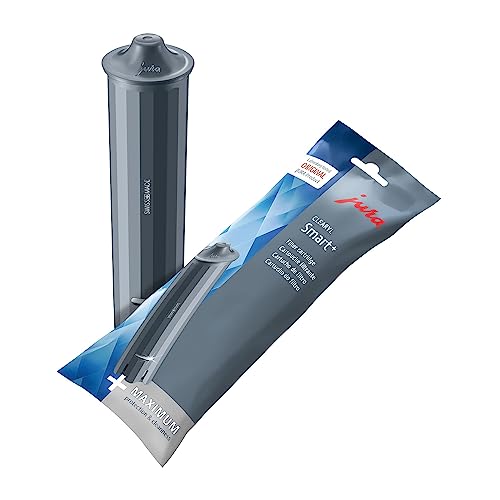
Jura 24234 CLEARYL Smart+ Water Filter Cartridge, 1 Pack
by Jura
The OEM filter for Jura machines that use Clearyl Smart+, built to keep scale out of a costly brewer.
Pros
- Compatible Jura machines recognize the cartridge through Smart Connect and track when it is due
- Softens scale-forming hardness, and Jura says machines running its filter as directed do not need descaling
- Also reduces chlorine and off-tastes before water reaches the brew unit
- Drops into the tank without tools
Cons
- Older Jura machines may use a different cartridge; check your manual
- A single pack means frequent reordering for daily drinkers
Hamilton Beach Coffeemaker Water Filter Pods and Handle
Hamilton Beach sells this two-pack of charcoal pods with a handle for its coffee makers that are built to take a filter. Like the Keurig and Cuisinart options, it is a reservoir charcoal filter: it reduces chlorine taste and odor and leaves hardness alone. That is a sensible upgrade for an everyday drip machine on city water.
Confirm in your manual that your model takes this filter, because many Hamilton Beach machines do not. If yours does not, a Brita pitcher does the same job for any brewer. Either way, keep descaling on a schedule, since charcoal does nothing for scale.

Hamilton Beach Coffeemaker Water Filter Replacement Pods and Handle, 2-Pack
by Hamilton Beach
Charcoal pods and a handle for Hamilton Beach coffee makers that take the filter.
Pros
- Includes the handle and charcoal pods, so you can add filtering to a compatible Hamilton Beach brewer
- Charcoal reduces chlorine taste and odor in the reservoir
- Pods swap in seconds
- Genuine Hamilton Beach part
Cons
- Only fits Hamilton Beach models built to take the filter; check the manual
- Does not soften water, so descaling is still needed
Best Water Filter Pitcher for Coffee
A pitcher is the right water filter for coffee when your tap is chlorinated city water and you want something that works with any brewer, from a French press to a twelve-cup drip machine. The key difference between pitchers is chemistry, not capacity. Carbon pitchers keep most of the minerals; ion-exchange pitchers strip them. For coffee, that one difference decides the cup, so match the pitcher to whether you plan to brew straight from it or rebuild the water with minerals.
| Product | Price | Buy |
|---|---|---|
| Brita Large 10-Cup Elite Water Filter PitcherBest pitcher overall Elite carbon filter lasts about six months, removes chlorine and keeps calcium and magnesium | $40.77 | View on Amazon |
| Brita Large 10 Cup Water Filter Pitcher (Standard Filter)Best budget pitcher Same pitcher with a Standard filter, a simple chlorine fix for soft city water | $28.00 | View on Amazon |
| ZeroWater 10-Cup PitcherBest pitcher for a mineral recipe Strips nearly everything, so buy it for coffee only if you add minerals back | $26.24 | View on Amazon |
Best Water Filter for Cuisinart Coffee Maker
Most Cuisinart drip machines have a charcoal filter holder inside the reservoir, and keeping a fresh filter in it is the easiest way to take chlorine out of the brew water. Both of these fit that holder. The choice is between genuine Cuisinart packaging and a large compatible pack that lasts about two years.
| Product | Price | Buy |
|---|---|---|
| Cuisinart Replacement Charcoal Water Filters (DCC-RWF), Set of 2Best OEM Cuisinart filter Genuine DCC-RWF part, changed about every 60 days or 60 uses | $9.49 | View on Amazon |
| Pureline Replacement Charcoal Water Filters for Cuisinart, 12 PackBest value Cuisinart filter Compatible twelve-pack covering about two years; seat it carefully in the holder | $12.99 | View on Amazon |
Best Water Filter for Keurig Coffee Maker
Keurig reservoirs take a charcoal cartridge in a clip-in handle. Buy the starter kit once to get the handle, then keep refills on hand. Check whether your brewer has a tall reservoir before ordering, because handle fit depends on reservoir shape.
| Product | Price | Buy |
|---|---|---|
| Keurig Tall Handle Water Filter Starter KitBest Keurig starter kit Handle plus two cartridges for tall-reservoir Keurig brewers; check your reservoir | $14.98 | View on Amazon |
| Keurig Water Filter Refill Cartridges, 6 CountBest Keurig refill pack Six genuine cartridges, about a year of filtering once you own the handle | $16.78 | View on Amazon |
Best Water Filter for Breville Coffee Machine
Breville espresso machines with a filter holder in the tank should run the Claro Swiss cartridge, because it softens the water and slows scale where it forms. A carbon pitcher only adds value if your city water is heavy on chlorine, and it does not replace the in-tank softener. Run both if chlorine is a problem where you live.
| Product | Price | Buy |
|---|---|---|
| Breville BCC009 Claro Swiss Water Filter, 2 PackBest for Breville espresso machines Softens hardness in the tank; replace about every 90 days | $24.95 | View on Amazon |
| Brita Large 10-Cup Elite Water Filter PitcherBest add-on for chlorinated water Removes chlorine before you fill the tank; it does not soften, so keep the Claro Swiss in | $40.77 | View on Amazon |
Best Water Filter for Mr. Coffee Coffee Makers
Mr. Coffee machines built for the Advanced Water Filter should use the genuine cartridge, which handles some calcium as well as chlorine. Many Mr. Coffee models have no filter holder at all, and for those a pitcher is the simple answer: fill the reservoir from it every morning.
| Product | Price | Buy |
|---|---|---|
| Mr. Coffee Advanced Water Filter Replacement Cartridges, 2-CountBest for Mr. Coffee with a filter holder Genuine cartridge that reduces chlorine and calcium, about 60 days each | $19.57 | View on Amazon |
| Brita Large 10 Cup Water Filter Pitcher (Standard Filter)Best for Mr. Coffee without a filter holder Fill the reservoir from a Standard Brita pitcher to remove chlorine | $28.00 | View on Amazon |
Best Water Filter for Coffee Machines
If you want one solution that works across any coffee machine, including the next one you buy, treat the water before it reaches the machine. There are three ways to do that, from the most involved to the simplest, and the right one depends on how hard your tap water is.
| Product | Price | Buy |
|---|---|---|
| iSpring RCC7AK-BN 75 GPD Alkaline 6-Stage Reverse Osmosis SystemBest whole-kitchen solution Under-sink RO with remineralization for hard or inconsistent tap water | $199.99 | View on Amazon |
| Brita Large 10-Cup Elite Water Filter PitcherBest simple solution Carbon pitcher that removes chlorine and keeps minerals, for soft city water | $40.77 | View on Amazon |
| Third Wave Water Classic Light Roast Profile, 12 Single Gallon SticksBest for building exact brew water Mineral sticks for distilled or RO water when you want a repeatable recipe | $18.00 | View on Amazon |
Best Water Filter for De’Longhi Coffee Machine
De’Longhi espresso and bean-to-cup machines take the DLSC002 softening cartridge in the tank, and in a super-automatic it is the main protection against scale in the brew unit. Add a carbon pitcher only if chlorine is noticeable in your tap, and keep the softener installed either way.
| Product | Price | Buy |
|---|---|---|
| De'Longhi DLSC002 Water Softener FilterBest for De'Longhi machines In-tank ion-exchange softener; replace about every two months | $11.66 | View on Amazon |
| Brita Large 10-Cup Elite Water Filter PitcherBest add-on for chlorinated water Removes chlorine before you fill the tank; keep the softener installed | $40.77 | View on Amazon |
Best Water Filters for Coffee by Use Case
The remaining picks cover specific machines and specific water goals, from Jura super-automatics to building brew water from distilled. Each product is reviewed in full above.
| Product | Price | Buy |
|---|---|---|
| Jura 24234 CLEARYL Smart+ Water Filter Cartridge, 1 PackBest for Jura machines Clearyl Smart+ cartridge that compatible Jura machines recognize and track | $24.79 | View on Amazon |
| Hamilton Beach Coffeemaker Water Filter Replacement Pods and Handle, 2-PackBest for Hamilton Beach coffee makers Charcoal pods and handle for Hamilton Beach brewers that take the filter | $15.88 | View on Amazon |
| iSpring RCC7AK-BN 75 GPD Alkaline 6-Stage Reverse Osmosis SystemBest for reverse osmosis water for coffee RO with a remineralization stage so the water still brews a full cup | $199.99 | View on Amazon |
| Third Wave Water Classic Light Roast Profile, 12 Single Gallon SticksBest for distilled water brewing (Third Wave Water for coffee) Mineral sticks that turn a gallon of distilled water into brew-ready water | $18.00 | View on Amazon |
| ZeroWater 10-Cup PitcherBest for checking your water's TDS Included meter reads TDS, handy for testing your tap before choosing a filter | $26.24 | View on Amazon |
| Pureline Replacement Charcoal Water Filters for Cuisinart, 12 PackBest value charcoal filter Twelve compatible Cuisinart charcoal filters, about two years of changes | $12.99 | View on Amazon |
Buyer's Guide
Water filters for coffee solve different problems, and the wrong type can make the cup worse. These are the six things I check before recommending one.
Your Source Water
Start by finding out what is in your tap. Your utility's annual Consumer Confidence Report lists hardness, dissolved solids and the disinfectant it uses, and an inexpensive TDS meter or water hardness test strips will confirm it at the faucet. Soft, chlorinated city water needs a different fix from hard well water, so this one step decides everything else.
Chlorine and Chloramine
Chlorine taste flattens aroma, and activated carbon removes it well. Many utilities now disinfect with chloramine instead, which is more stable and needs longer contact time or catalytic carbon to reduce. If your water report lists chloramine, check that a filter's performance data covers chloramine specifically rather than chlorine alone.
Hardness and Scale Protection
Calcium and magnesium help extract flavor, but too much hardness leaves scale in kettles, boilers and valves. Carbon filters do not soften water. If you run an espresso or bean-to-cup machine in a hard-water area, use its softening cartridge and keep descaling on schedule.
Mineral Balance for Flavor
The SCA water standard targets total dissolved solids around 150 mg/L, calcium hardness around 68 mg/L and alkalinity near 40 mg/L. Too much alkalinity buffers acidity and the cup turns flat or chalky; too little and it can taste sour and thin. Filters that strip everything, such as ZeroWater or plain reverse osmosis, need minerals added back for coffee.
Machine Fit
In-machine cartridges are brand and model specific. Check your manual for the exact part before ordering, especially for Keurig reservoirs, Breville espresso machines, De'Longhi and Jura super-automatics, and Mr. Coffee or Hamilton Beach drip machines. If your brewer has no filter holder, a pitcher or an under-sink system works with anything.
Filter Life and Upkeep
A filter only works while it has capacity left. Charcoal pouches and Keurig cartridges run about two months, Breville cartridges about 90 days, and the Brita Elite about six months. Write the install date on the box or set a reminder, because a spent filter stops working long before it looks any different.
How to Choose the Best Water Filter for Coffee
Every product above solves a different problem, so the real decision is diagnosing your water before you buy anything. Here is how I would work through it.
Start With Your Source Water
You cannot choose a filter without knowing what you are filtering. The quickest free source is your utility’s annual Consumer Confidence Report, which lists hardness, dissolved solids and the disinfectant the utility uses. Then confirm at the tap: a TDS meter gives you total dissolved solids in seconds, and water hardness test strips tell you how much of that is calcium and magnesium. Well owners should test, since there is no utility report and hardness can be high. If your TDS lands somewhere near 75 to 250 mg/L and the water smells faintly of a pool, you are a carbon-filter household. If the reading is high and your kettle grows white crust, hardness is your problem.
Hardness, Alkalinity and Why Minerals Matter
Calcium and magnesium do real work in a brew. They bind to flavor compounds in the grounds and help pull them into the cup, which is why very soft or distilled water tastes flat and why the SCA standard asks for about 68 mg/L of calcium hardness rather than zero. Too much hardness, though, deposits scale in heating elements and valves. Alkalinity is a separate measure: the bicarbonate buffer that neutralizes acid. Coffee needs a little, around 40 mg/L, or it can taste sharp and sour. Too much buffers away the acidity that makes a good coffee taste alive, and the cup turns flat or chalky. The goal is balance, not purity.
Chlorine vs Chloramine
Chlorine is the easy one. It is volatile and activated carbon adsorbs it readily, which is why a basic pitcher or a charcoal water filter for coffee maker reservoirs makes such a noticeable difference on city water. Many utilities now use chloramine, chlorine bound to ammonia, because it lasts longer in the pipes. That stability makes it harder to remove: it needs more contact time with carbon or a catalytic carbon designed for it. Most pitcher filters list chlorine reduction, so if your report says chloramine, look for a filter whose performance data names chloramine specifically, or consider an under-sink system with more carbon contact time.
A Simple Decision Guide
- Soft, chlorinated city water: a carbon pitcher like the Brita Elite, or your coffee maker’s charcoal cartridge. Minerals stay, chlorine goes.
- Hard city water: an in-machine softening cartridge (Breville, De’Longhi, Jura, Mr. Coffee) plus regular descaling, or RO with remineralization if you want one fix for the whole kitchen.
- Well water or very hard water: RO with remineralization, or RO or distilled water rebuilt with Third Wave Water.
Pitcher or Machine Cartridge
If your machine has a filter holder, use it, because it treats the water that actually reaches the heater. For espresso and bean-to-cup machines, a water softener for coffee machine tanks is the part that protects the hardware. A pitcher is the universal option for brewers with no holder and for anyone who brews several ways. The two are not mutually exclusive, and on chlorine-heavy hard water I would run both. Whatever you choose, change it on schedule. A spent filter is the usual reason a filter seems not to work.
Final Verdict
For most coffee drinkers on city water, the Brita Large 10-Cup Elite Water Filter Pitcher is the best water filter for coffee. It removes chlorine, leaves the calcium and magnesium that extraction depends on, carries lead certification, and runs about six months per filter, so it works with whatever brewer you own. If your water is soft and you want to start simply, the Brita Large 10 Cup Pitcher with the Standard filter gets you the same chlorine fix with a shorter-lived filter.
If your tap is hard, high in dissolved solids, or comes from a well, the iSpring RCC7AK-BN is the upgrade: reverse osmosis clears the problem and the remineralization stage puts some minerals back so the water still brews a full cup. Espresso owners should also keep their machine’s own cartridge installed, whether that is the Breville Claro Swiss, the De’Longhi DLSC002 or the Jura Clearyl Smart+. Good water will not rescue stale coffee, so pair it with fresh beans from our best coffee beans guide, and you will taste what the roaster intended.
Frequently Asked Questions
Is a Brita water filter good for coffee?
Can you use distilled water for coffee?
What is the best water for coffee?
Is filtered tap water better for coffee?
Is ZeroWater good for coffee?
Is alkaline water good for coffee?
What water filter do coffee shops use?
Related Articles
How to Clean a Coffee Maker: A Q Grader's Complete Guide
maintenance-cleaning
How to Descale an Espresso Machine: A Q Grader's Guide
maintenance-cleaning
7 Best Drip Coffee Makers of 2026
drip-pour-over
11 Best Single-Serve Coffee Makers of 2026
travel-single-serve
7 Best Espresso Machines of 2026
espresso-machines
About the Reviewer

Clara Bennett, CQI Q Grader, SCA Roaster
B.S. Food Science, UC Davis
Clara Bennett is a Coffee Quality Institute (CQI) licensed Q Grader and SCA-certified roaster with over a decade in specialty coffee — from competition barista to production roaster and green-coffee buyer. She has cupped thousands of coffees to CQI protocol and dialed in espresso on everything from $90 entry machines to commercial three-group setups. She founded Brew Gazette in 2026 to turn cupping-table standards into plain-English buying advice.