7 Best Espresso Machines of 2026
CQI Q Grader and SCA roaster Clara Bennett reviews the 7 best espresso machines of 2026, compared by machine type, boiler, pump pressure, grinder, and portafilter for café-quality shots at home.
Updated
I taste coffee for a living. As a CQI-licensed Q Grader and an SCA-certified roaster, I spend my days on the cupping table evaluating how origin, roast level, and extraction shape what lands in the cup — and the question I get asked more than any other is which espresso machine someone should buy to bring that café experience home. It is a harder question than it sounds, because the machine is only one variable in a chain that runs from the bean through the grind to the shot. The right machine for a busy parent who wants a one-touch latte is the wrong machine for someone who wants to spend Saturday mornings chasing the perfect light-roast extraction. So for this roundup I evaluated seven of the best espresso machines of 2026 the way I evaluate everything else: by what they actually let you control, and by the cup they produce when you do.
What I look for first is whether a machine gives you the levers that matter. Espresso extraction comes down to grind, dose, pressure, and temperature, and the machines worth your money are the ones that either hand you those levers cleanly or take them off your plate entirely and do them well. I am skeptical of marketing numbers — a 20-bar pump does not pull a better shot than a 9-bar one, as I explain below — and I care far more about temperature stability and grind quality, because those are what I can taste. I have organized the seven picks to cover every kind of buyer: the enthusiast who wants to learn, the beginner on a budget, the household that wants push-button convenience, and the value hunter who wants pro-size gear without the prosumer price.
Whichever machine you land on, remember that it is half the system. The grinder feeding it matters at least as much as the machine itself — you can read my dedicated picks in the coffee grinders category — and the freshness of what you put through it matters more than either. A mediocre machine fed freshly roasted coffee beans and a good grind will out-cup a great machine fed stale supermarket grounds every time. You will also want a descaling routine from day one; our maintenance and cleaning guides cover keeping a machine running for the long haul. Let’s get into the machines.
| Product | Price | Buy |
|---|---|---|
| Breville Barista Express BES870XL Espresso MachineBest Overall | $659.99 | View on Amazon |
| De'Longhi Stilosa EC260BK Espresso MachineBudget Pick | $92.16 | View on Amazon |
| Philips 3200 Series LatteGo Fully Automatic Espresso Machine EP3241/54Premium Pick | $668.99 | View on Amazon |
| Breville Bambino BES450BSS Espresso MachineRunner-Up | $299.95 | View on Amazon |
| Chefman Crema Deluxe Espresso Machine with Double BoilerRunner-Up | $270.13 | View on Amazon |
| CASABREWS CM5418 20 Bar Espresso MachineRunner-Up | $118.99 | View on Amazon |
| CASABREWS Ultra Espresso Machine with Temperature Control | $209.99 | View on Amazon |
Find the Best Espresso Machine for Your Need
Different kitchens want different machines. Jump to the use case that fits how you actually make coffee:
- Overall best espresso machines
- Best semi-automatic espresso machine
- Best compact espresso machine
- Best espresso machine with a built-in grinder
- Best espresso machine for beginners
- Best budget espresso machine
- More use cases: super-automatic, manual, dual-boiler
How We Tested and Evaluated These Machines
Every machine in this roundup was selected against a consistent set of criteria: a verified, active Amazon listing; real owner review volume; meaningful differentiation in machine type, boiler design, or grind capability; and credible brand or service support. I evaluated each on the levers that govern extraction — grind quality and resolution, temperature stability, pump and pressure behavior, and milk-steaming capability — and I weighed those against the cup quality owners actually report and against my own sensory framework for what a balanced shot should taste like across roast levels. I read through owner feedback focused on temperature consistency, grinder longevity, milk-system cleaning, and fitment of the portafilter ecosystem, and I deliberately spread the picks across machine types and price tiers so that a beginner, an enthusiast, and a convenience-first buyer each find a clear answer. Machines from unverified sellers or with suspiciously inflated ratings were excluded.
Best Espresso Machines Overall
These are the seven machines I’d recommend without hesitation in 2026, each reviewed once below with its full strengths and tradeoffs. The best overall pick leads, because it fits the most kitchens; the use-case sections further down regroup these same machines by how you actually brew.
Best Overall: Breville Barista Express BES870XL Espresso Machine
The Breville Barista Express earns the top spot because it gives you every lever that matters and makes them learnable, which is exactly what I want in a machine for someone serious about espresso. The integrated conical burr grinder is the heart of it. Grinding fresh, seconds before extraction, is the single highest-impact thing you can do for cup quality — coffee sheds aromatics within minutes of grinding — and a grind-to-cup machine guarantees you never pull a shot with stale grounds. With sixteen grind settings and adjustable dose, you have the resolution to chase a finer grind for a dense light roast or a coarser one for a brittle dark roast, all on the same machine, without buying a separate grinder to do it.
The detail I value most as a Q Grader is the PID temperature control paired with the single thermocoil. Temperature is one of the four levers of extraction, and an unstable machine that swings several degrees between shots will give you a sour, underdeveloped cup one minute and a scorched one the next. The Barista Express locks temperature in a tight, repeatable window, and that repeatability is what lets you actually learn — you change one variable, taste the result, and trust that the temperature was not drifting underneath you. That is the foundation of dialing in, and most machines at this price do not offer it.
The honest tradeoff is the learning curve. Your first week of shots may run sour, bitter, or gushing while you find the intersection of grind, dose, tamp, and timing — but no machine on earth has a deeper support library to pull you through it, with over 27,000 reviews and countless dial-in guides made for this exact model. Watch the grinder over the years if you favor oily dark roasts, since clogged burrs are the most common long-term complaint, and measure your counter first because it has a real footprint. As the Toyota of the coffee world — the machine I hand to anyone who wants to genuinely learn the craft — this is the one. Pair it with freshly roasted beans and you have a complete café on your counter.

Breville Barista Express BES870XL Espresso Machine
by Breville
The best all-around home espresso machine -- an integrated grinder, PID temperature stability, and the deepest owner community make it the machine I recommend to anyone serious about learning to pull café-quality shots.
Pros
- The integrated conical burr grinder and grind-to-cup workflow take you from whole bean to dosed portafilter in under a minute, so you are always pulling shots with freshly ground coffee -- the single biggest variable in cup quality
- Single thermocoil with PID temperature control holds brew water in a tight, repeatable window shot after shot -- temperature stability is what separates a balanced, sweet extraction from a sour or scorched one
- Sixteen grind settings plus adjustable dose let you dial in everything from light Scandinavian roasts to dark Italian roasts on one machine without buying a separate grinder
- The largest owner community of any prosumer espresso machine -- over 27,000 reviews and an enormous library of dial-in guides, parts, and troubleshooting for this exact machine
Cons
- A genuine learning curve -- grind, dose, tamp, and timing all interact, and your first shots will likely be sour, bitter, or gushing before you find the window
- The built-in grinder is the component owners report failing first over years of heavy use, usually from oily dark-roast beans clogging the burr chamber
- A large footprint -- measure your counter and cabinet clearance, because it does not tuck under a low upper cabinet easily
Budget Pick: De’Longhi Stilosa EC260BK Espresso Machine
The De’Longhi Stilosa is the machine I point people toward when they want to find out whether home espresso is a hobby worth committing to before spending real money. It crosses the threshold into true espresso at the lowest credible price in this roundup — a metal portafilter, a steam wand, and a genuine pump-driven extraction, not the pressurized capsule gimmicks that clutter the under-100 segment and never quite produce real crema. That distinction matters, because a lot of inexpensive machines fake espresso, and the Stilosa actually pulls it.
What earns it the budget spot over cheaper unknowns is the name on the front. De’Longhi is one of the most established brands in home coffee, and that translates into real parts availability and reliability when a gasket or seal eventually wears — something no-name machines at the same price cannot promise. The compact eight-inch-wide body is a genuine advantage too, fitting on apartment, dorm, and office counters where a prosumer machine would never sit, and the durable stainless steel boiler heats quickly for the tier.
Be clear about the compromises. The 51mm portafilter is the budget standard, which limits your accessory and upgrade path compared with the 54mm and 58mm ecosystems. There is no temperature control, so you cannot dial in extraction with precision, and the build uses lightweight plastic in places. None of that disqualifies it — it makes very enjoyable coffee for the money — it just means the Stilosa is an entry point rather than a destination. Feed it a good grind from a separate burr grinder and freshly roasted beans, and it punches well above its price.
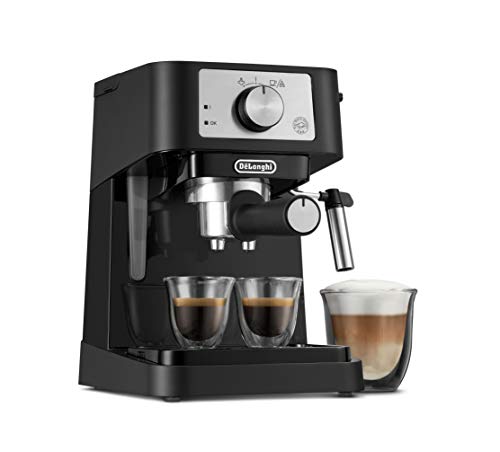
De'Longhi Stilosa EC260BK Espresso Machine
by De'Longhi
The best way to start pulling real espresso for under a hundred dollars -- a trusted brand, a true pump-driven shot, and a compact footprint make it the entry machine I point beginners toward.
Pros
- Crosses into real espresso at the lowest credible price here -- a metal portafilter, a steam wand, and a true pump-driven extraction rather than the pressurized capsule gimmicks of the under-100 segment
- De'Longhi is one of the most established names in home coffee, so it carries genuine brand reliability and parts availability no-name budget machines cannot match
- The compact eight-inch-wide body fits counters where a prosumer machine never would -- ideal for apartments, dorms, offices, or testing whether home espresso is a hobby you want to commit to
- The stainless steel boiler is durable and heats quickly for the price, and the included accessories let you pull your first shot the day it arrives
Cons
- The 51mm portafilter is the budget standard, and 51mm accessories are far less common than 54mm and 58mm, so the upgrade path is limited
- No temperature control or PID, so brew temperature drifts and you cannot dial in extraction with precision
- The build leans on lightweight plastic in places -- expect an entry machine rather than a lifetime purchase
Upgrade Pick: Philips 3200 Series LatteGo Fully Automatic Espresso Machine
The Philips 3200 LatteGo is for the buyer who has decided they do not want espresso to be a hobby — they just want excellent coffee and milk drinks on demand, every morning, with zero skill required. As a super-automatic it grinds, doses, tamps, and extracts entirely internally, so you load whole beans, press a button, and get a consistent shot every single time. That removes the dial-in skill a semi-automatic demands, which is liberating for a shared kitchen or a household where nobody wants to learn barista technique.
The feature that makes me actually recommend it over other super-automatics is the LatteGo milk system. I have cleaned a lot of milk-line machines, and the dirty secret of the category is that the ones with tubes and internal milk paths are a chore to clean, so people stop using the milk function entirely. LatteGo froths through two snap-together parts with no tubes at all and rinses under the tap in seconds — that is the difference between a milk machine you use daily and one you abandon after a month. Underneath, a ceramic burr grinder with twelve settings runs cooler and wears more slowly than steel, a quality choice Philips did not have to make at this tier, and five one-touch presets plus a two-year warranty round out a genuinely convenient package.
The tradeoffs are the ones inherent to super-automatics. Some owners find the coffee runs cooler than expected, which preheating the cup and a hot-water flush largely fix, and the machine needs a periodic deep-clean and descale cycle that is more involved than rinsing a portafilter — skip it and you shorten the brew unit’s life, so build the cleaning routine in from the start. The grinder is also a touch loud in a quiet kitchen. If convenience is your priority and you would rather press a button than chase an extraction, this is the upgrade that delivers.
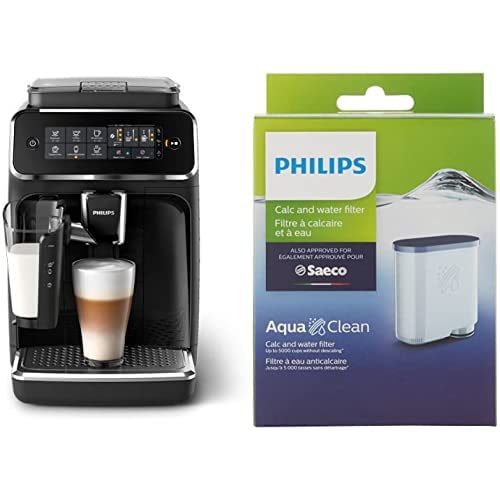
Philips 3200 Series LatteGo Fully Automatic Espresso Machine EP3241/54
by Philips
The best super-automatic for convenience -- bean-to-cup at the touch of a button with a no-tube LatteGo milk system clean enough to use every day, ideal for households that want espresso without the learning curve.
Pros
- Push-button espresso done genuinely well -- load whole beans, press a button, and it grinds, doses, tamps, and extracts internally for a consistent shot every time with none of the dial-in skill a semi-automatic demands
- The LatteGo milk system froths through two snap-together parts with no tubes to clean and rinses in seconds -- the no-tube design is the difference between using a milk machine daily and abandoning it
- A ceramic burr grinder with twelve settings is built in, and ceramic burrs run cooler and resist wear better than steel over years of daily grinding
- Five one-touch presets and a two-year warranty make it ideal for busy mornings and shared kitchens where no one wants to learn barista technique
Cons
- Coffee can run cooler than expected, common to super-automatics -- preheating the cup and running a hot-water flush first largely solves it
- It requires a periodic deep-clean and descale cycle that is more involved than rinsing a portafilter, and skipping it shortens the brew unit's life
- The grinder is audibly louder than the steel burrs on some competing super-automatics, noticeable in a quiet morning kitchen
Breville Bambino BES450BSS Espresso Machine
The Breville Bambino is the machine I recommend when counter space is tight but you still want real, skill-driven espresso. Its headline feature is the ThermoJet heating system, which reaches extraction temperature in roughly three seconds. That sounds like a minor convenience until you live with it — there is no five-minute warm-up standing between you and your first shot, so you actually reach for it on rushed mornings instead of defaulting to drip. For daily use, instant readiness changes the relationship you have with the machine.
The automatic steam wand is the Bambino’s second standout. Manual milk steaming is a skill that takes weeks to develop, and the Bambino’s assisted wand delivers café-grade microfoam with far less practice, letting a beginner build flat-white texture and pour basic latte art early. Because it uses the 54mm portafilter, it plugs straight into Breville’s deep accessory ecosystem — precision baskets, the Razor dosing tool, bottomless portafilters — so you have a real upgrade path as your technique grows. And Breville’s US service network is among the best in the category, which matters for a machine you intend to keep.
The honest caveats: some owners report steam wand reliability issues over time, so register the machine and stay within the service window, and there is no PID, so water temperature is not user-adjustable and you lose some extraction precision. Most importantly, there is no built-in grinder, so you must budget for a separate quality burr grinder — and since the grinder matters more to your cup than the machine, that is not a place to cut corners. Pair the Bambino with a capable grinder and you have a tiny, fast, surprisingly capable setup.
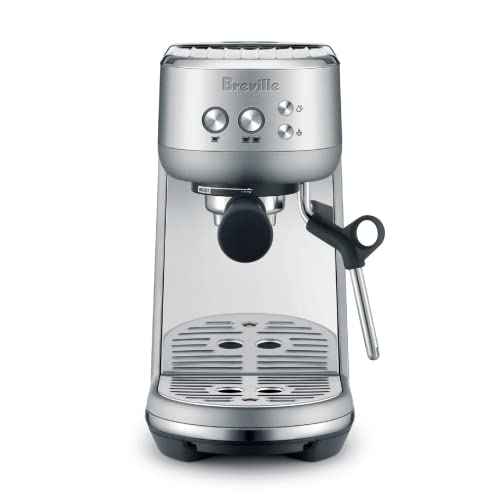
Breville Bambino BES450BSS Espresso Machine
by Breville
The best compact semi-automatic for small counters -- a three-second heat-up and an automatic milk wand deliver real café texture in a tiny footprint, ideal if you already own or plan to buy a separate grinder.
Pros
- The ThermoJet system reaches extraction temperature in about three seconds -- you walk up, it is ready, and there is no warm-up between you and your first shot, so you actually use it on busy mornings
- The automatic steam wand delivers café-grade microfoam with far less skill than a manual wand, letting beginners build flat-white texture and pour latte art
- It uses the 54mm portafilter and shares the deep Breville accessory ecosystem -- precision baskets, the Razor dosing tool, and bottomless portafilters are all readily available
- Breville's US service and parts network is among the best in home espresso, so support and replacements are easy to source years down the line
Cons
- Some owners report steam wand reliability issues over time, so register the machine and keep it within the service window
- No built-in grinder, so budget for a separate quality burr grinder -- and the grinder matters more to your cup than the machine, so do not skimp
- Water temperature is not user-adjustable, so you lose the fine extraction control a PID-equipped machine offers
Chefman Crema Deluxe Espresso Machine with Double Boiler
The Chefman Crema Deluxe is the value play for someone who wants grind-to-cup convenience and the ability to brew and steam at the same time without paying prosumer money. It pairs a built-in conical burr grinder with a 58mm professional-size portafilter, and it does something the rest of this lineup does not: it runs a genuine dual boiler. That 58mm detail matters more than it looks — 58mm is the commercial standard, so every basket, tamper, and bottomless portafilter you ever buy on this machine is the size professionals use, which sets you up well for any future upgrade.
The dual boiler is the headline. As I explain in the buyer’s guide below, separate boilers for brewing and steaming are normally a prosumer feature you pay a premium for, because they let you pull a shot and steam milk simultaneously instead of waiting for one boiler to climb between tasks. Finding that on an all-in-one at this price is genuinely unusual, and for a household making back-to-back milk drinks it is the fastest workflow here. The thirty-setting grinder feeds the portafilter directly for seconds-fresh grounds, and the large removable tank is among the biggest in this roundup — a real relief for anyone who resents the constant refill cycle of small-tank machines.
The reasons it lands as a strong runner-up rather than a top pick come down to precision and trust signals. There is no PID or temperature readout, so you dial in extraction by feel rather than against the repeatable numbers a temperature-controlled machine gives you, and the dual boiler plus built-in grinder make for a real countertop footprint — measure your space first. What reassures me here is the track record: this is an established brand carrying Amazon’s Choice status with over 3,200 owner reviews, which is a far deeper reliability signal than most all-in-one machines at this price can show. If simultaneous brewing and steaming in a grind-to-cup machine is what you want, the Crema Deluxe delivers a lot of capability for the money.
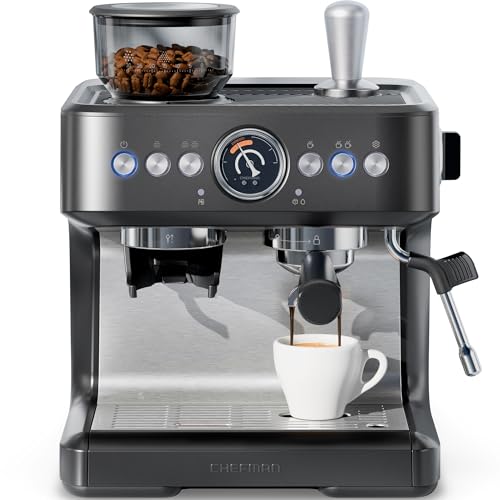
Chefman Crema Deluxe Espresso Machine with Double Boiler
by Chefman
The best value all-in-one for simultaneous brewing and steaming -- a dual boiler, a built-in 30-setting grinder, a 58mm commercial portafilter, and a large tank from an established brand with thousands of owner reviews.
Pros
- A genuine dual boiler lets you pull a shot and steam milk at the same time -- the fastest morning workflow here and a feature normally reserved for machines costing far more, which is what makes it an unusual value
- A built-in conical burr grinder with thirty settings grinds straight into the 58mm portafilter, so you get seconds-fresh grounds and the commercial-standard basket size in one grind-to-cup machine
- Amazon's Choice with over 3,200 owner reviews signals proven reliability and broad satisfaction -- rare for an all-in-one grind-to-cup machine at this price, where reliability is usually the gamble
- The large removable water tank is among the biggest here, so you refill far less often -- a real convenience for households pulling several drinks a day
Cons
- No PID or temperature readout, so you dial in extraction by feel rather than against precise, repeatable numbers
- The dual boiler and built-in grinder give it a real countertop footprint, so measure your counter depth and cabinet clearance before committing
CASABREWS CM5418 20 Bar Espresso Machine
The CASABREWS CM5418 is the smart pick for a learner on a tight budget who wants more than the entry tier offers without jumping to mid-range pricing. The standout is that it puts a 54mm portafilter on a machine priced barely above the cheapest options. Stepping up from 51mm to 54mm is a real upgrade — it opens a much wider accessory ecosystem and puts you on a basket size that serious home baristas actually use, which gives you somewhere to grow rather than a dead-end starter format.
What makes it genuinely instructive is the live pressure gauge on the front. Watching the needle climb during a shot is one of the fastest ways to learn what your grind is doing: too fine and the pressure spikes and stalls, too coarse and it never builds, and seeing that in real time teaches you to adjust far quicker than guessing from the shot alone. With Amazon’s Choice status and nearly 8,000 reviews, it has the sales velocity and broad satisfaction that suggest reliability at a price where reliability is usually the gamble, and the stainless construction and steam wand deliver real espresso and steamed milk without pressurized-pod shortcuts.
The tradeoffs are straightforward: there is no built-in grinder, so a separate burr grinder is a required purchase to get the most out of it, and CASABREWS is a value brand whose service and parts network is more limited than the legacy names. Neither is a dealbreaker at this price — they are simply the corners cut to deliver a 54mm machine with a pressure gauge this affordably. For a beginner who wants to learn extraction with real feedback on a budget, it is an excellent teaching tool.

CASABREWS CM5418 20 Bar Espresso Machine
by CASABREWS
The best near-budget machine with a pressure gauge -- a 54mm portafilter and a live pressure readout at barely above entry price make it a smart, instructive first machine for learners on a tight budget.
Pros
- Puts a 54mm portafilter on a machine barely above the entry tier -- moving up from 51mm opens a much wider accessory ecosystem and gets you onto a basket size serious home baristas actually use
- A live pressure gauge on the front lets you watch extraction pressure in real time -- seeing the needle climb tells you whether your grind is too fine or too coarse far faster than guessing from the shot
- Amazon's Choice status with nearly 8,000 reviews reflects high sales velocity and broad satisfaction at a price where reliability is usually the gamble
- Stainless steel construction and a steam wand deliver real espresso and steamed milk without the pressurized-pod shortcuts machines at this price often hide behind
Cons
- No built-in grinder, so a separate burr grinder is a required additional purchase to get the most out of it
- CASABREWS is a value brand with a more limited service and parts network than the legacy names, so factor that into a long-term decision
CASABREWS Ultra Espresso Machine with Temperature Control
The CASABREWS Ultra is the most quietly impressive machine in this roundup, and it carries the highest star rating here for a specific reason: it brings real temperature control to a machine priced under two hundred dollars. Its LCD lets you set the brew temperature directly, and as I keep returning to throughout this guide, temperature is one of the four levers of extraction and the one I can taste most clearly. Adjustable temperature is normally a prosumer feature, and having it this affordably means you can tune a shot the way a Q Grader would — cooler to brighten a dark roast, warmer to coax sweetness from a dense light roast.
The 58mm portafilter reinforces the value. Like the Chefman, it puts you on the commercial standard from day one, so every accessory you buy carries forward to any future machine, and you are practicing on pro-size gear rather than a format you will outgrow. The LCD does more than set temperature — it gives beginners concrete numbers for timing and temperature to adjust against, which replaces the vague feel-based guesswork that frustrates new baristas and meaningfully shortens the learning curve. Amazon’s Choice status and a 4.6 rating tell me early owners are pulling consistent, repeatable shots, which is exactly what that temperature control exists to deliver.
The honest caveats mirror the other CASABREWS machine. With only around 750 reviews it has the smallest owner base here, so the long-term reliability picture is still forming, and service and parts support trail the legacy brands. If you can accept a younger track record in exchange for prosumer-grade temperature control and a 58mm portafilter at this price, the Ultra gives a serious beginner extraction control that machines costing far more do not offer.
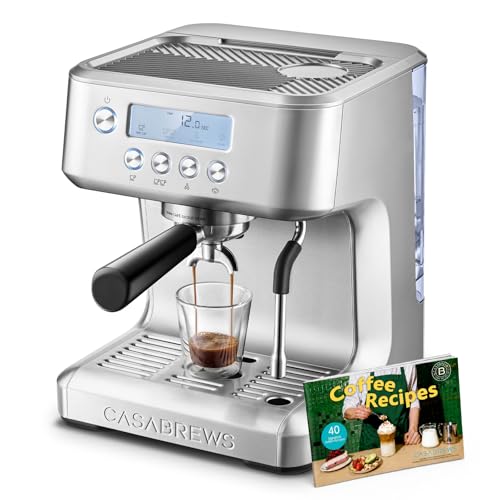
CASABREWS Ultra Espresso Machine with Temperature Control
by CASABREWS
The best sub-200 machine with real temperature control -- an LCD with adjustable brew temperature and a 58mm pro-size portafilter give serious beginners prosumer extraction control at a remarkably low price.
Pros
- The highest star rating in this roundup, driven by an LCD with adjustable brew temperature under two hundred dollars -- temperature control is normally a prosumer feature, and it lets you tune extraction the way a Q Grader would
- The 58mm portafilter is the commercial standard, so every accessory you buy carries forward to any future upgrade -- you are learning on pro-size gear from day one
- The LCD readout removes guesswork on timing and temperature, giving beginners concrete numbers to adjust rather than relying on feel, which shortens the learning curve
- Amazon's Choice status and a 4.6 rating signal early owners are getting consistent, repeatable shots -- exactly what the temperature control is designed to deliver
Cons
- With only around 750 reviews it has the smallest owner base here, so the long-term reliability picture is still forming and the troubleshooting community is thin
- As with the other CASABREWS machine, service and parts support lag behind the legacy brands, so weigh that against the strong feature set
Best Semi-Automatic Espresso Machine
A semi-automatic hands you the levers — grind, dose, and shot timing — while the pump does the pressure, which is the format most enthusiasts want because it rewards skill without demanding you learn a lever machine. These three cover the range from learn-the-craft flagship to compact daily driver to value pick with real temperature control.
| Product | Price | Buy |
|---|---|---|
| Breville Barista Express BES870XL Espresso MachineBest overall semi-automatic Built-in grinder plus true PID temperature control make it the most complete machine to learn on | $659.99 | View on Amazon |
| Breville Bambino BES450BSS Espresso MachineBest compact semi-automatic ThermoJet heat-up in about three seconds and an assisted steam wand in the smallest footprint here | $299.95 | View on Amazon |
| CASABREWS Ultra Espresso Machine with Temperature ControlBest value semi-automatic LCD temperature control and a 58mm portafilter for under $200 -- prosumer levers at a value price | $209.99 | View on Amazon |
Best Compact Espresso Machine
If counter space is the constraint, footprint decides the machine — but you should not have to give up a real pump-driven shot to save a few inches. These three keep a genuine espresso extraction in a body that fits an apartment, dorm, or office counter.
| Product | Price | Buy |
|---|---|---|
| Breville Bambino BES450BSS Espresso MachineBest compact overall Small footprint with a three-second heat-up and a 54mm portafilter's full upgrade path | $299.95 | View on Amazon |
| CASABREWS CM5418 20 Bar Espresso MachineBest ultra-slim value One of the slimmest bodies here with a 54mm basket and a learning-friendly pressure gauge | $118.99 | View on Amazon |
| De'Longhi Stilosa EC260BK Espresso MachineBest compact entry The eight-inch-wide entry machine that fits anywhere and still pulls a real pump shot | $92.16 | View on Amazon |
Best Espresso Machine with a Built-In Grinder
Grinding seconds before extraction is the highest-impact thing you can do for the cup, and an all-in-one guarantees it while saving counter space. Only two machines here pair the brew group with an integrated burr grinder — and they aim at different buyers.
| Product | Price | Buy |
|---|---|---|
| Breville Barista Express BES870XL Espresso MachineBest grind-to-cup overall A 16-setting conical grinder feeds a PID-stabilized 54mm group -- the complete learn-to-dial-in package | $659.99 | View on Amazon |
| Chefman Crema Deluxe Espresso Machine with Double BoilerBest dual-boiler grind-to-cup A 30-setting grinder plus a genuine dual boiler and 58mm basket to brew and steam at once for the money | $270.13 | View on Amazon |
Best Espresso Machine for Beginners
A good first machine makes real espresso approachable: a forgiving format, honest feedback while you learn, and a price that does not sting if the hobby does not stick. These three each teach in a different way.
| Product | Price | Buy |
|---|---|---|
| De'Longhi Stilosa EC260BK Espresso MachineEasiest budget entry The lowest-cost way into true pump espresso from a trusted brand with real parts support | $92.16 | View on Amazon |
| Breville Bambino BES450BSS Espresso MachineEasiest quality entry An assisted steam wand and instant heat-up make quality shots and microfoam approachable fast | $299.95 | View on Amazon |
| CASABREWS CM5418 20 Bar Espresso MachineBest learner with feedback A live pressure gauge turns every shot into a lesson in what your grind is doing | $118.99 | View on Amazon |
Best Budget Espresso Machine
You can pull genuine espresso — crema, steamed milk, and all — for well under $200 if you buy on the levers that matter and skip the ones that do not. These three are the best value at the bottom of the range, from cheapest-that-works to the most machine-per-dollar.
| Product | Price | Buy |
|---|---|---|
| De'Longhi Stilosa EC260BK Espresso MachineBest cheapest real espresso A true pump shot and steam wand at the lowest credible price, from an established brand | $92.16 | View on Amazon |
| CASABREWS CM5418 20 Bar Espresso MachineBest under $150 A 54mm portafilter and pressure gauge at a barely-above-entry price -- room to grow | $118.99 | View on Amazon |
| CASABREWS Ultra Espresso Machine with Temperature ControlBest under $200 Adjustable brew temperature and a 58mm basket that punch far above the price | $209.99 | View on Amazon |
Best Espresso Machines by Use Case
A few buyers want a specific machine type the sections above don’t headline — hands-free bean-to-cup, a manual-feel entry shot, or dual boilers for back-to-back milk drinks. Here is the best pick on this list for each.
| Product | Price | Buy |
|---|---|---|
| Philips 3200 Series LatteGo Fully Automatic Espresso Machine EP3241/54Best super-automatic (bean-to-cup) Loads whole beans and makes a one-touch milk drink with a no-tube LatteGo system that's actually clean enough to use daily | $668.99 | View on Amazon |
| De'Longhi Stilosa EC260BK Espresso MachineBest manual-pump entry A hands-on pump machine from a trusted brand -- the lowest-cost way to learn the manual espresso motions | $92.16 | View on Amazon |
| Chefman Crema Deluxe Espresso Machine with Double BoilerBest dual-boiler Separate brew and steam boilers pull a shot and texture milk simultaneously, a prosumer trick at an all-in-one price | $270.13 | View on Amazon |
How to Choose the Best Espresso Machine
Picking an espresso machine is really about matching the machine to how you want to spend your mornings. Below are the six factors I weigh on the cupping table and behind the group head, each one a lens that narrows the field toward the right machine for you.
Machine Type
Espresso machines fall into three families, and choosing the right one is the most consequential decision you will make. Semi-automatics like the Barista Express and the Chefman hand you control over grind, dose, and shot timing — they reward skill and let you chase the best possible cup, which is what most enthusiasts want. Fully automatic, or super-automatic, machines like the Philips 3200 grind, tamp, and brew internally at the touch of a button, trading control for effortless consistency, which is the right call for busy or shared households. Manual lever machines, not represented here, offer the most control but demand the most practice. Be honest with yourself about whether you want to learn a craft or simply want good coffee fast, because that one answer narrows the field faster than any spec sheet.
Boiler Type
The boiler governs temperature stability and how quickly you can move between brewing and steaming. A single boiler, standard across most machines here, heats for one task at a time, so you brew, then wait a few seconds while it climbs to steam temperature — a non-issue for a couple of drinks. Thermoblock and thermocoil systems like Breville’s ThermoJet heat on demand and hit temperature in seconds, a daily convenience that genuinely changes how often you use the machine. Heat exchangers and dual boilers allow simultaneous brewing and steaming with the tightest temperature control, but they cost considerably more. Unless you are making milk drinks for a crowd, a single boiler or a fast thermocoil is plenty — put the dual-boiler money toward a better grinder.
PID Temperature Control
Temperature is one of the four levers of extraction, and a PID circuit holds your brew water in a tight, repeatable window rather than letting it drift as the boiler cycles on and off. As a Q Grader I can taste a five-degree swing — too cool reads sour and underdeveloped, too hot reads scorched and bitter — and the real gift of a PID is repeatability. With temperature locked, you can change one variable at a time and learn from each shot, which is the entire basis of dialing in. The Barista Express includes a true PID, and the CASABREWS Ultra exposes adjustable temperature through its LCD. Entry machines skip it to hit their price and still make enjoyable coffee, but if your goal is to seriously learn extraction, make temperature control a priority.
Built-in Grinder vs Standalone
Freshly ground coffee is the highest-impact variable in your cup, because aromatics begin dissipating within minutes of grinding. A built-in grinder, as on the Barista Express and the Chefman all-in-one, guarantees seconds-fresh grounds and saves both money and counter space — the simplest, most reliable route to a great shot, and what I recommend for most people and nearly every beginner. The tradeoff is that an integrated grinder is usually not as capable as a dedicated standalone at the same total cost, and a grinder failure can sideline the whole machine. Committed long-term hobbyists may prefer a quality standalone grinder paired with a grinder-less machine like the Bambino, which delivers better grind quality and lets you upgrade each piece independently. Whatever you do, never pair a good machine with a cheap blade grinder — the grinder matters more to your cup than the machine does.
Steam Wand (manual vs automatic)
If you drink lattes, cappuccinos, or flat whites, the milk system deserves as much attention as the brew group. A manual steam wand, found on the Bambino, the Chefman, and the CASABREWS machines, gives you full control over milk texture and is how you learn to pour proper microfoam and latte art — but it takes real practice to master. An automatic or assisted wand delivers café-grade microfoam with far less skill, which is ideal for beginners. Super-automatics like the Philips 3200 go a step further with self-contained milk systems, and the LatteGo’s no-tube design is the rare one that is genuinely clean enough to use every day — the milk-line machines that are a hassle to clean are the ones people quietly abandon. Match the wand to an honest read of how much you want to practice steaming versus simply press a button.
Budget & Footprint
Set your budget across the whole system, not just the machine. If a machine lacks a grinder, fold a quality burr grinder into the total, because skimping there undermines everything else you spend. Entry machines like the De’Longhi Stilosa get you into real espresso affordably and compactly, which is ideal for apartments, offices, or simply testing whether the hobby sticks. Mid-range machines add temperature control, larger tanks, and pro-size portafilters. Prosumer grind-to-cup machines bundle a capable grinder and PID at a higher price. And do not overlook footprint, the spec people forget: measure your counter depth and your cabinet clearance before buying, because the larger machines will not tuck under a low upper cabinet, and a machine you have to wrestle out to use is a machine you eventually stop using.
Buyer's Guide
I have cupped on every roast level and pulled shots on machines from sub-100 starters to commercial groups, and these are the six factors that actually determine whether a home espresso machine earns its counter space.
Machine Type
Espresso machines fall into three families, and choosing the right one is the most important decision you will make. Semi-automatics like the Breville Barista Express and the Chefman put you in control of grind, dose, and shot timing -- they reward skill and let you chase the best possible cup, which is what most enthusiasts want. Fully automatic, or super-automatic, machines like the Philips 3200 grind, tamp, and brew internally at the touch of a button, trading control for effortless consistency -- the right call for busy households and anyone who does not want a hobby. Manual lever machines, not represented here, give the most control but demand the most skill. Be honest about whether you want to learn the craft or just want good coffee fast, because that single decision narrows the field more than any spec.
Boiler Type
The boiler determines temperature stability and how quickly you can move between brewing and steaming. A single boiler -- standard on most machines in this roundup -- heats for one task at a time, so you brew, then pause a few seconds while it climbs to steam temperature, which is a non-issue for a couple of drinks. Thermoblock and thermocoil systems like Breville's ThermoJet heat water on demand and reach temperature in seconds, which is a daily convenience worth real money. Heat exchangers and dual boilers allow simultaneous brewing and steaming and offer the tightest temperature control, but they cost considerably more. For most home setups, a single boiler or a fast thermocoil is plenty -- reserve the dual-boiler premium for high-volume milk-drink households.
PID Temperature Control
Temperature is one of the four levers of extraction, and a PID holds your brew water within a tight, repeatable window instead of letting it drift as the boiler cycles. As a Q Grader I can taste a five-degree swing: too cool reads sour and underdeveloped, too hot reads scorched and bitter. The real value of PID is repeatability -- with temperature locked, you can change one variable at a time and actually learn from each shot, which is the foundation of dialing in. The Barista Express includes a true PID, and the CASABREWS Ultra exposes adjustable temperature through its LCD. Entry machines skip it to hit their price and still make enjoyable coffee, but if you want to seriously learn extraction, prioritize a machine that controls temperature.
Built-in Grinder vs Standalone
Freshly ground coffee is the highest-impact variable in your cup, because aromatics start dissipating within minutes of grinding. A built-in grinder, as on the Barista Express and the Chefman all-in-one, guarantees seconds-fresh grounds and saves both money and counter space -- the simplest, most reliable path to a great shot, and what I recommend for most people and nearly all beginners. The tradeoff is that an integrated grinder usually is not as capable as a dedicated standalone at the same total cost, and a grinder failure can sideline the whole machine. If you are in for the long haul, a quality standalone grinder paired with a grinder-less machine like the Bambino delivers better grind quality and lets you upgrade each component independently. Either way, never pair a good machine with a cheap blade grinder -- the grinder matters more than the machine.
Steam Wand (manual vs automatic)
If you drink lattes, cappuccinos, or flat whites, the milk system matters as much as the brew group. A manual steam wand, found on the Bambino, the Chefman, and the CASABREWS machines, gives you full control over milk texture and is how you learn to pour proper microfoam and latte art -- but it takes practice to master. An automatic or assisted wand, like the Bambino's, delivers café-grade microfoam with far less skill. Super-automatics like the Philips 3200 go further with self-contained milk systems, and the LatteGo's no-tube design is the rare one that is genuinely clean enough to use daily -- milk-line machines that are a chore to clean get abandoned. Match the wand to your honesty about how much you want to practice milk steaming versus just press a button.
Budget & Footprint
Set your budget across the whole system, not just the machine -- if it lacks a grinder, factor in a quality burr grinder, because skimping there undermines everything else. Entry machines like the De'Longhi Stilosa get you into real espresso affordably and compactly, which is ideal for apartments, offices, or testing the hobby. Mid-range machines add temperature control, larger tanks, and pro-size portafilters. Prosumer grind-to-cup machines bundle a capable grinder and PID at a higher price. Footprint is the spec people forget: measure your counter depth and your cabinet clearance before buying, because the larger machines do not tuck under a low upper cabinet, and a machine you have to wrestle out to use is a machine you stop using.
The Verdict: Which Espresso Machine Should You Buy?
After weighing all seven on the levers that actually shape the cup, the Breville Barista Express BES870XL is my best overall pick for 2026. It hands you every variable that matters — an integrated grinder for seconds-fresh grounds, PID temperature stability for repeatable extraction, and the grind resolution to chase any roast level — and it backs that with the deepest support community in home espresso, so the learning curve is one you can actually climb. It is the machine I recommend to anyone serious about pulling café-quality shots at home. If your budget is tighter, the De’Longhi Stilosa is my budget pick and a genuinely smart entry point: a trusted brand, a true pump-driven shot, and a compact footprint that lets you discover the hobby before committing more. And if you would rather skip the craft entirely and just press a button for an excellent milk drink every morning, the Philips 3200 LatteGo is the upgrade that delivers convenience without the cleaning headaches that sink most super-automatics.
Whichever you choose, remember that the machine is only one link in the chain. Feed it a good grind from a quality burr grinder, pour freshly roasted beans through it, and keep it descaled, and even a modest machine will reward you. Browse our espresso machines category for more reviews, pair your pick with the right grinder, and explore our free brewing tools and calculators to dial in your ratios — because the best espresso machine is the one that fits how you actually want to make coffee, and any of these seven, matched to the right buyer, will earn its place on your counter.
Frequently Asked Questions
What is the best espresso machine for beginners?
What does '9 bars of pressure' mean -- and why do machines claim 15 or 20 bar?
Do I need a PID controller?
Single boiler vs dual boiler vs heat exchanger -- which should I buy?
Is an espresso machine with a built-in grinder worth it?
Semi-automatic or super-automatic -- which espresso machine should I buy?
Which espresso machine is best for lattes and cappuccinos?
Related Articles
7 Best Drip Coffee Makers of 2026
drip-pour-over
8 Best Coffee Grinders of 2026
coffee-grinders
How to Make Cold Brew Coffee: A Q Grader's Complete Guide
manual-brewers
How to Use a French Press: A Q Grader's Step-by-Step Guide
manual-brewers
How Much Caffeine Is in Espresso? A Q Grader Settles the Numbers
espresso-machines
About the Reviewer

Clara Bennett, CQI Q Grader, SCA Roaster
B.S. Food Science, UC Davis
Clara Bennett is a Coffee Quality Institute (CQI) licensed Q Grader and SCA-certified roaster with over a decade in specialty coffee — from competition barista to production roaster and green-coffee buyer. She has cupped thousands of coffees to CQI protocol and dialed in espresso on everything from $90 entry machines to commercial three-group setups. She founded Brew Gazette in 2026 to turn cupping-table standards into plain-English buying advice.