9 Best Espresso Grinders of 2026
CQI Q Grader and SCA roaster Clara Bennett ranks the 9 best espresso grinders of 2026 — dedicated single-dose, stepless, and flat-burr grinders tested for dial-in resolution, retention, and shot consistency, from a $109 hand grinder to grind-by-weight.
Updated
If you care about espresso, the grinder is where the shot is won or lost. As a Q Grader I can taste it before I taste the machine: espresso runs water through a dense puck under nine bars of pressure, and that pressure ruthlessly exposes an uneven or imprecise grind as a shot that is sour and bitter at the same time. A great machine cannot fix that; a great grinder makes a modest machine sing. So the honest priority for anyone chasing café shots at home is to spend on the grinder first.
What makes a grinder an espresso grinder, specifically, is not the same thing that makes a good drip grinder. Espresso needs a very fine grind, fine adjustment resolution to dial that grind in precisely, and low retention so your small, exact dose is accurate and fresh. I have chosen these nine to cover every kind of espresso buyer: the beginner who wants a forgiving on-ramp, the single-dose enthusiast rotating single-origins, the hand-grinder minimalist, and the buyer ready to invest in flat-burr clarity or grind-by-weight precision. The grinder is only half the setup, though — pair whichever you choose with the right espresso machine and freshly roasted espresso beans, because a great grind on stale beans is a wasted shot.
| Product | Price | Buy |
|---|---|---|
| Baratza Sette 30 Conical Burr Espresso GrinderBest Overall | $299.95 | View on Amazon |
| Baratza Encore ESP Espresso GrinderBudget Pick | $199.95 | View on Amazon |
| Eureka Mignon Specialita Espresso Grinder (55mm)Premium Pick | $549.00 | View on Amazon |
| MiiCoffee DF64 II Single-Dose Espresso Grinder (64mm Flat)Runner-Up | $399.00 | View on Amazon |
| Turin SK40 Single-Dose Espresso GrinderRunner-Up | $199.00 | View on Amazon |
| KINGrinder K6 Manual Espresso GrinderRunner-Up | $109.00 | View on Amazon |
| TIMEMORE C5 ESP Pro Manual Espresso GrinderRunner-Up | $92.00 | View on Amazon |
| Breville Smart Grinder Pro BCG820BSSRunner-Up | $199.95 | View on Amazon |
| Eureka Mignon Libra Grind-by-Weight Espresso GrinderRunner-Up | $799.00 | View on Amazon |
Find the Best Espresso Grinder for Your Need
Different setups want different grinders. Jump to the use case that fits how you actually pull shots:
- Overall best espresso grinders
- Best budget espresso grinder (under $200)
- Best single-dose espresso grinder
- Best espresso grinder for home
- Best espresso grinder for beginners
- Best espresso grinder with a built-in scale
How We Tested and Evaluated These Grinders
Every grinder in this roundup was selected against a consistent set of criteria: a verified, currently-live Amazon listing; real owner review volume; and genuine espresso capability, meaning it reaches a true espresso-fine grind with enough adjustment resolution to dial a shot in. I evaluated each on the variables that actually govern a shot — how fine and how uniform the grind is, how precisely you can adjust at the espresso end, how much coffee it retains between doses, and how repeatable the dosing is — and I weighed those against the shot quality owners report and my own sensory framework for what a balanced espresso should taste like across roast levels. I read owner feedback focused on retention, dial-in precision, dosing consistency, motor reliability, and long-term support, and I deliberately spread the picks across burr types, price tiers, and electric-versus-manual formats so a beginner, a single-dose enthusiast, and a budget hand-grinder buyer each find a clear answer. Grinders that cannot genuinely reach espresso, or that came from unverified sellers, were excluded.
Best Espresso Grinders Overall
These are the nine grinders I’d recommend without hesitation in 2026, each reviewed once below with its full strengths and tradeoffs. The best overall pick leads because it fits the most espresso setups; the use-case sections further down regroup these same grinders by how you actually pull shots.
Best Overall: Baratza Sette 30 Conical Burr Espresso Grinder
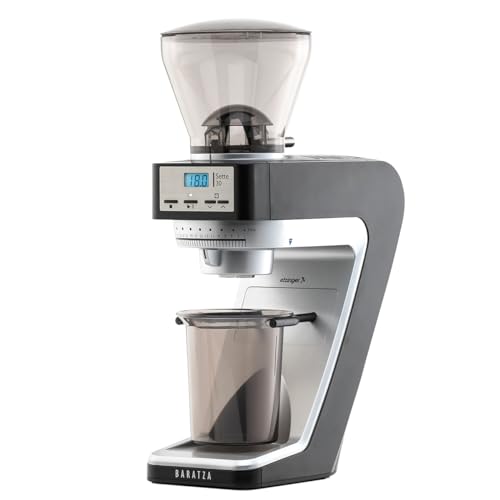
The Baratza Sette 30 earns the top spot because it nails the two things espresso demands most — low retention and real dial-in resolution — at a price that does not require flat-burr money. Its defining feature is the straight-through grind path: the inner burr stays fixed while the outer one spins, so grounds fall straight down into the portafilter with almost nothing left behind inside. Near-zero retention is exactly what espresso needs, because a few stale grams hiding in the chute both taint your next shot and throw your small, precise dose off by enough to change the extraction.
The detail I value most as a Q Grader is the macro-plus-micro adjustment. You set the broad grind zone with the 30 macro steps and then fine-tune with the micro ring, and that micro control is where espresso is actually dialed in — the tiny grind change between a shot that gushes sour and one that chokes bitter. Paired with a digital timer accurate to a tenth of a second, it lets you find your number and then pull repeatable shot after repeatable shot, which is the whole foundation of learning espresso: you cannot learn from a shot if the grinder shifted underneath you.
The honest tradeoffs are noise and materials. It is genuinely loud — owners joke about a tornado siren — though it only runs a few seconds per dose. And it leans on plastic gears that can wear after several years of daily use. But this is where Baratza separates itself: the gearbox is a cheap, user-swappable part, and the company’s US support routinely ships components free years past warranty, so a Sette gets repaired and kept rather than tossed. For the grinder I’d put behind most home espresso machines, this is the one.
Baratza Sette 30 Conical Burr Espresso Grinder
by Baratza
The best all-around dedicated espresso grinder for 2026 -- a low-retention straight-through design, genuine macro-plus-micro dial-in resolution, and Baratza's unmatched repairability make it the grinder I'd put behind most home machines.
Pros
- The straight-through grind path is the feature that makes this my overall pick: the outer burr spins while the inner one stays put, so grounds drop straight down into the portafilter with almost nothing left inside -- near-zero retention is exactly what espresso demands, because a few stale grams hiding in the chute taint the next shot and throw your dose off by enough to matter
- Macro plus micro adjustment gives you real espresso dial-in resolution -- you set the broad grind zone with the 30 macro steps and then fine-tune with the micro ring, which is how you land the tiny grind change between a shot that gushes sour and one that chokes bitter, all without buying up into flat-burr money
- It grinds fast, up to about five grams a second, and doses by a digital timer down to a tenth of a second, so once you find your number you pull repeatable shot after repeatable shot -- repeatability is the whole game in espresso, because you cannot learn from a shot if the grinder changed underneath you
- Baratza's US service network is the best in the category and owners prove it: burrs, gears, and motors are user-replaceable, and the company routinely ships parts free years past warranty -- this is a grinder people keep for a decade rather than replace
Cons
- It is genuinely loud -- more than one owner compares it to a siren -- though it only runs a few seconds per dose, so it is a morning annoyance rather than a dealbreaker
- The build leans on plastic gears that can wear after several years of daily use; the saving grace is that Baratza sells the gearbox as a cheap, swappable part rather than making you buy a new grinder
- The portafilter cradle leaves a little grind residue on the base, so expect a quick brush now and then
Budget Pick: Baratza Encore ESP Espresso Grinder
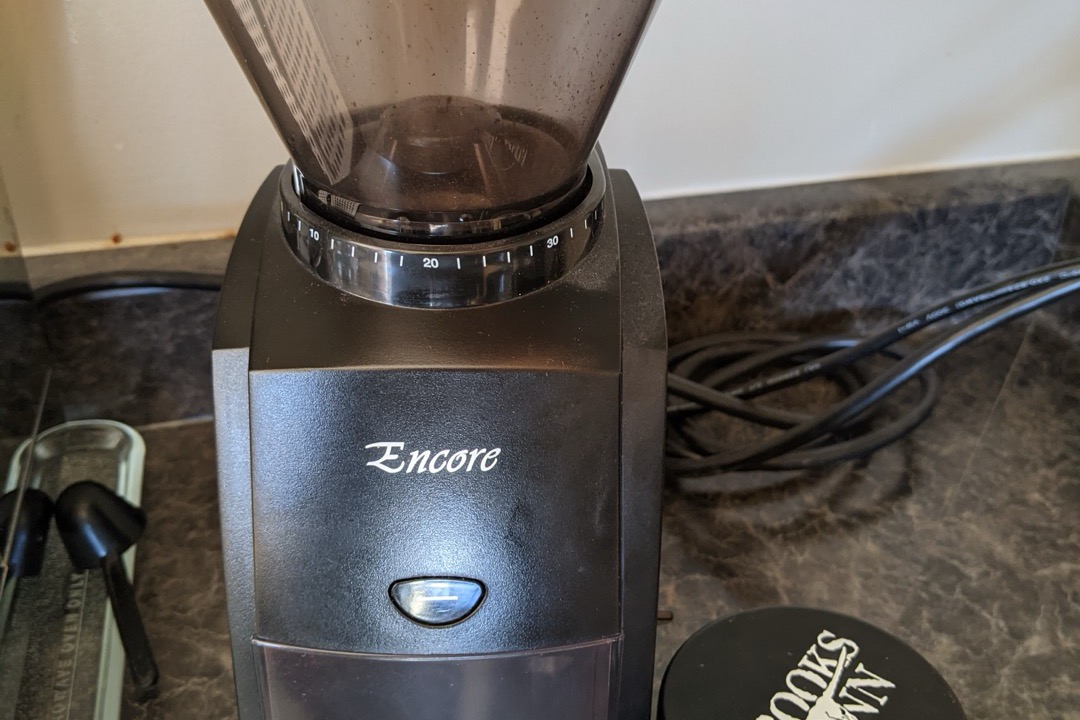
The Baratza Encore ESP is the grinder I point beginners toward when they want a real, name-brand espresso grinder without stretching past two hundred dollars. Baratza re-geared the classic Encore specifically so its fine end reaches true espresso — something the original could never do — so you get a genuine portafilter grinder from the most trusted name in the category for an entry price. With an Amazon’s Choice badge and well over a thousand owner reviews behind it, it is the safest first-grinder bet a new espresso drinker can make.
What makes it right for a beginner is how simple it is to live with. There is no touchscreen and no menu — just a hopper and a grind dial — which is exactly what you want while you are still learning to read a shot by taste rather than by spec sheet. The 40mm conical burr gives enough fine-end resolution to dial in a home machine, and because it is a Baratza, the burrs and internals are replaceable and backed by the same legendary US support, so a budget price does not come with a throwaway build.
Be clear on the compromises. The adjustment is stepped, not stepless, so at the very fine espresso end the jumps between settings are coarser than a dedicated stepless grinder — you can dial in a good shot, but the last increment of precision belongs to the pricier picks. And it is hopper-fed rather than single-dose, so a few grams retain and single-origin swaps are less clean. Neither disqualifies it; they are simply the corners cut to hit the price. As a first espresso grinder you will not quickly outgrow, it is the smart entry point.

Baratza Encore ESP Espresso Grinder
by Baratza
The best budget espresso grinder -- a genuine, espresso-capable Baratza with the trust and serviceability of the brand, for buyers who want a real portafilter grinder without stretching past $200.
Pros
- This is the least you can spend on a name-brand electric and still get a genuine portafilter grinder -- Baratza re-geared the classic Encore specifically so its fine end reaches true espresso, which the original never could, so you get the brand's trust and serviceability for the price of a good entry machine's grinder budget
- The 40mm conical burr and espresso-tuned adjustment give you enough fine-end resolution to dial in a home machine, and with an Amazon's Choice badge and well over a thousand owner reviews behind it, it is the safest first-grinder bet for a new espresso drinker
- It is refreshingly simple to live with -- no touchscreen, no menu, just a hopper and a grind dial -- which is exactly what a beginner wants while they are still learning to read a shot by taste rather than by spec sheet
- Like every Baratza it is built to be serviced, so the burrs and internals are replaceable and the same legendary US support stands behind it -- a budget price without the throwaway build that usually comes with one
Cons
- The adjustment is stepped, not stepless, so at the very fine espresso end the jumps between settings are coarser than a dedicated stepless grinder -- you can dial in a good shot, but the last increment of precision belongs to the pricier picks
- It is hopper-fed rather than single-dose, so a few grams retain in the machine and you cannot swap single-origins as cleanly as a bellows grinder
- The grinds catch some static and can cling in the bin; a light spritz of water on the beans before grinding settles it
Upgrade Pick: Eureka Mignon Specialita Espresso Grinder
The Eureka Mignon Specialita is the step up for the buyer who has decided espresso clarity is worth investing in. Its 55mm hardened-steel flat burrs are the reason: flat burrs force every particle through one identical gap, tightening the grind distribution, and in the cup that reads as clarity and sweetness — a cleaner, more articulate shot than a conical of the same price delivers. This is the classic route to a bright, modern espresso where you actually taste the distinct notes of a good single-origin.
The feature that makes me recommend it over other flat-burr grinders is the one Eureka built its whole reputation on. The sound-insulated case, packed with rubber mounts and gaskets, drops the grind noise enough that you can pull a shot before dawn without waking the house. Underneath, stepless multi-turn adjustment gives you near-infinite resolution at the espresso end, so you dial in by taste to exactly the grind a coffee wants, and a bottom-burr adjustment lets you pull the top burr to clean without losing your setting. The backlit touchscreen is the part you touch every morning: it holds timed single, double, and continuous doses, so grinding becomes press-and-walk-away rather than standing over a dial.
The tradeoffs are honest ones. It is hopper-fed rather than single-dose, so constant single-origin rotators will leave a few grams behind between beans, and the Amazon review base is still thin for the price — you are buying on Eureka’s long café reputation more than a deep track record. Owners also report that long back-to-back grinding can trip the motor’s thermal cutout, so it wants a pause between doses. At this price you are in serious-hobby territory, so it only makes sense if espresso clarity is genuinely what you are after. If it is, the Specialita delivers café-grade grind quality and near silence in one quiet Italian package.

Eureka Mignon Specialita Espresso Grinder (55mm)
by Eureka
The best upgrade pick -- an Italian 55mm flat-burr grinder whose clarity and near-silent operation justify the step up for anyone serious about the cup, with touchscreen timed dosing on top, as long as you are fine with a hopper rather than single-dosing.
Pros
- The 55mm hardened-steel flat burrs are the reason to step up here: flat burrs force every particle through one identical gap, tightening the grind distribution, and in the cup that reads as clarity and sweetness in the shot -- a cleaner, more articulate espresso than a conical of the same price delivers
- It is genuinely quiet, which is not a luxury feature so much as a daily-life one -- the sound-insulated case with rubber mounts drops the grind noise enough that you can pull a shot at 5am without waking the house, and Eureka built its whole reputation on it
- Stepless adjustment with a multi-turn worm gear gives you near-infinite fine resolution at the espresso end, so you dial in by taste to exactly the grind a coffee wants rather than settling for the nearest click
- The backlit touchscreen holds timed single, double, and continuous doses, so the daily workflow is press-and-walk-away rather than watching a dial -- and the bottom-burr adjustment means you can pull the top burr to clean without losing your grind setting
Cons
- It is hopper-fed, not single-dose, so if you rotate single-origins constantly you will leave a few grams behind between beans -- less ideal than a bellows grinder for the swap-every-bag crowd
- The review base is still thin for the price and the star average is the lowest of the Eureka pair here, so you are buying on Eureka's long café reputation more than on a deep Amazon track record
- Long continuous grinding can trip the motor's thermal cutout, which catches out owners expecting to run several doses back to back without a pause
MiiCoffee DF64 II Single-Dose Espresso Grinder
The MiiCoffee DF64 II is the grinder that turned single-dosing from a niche ritual into the enthusiast default, and it earns its place as the single-dose specialist here. Its 64mm flat burr is a genuine café-size grind engine at a home price — larger flats grind cooler and more uniformly than the smaller burrs above them, and the payoff is a shot with more separation and clarity. This is why the DF64 became the grinder people buy when they leave a hopper machine behind and want to hear what their beans actually taste like.
It is built for single-dosing from the ground up. You weigh in exactly the beans for one shot, a rubber bellows puffs the last grounds out, and retention lands under a tenth of a gram — so what you dose is what you brew, and yesterday’s bean never mixes into today’s. The stepless-style fine adjustment gives you the resolution to chase espresso precisely, and the platform is famously upgradeable: aftermarket SSP burrs drop straight in if you ever want to tune the flavor profile further. It ships with the bellows, dosing cup, and dosing ring, so it is a complete single-dose workflow out of the box.
The caveats are price and support. It costs more than the conical single-dose options, and that only makes sense if flat-burr clarity is something you will actually taste and want. Support also runs through a third-party importer on a one-year warranty rather than a Baratza-style domestic network, so factor that into long-term ownership. And single-dosing is a deliberately slower ritual — weigh, grind, puff, tap — so if you want to press and walk away, look elsewhere. For the enthusiast who rotates beans and wants café clarity, it is the one.

MiiCoffee DF64 II Single-Dose Espresso Grinder (64mm Flat)
by MiiCoffee
The best single-dose espresso grinder -- a 64mm flat-burr enthusiast favorite with near-zero retention and an upgrade path, for buyers who rotate beans and want café-grade clarity at home.
Pros
- The 64mm flat burr is a genuine café-size grind engine at a home price -- larger flats grind cooler and more uniformly than the 40-55mm burrs above them, and the payoff is a shot with more separation and clarity, which is why the DF64 became the community default for enthusiasts leaving hopper grinders behind
- It is built for single-dosing from the ground up: you weigh in exactly the beans for one shot, a rubber bellows puffs the last grounds out, and retention lands under a tenth of a gram -- so what you dose is what you brew, and yesterday's bean never mixes into today's
- The stepless-style fine adjustment gives you the resolution to chase espresso precisely, and the platform is famously upgradeable -- aftermarket SSP burrs drop straight in if you ever want to tune the flavor profile further
- It ships with the bellows, a dosing cup, and a dosing ring, so it is a complete single-dose workflow out of the box rather than a grinder you have to accessorize into usefulness
Cons
- It is pricier than the conical single-dose options, and the value only makes sense if flat-burr clarity is something you will actually taste and want
- Support runs through a third-party importer on a one-year warranty rather than a Baratza-style domestic network, so factor that into the long-term ownership picture
- Single-dosing is a deliberately slower ritual -- weigh, grind, puff, tap -- so if you want to press and walk away, a hopper grinder suits you better
Turin SK40 Single-Dose Espresso Grinder
The Turin SK40 is the value play for someone who wants true single-dose grinding without paying DF64 or Eureka money. It brings the two most-requested espresso features — near-zero retention and stepless adjustment — down to a budget price. A tilted base and rubber bellows push the grounds out so cleanly that owners repeatedly say what goes in is exactly what comes out, and that low-retention accuracy usually costs twice as much. For an espresso-first kitchen on a budget, that is the headline.
The adjustment is genuinely stepless, not stepped, so you get infinite fine-tuning at the espresso end for the same money as a stepped hopper grinder — that resolution is what lets you dial a shot in by taste rather than jumping past the sweet spot. The 40mm stainless conical burrs and all-aluminum body punch well above the price, and reviewers coming from plastic grinders describe it as the upgrade that finally made their espresso consistent. It carries the highest early rating of any electric grinder here and an Amazon’s Choice badge in its niche.
The reasons it lands as a strong value pick rather than the outright best come down to two things. Switching from espresso-fine to a coarse brew grind takes real effort because the gear-collar adjustment moves slowly — fine if you brew espresso almost exclusively, less so if you swap methods daily. And the review base is still small, so the long-term reliability picture is early. If espresso is nearly all you make and you want stepless single-dosing for the least money, the SK40 is a lot of grinder for the outlay.

Turin SK40 Single-Dose Espresso Grinder
by Turin
The best value stepless single-dose grinder -- bellows-driven near-zero retention and infinite adjustment at a price that usually buys a stepped hopper grinder, ideal for an espresso-first kitchen.
Pros
- It brings true single-dose, near-zero-retention grinding down to a budget price -- a tilted base and rubber bellows push the grounds out so cleanly that owners repeatedly say what goes in is exactly what comes out, which is the single most-requested espresso feature and usually costs twice as much
- The adjustment is genuinely stepless, not stepped, so you get infinite fine-tuning at the espresso end for the same money as a stepped hopper grinder -- that resolution is what lets you dial a shot in by taste rather than jumping past the sweet spot
- The 40mm stainless conical burrs and all-aluminum body punch well above the price; reviewers coming from plastic grinders describe it as the upgrade that finally made their espresso consistent
- It is compact and Amazon's Choice in its niche, with an early rating (4.6) that is the highest among the electric grinders here -- a lot of grinder for the outlay
Cons
- Switching from espresso-fine to a coarse brew grind takes real effort because the gear-collar adjustment moves slowly -- fine if you brew espresso almost exclusively, less so if you swap methods daily
- The review base is still small, so the long-term reliability picture is early -- you are betting on a strong start rather than years of data
- One or two owners call the grind dial slightly temperamental to set precisely, so budget a little patience during first dial-in
KINGrinder K6 Manual Espresso Grinder
The KINGrinder K6 is the grinder I recommend when someone wants espresso-grade grind quality for the price of a nice accessory. Reviewers who own electric single-dose grinders say it plainly: the K6’s shots hold their own against machines costing two and three times as much. The reason is structural — a hand grinder spends its whole budget on burrs and bearings instead of a motor and electronics, so you are paying for the parts that actually shape the shot.
Its external numbered adjustment is what makes it genuinely espresso-friendly rather than just capable. At 16 microns per click and 60 clicks per rotation, you can leave your espresso number, grind a coarser pour-over, and dial straight back to your exact shot setting with zero guesswork — the kind of repeatability that most hand grinders, with their unmarked internal dials, cannot offer. As a manual grinder it is single-dose by nature with essentially zero retention, it makes almost no noise, and a full-aluminum body with a dual-bearing axle eliminates the burr wobble that ruins consistency on cheap hand grinders.
The honest costs are effort and a couple of quirks. A fine espresso grind takes real physical work — expect a solid 45 seconds of firm cranking per dose, which is the trade for the price and grind quality, though it does accept a hex-shank drill if your wrist tires. The catch-cup threads can pack with fine grounds and get stiff, and the burrs are not individually replaceable, so this is a grinder you use hard rather than rebuild over decades. For the best manual espresso grind per dollar, it is the pick.

KINGrinder K6 Manual Espresso Grinder
by KINGrinder
The best manual espresso grinder for the money -- enthusiast-grade shots, external repeatable adjustment, and zero retention for the price of a tamper set, if you do not mind cranking.
Pros
- It delivers espresso-grade grind quality for the price of a nice accessory -- reviewers who own electric single-dose grinders repeatedly say the K6's shots hold their own against machines costing two and three times as much, because a hand grinder spends its whole budget on burrs and bearings instead of a motor
- The external numbered adjustment is the feature that makes it espresso-friendly: 16 microns per click and 60 clicks per rotation let you leave your espresso number, grind a coarser pour-over, and dial straight back to your exact shot setting with zero guesswork
- As a manual grinder it is single-dose by nature with essentially zero retention -- you grind exactly what you weighed in, nothing stales inside, and it makes almost no noise, so it is the right tool for an early riser or a small apartment
- The full-aluminum body and dual-bearing axle eliminate the burr wobble that ruins consistency on cheap hand grinders, and it even takes a hex-shank drill if your wrist tires of fine espresso doses
Cons
- A fine espresso grind takes real physical effort -- expect a solid 45 seconds of firm cranking per dose, which is the honest trade for the price and grind quality
- The catch-cup threads can pack with fine grounds and get stiff to twist off; a quick brush keeps them clean
- The burrs are not individually replaceable, so this is a grinder you use hard rather than rebuild over decades
TIMEMORE C5 ESP Pro Manual Espresso Grinder
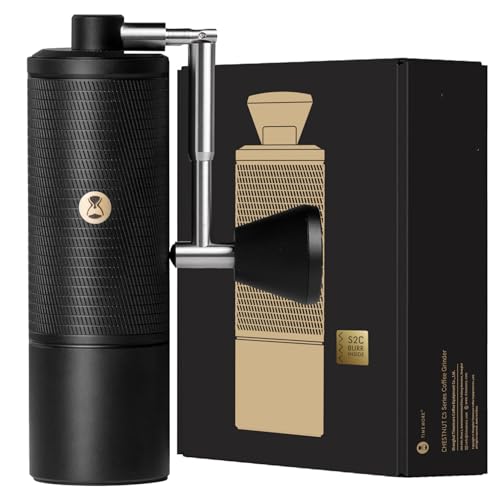
The TIMEMORE C5 ESP Pro is the hand grinder for the barista who dials in by taste and wants maximum precision in the palm of their hand. Unlike a general grinder that happens to reach fine, this one is engineered specifically for espresso: the S2C-042 burr paired with an adjustment pitch of just 0.015mm per click gives it finer espresso resolution than most manuals, which is exactly the micro-control a shot needs to move between sour and bitter in small, controllable steps.
Roughly 50 adjustment levels at that tiny per-click movement let you sneak up on the espresso sweet spot in increments a stepped electric grinder cannot match, so dialing in by taste is genuinely precise. The all-metal one-piece body and double-bearing axle keep the burr aligned for consistent particle size, and a folding handle makes it as at home in a suitcase as on the counter — true single-dose, zero retention, and near silent. Coming from a respected specialty brand with a deep accessory ecosystem, the build quality and finish sit a step above generic hand grinders at the price.
Owners agree with that read: on this year’s check the C5 ESP Pro carries the highest rating of any grinder in this roundup, electric or manual, and its review base keeps climbing — an encouraging trend for a grinder that was still new when I first tested it.
The caveats are modest. The 25-gram capacity handles one or two shots but means a second grind for anything larger, and because TIMEMORE sells several similar Chestnut models, you must confirm you are ordering the ESP Pro variant rather than a general-purpose sibling. Its review base is also smaller than the KINGrinder’s, so it is a slightly less-proven track record. If you want the finest manual dial-in resolution here in a pocketable grinder, the C5 ESP Pro is the precision pick.
TIMEMORE C5 ESP Pro Manual Espresso Grinder
by TIMEMORE
The best purpose-built espresso hand grinder -- finer micro-adjustment than nearly any manual at the price, in a pocketable all-metal body, for the barista who dials in by taste and values precision over sheer capacity.
Pros
- This is a hand grinder engineered specifically for espresso rather than a general grinder that happens to reach fine -- the S2C-042 burr and an adjustment pitch of just 0.015mm per click give it finer espresso resolution than most manuals, which is exactly the micro-control a shot needs
- Roughly 50 adjustment levels with that tiny per-click movement let you sneak up on the espresso sweet spot in increments a stepped electric cannot match, so dialing in by taste is genuinely precise
- The all-metal one-piece body and double-bearing axle keep the burr aligned for consistent particle size, and a folding handle makes it as at home in a suitcase as on the counter -- true single-dose with no retention, and near silent
- It comes from a respected specialty brand with a deep accessory ecosystem, so the build quality and finish are a step above generic hand grinders at the price
Cons
- The 25-gram capacity is fine for one or two shots but means a second grind for anything larger
- TIMEMORE sells several similar Chestnut models, so you must confirm you are ordering the ESP Pro variant and not a general-purpose sibling
- The review base is smaller than the KINGrinder's, so it is a slightly less-proven track record at this price
Breville Smart Grinder Pro (BCG820BSS)
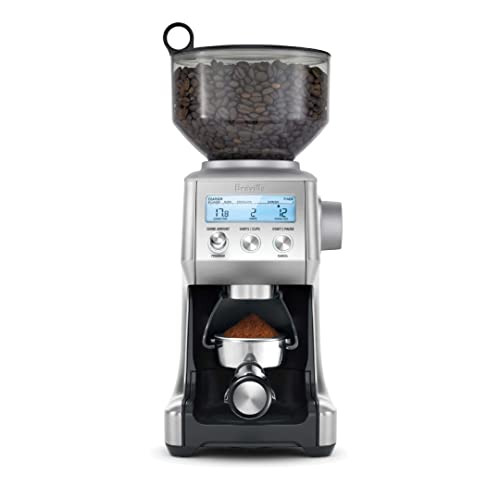
The Breville Smart Grinder Pro is the most beginner-friendly grinder in this roundup, and it is the one I hand to someone learning to dial in their first espresso machine. The reason is workflow: dual portafilter cradles let you grind hands-free straight into a 50-54mm or 58mm basket, and a dose-by-shots timer means a new barista gets a repeatable dose without owning a scale yet. That combination removes two of the most frustrating early hurdles — messy dosing and inconsistent grams — so you can focus on learning to read the shot.
Sixty stepped settings span from espresso-fine to French-press coarse with enough fine-end resolution to dial in a home machine, so one grinder covers your shots and the occasional pour-over while you learn what you like. And with more than seven thousand reviews, it has by far the deepest track record of any grinder here — its one known quirk, an occasional stall on dense, oily beans, has a well-documented pause-and-clear fix, so you are buying a known quantity rather than a gamble.
The tradeoffs are the ones inherent to a hopper grinder. It is not single-dose, so grounds retain in the chute and it is not the tool for cleanly rotating single-origins, and the catch container attracts static and clings — a light spritz on the beans or a tap settles it. The motor can also bog down on very oily dark roasts, manageable with the documented workaround. None of that undercuts its core strength: for a forgiving, proven on-ramp into espresso grinding, nothing here is easier to start with.
Breville Smart Grinder Pro BCG820BSS
by Breville
The most proven, most beginner-friendly on-ramp into espresso grinding -- a portafilter-cradle, dose-by-shots workflow with the deepest owner track record here, for anyone learning to dial in their first machine.
Pros
- It is the most beginner-friendly espresso grinder here by a wide margin: dual portafilter cradles let you grind hands-free straight into a 50-54mm or 58mm basket, and a dose-by-shots timer means a new barista gets a repeatable dose without owning a scale yet
- Sixty stepped settings span from espresso-fine to French-press coarse with enough fine-end resolution to dial in a home machine, so one grinder covers the shot and the occasional pour-over while you learn
- With more than 7,000 reviews it has by far the deepest track record of any grinder in this roundup, and its one known quirk -- an occasional stall on dense, oily beans -- has a well-documented pause-and-clear fix, so you are buying a known quantity
- The removable hopper and grind-by-shot workflow make it forgiving day to day, which is exactly what you want on the machine you are learning extraction on
Cons
- It is hopper-fed, not single-dose, so grounds retain in the chute and it is not the tool for cleanly rotating single-origins
- The catch container attracts static and clings; a light spritz on the beans or a tap settles it
- The motor can bog down on very oily dark roasts -- manageable with the documented workaround, but worth knowing if you live on espresso-roast beans
Eureka Mignon Libra Grind-by-Weight Espresso Grinder
The Eureka Mignon Libra is the splurge for the buyer who wants scale-accurate dosing built directly into the grinder. It is a true grind-by-weight machine: an internal load cell weighs the grounds as they fall and stops at your gram target, so instead of dosing by a timer that drifts as beans age and change density, you get the same weight in the basket every single shot. That is the most repeatable dose you can buy short of stopping to weigh on a separate scale — and repeatable dosing is the quiet foundation of repeatable espresso.
It stores two saved doses and grinds straight into the portafilter, which makes a two-drink household genuinely fast: press for your dose, press for your partner’s, no scale dance in between. And underneath the scale it is still a proper Eureka — 55mm hardened flat burrs, stepless multi-turn adjustment, and the same sound-insulated silent case — so the grind quality and quiet match the Specialita rather than being sacrificed to the gimmick. The bottom-burr adjustment holds your setting through cleanings, and an included dosing funnel keeps the workflow tidy.
The caveats are price and proof. It is the most expensive grinder here by a wide margin, so the grind-by-weight convenience has to be worth a real premium to you, and the review base is very thin — you are trusting Eureka’s reputation and the concept more than a deep owner track record. Grind-by-weight also adds a beat to each grind as the scale settles, trading a touch of speed for accuracy. If dosing to the gram every shot, hands-free, is what you want, the Libra is the grinder that builds it in.

Eureka Mignon Libra Grind-by-Weight Espresso Grinder
by Eureka
The best grind-by-weight espresso grinder -- a genuine load-cell that doses to the gram every shot, wrapped around Eureka's quiet 55mm flat-burr engine, for the buyer who wants scale-accurate dosing built in.
Pros
- This is a true grind-by-weight espresso grinder: an internal load cell weighs the grounds as they fall and stops at your gram target, so instead of dosing by a timer that drifts as beans age and change density, you get the same weight in the basket every single shot -- the most repeatable dose you can buy short of a separate scale
- It stores two saved doses and grinds straight into the portafilter, which makes a two-drink household genuinely fast: press for your dose, press for your partner's, no scale dance in between
- Underneath the scale it is still a proper Eureka -- 55mm hardened flat burrs, stepless multi-turn adjustment, and the same sound-insulated silent case -- so the grind quality and quiet match the Specialita, not just the gimmick
- The bottom-burr adjustment keeps your grind setting through cleanings, and an included dosing funnel keeps the weigh-and-grind workflow tidy
Cons
- It is the most expensive grinder here by a wide margin, so the grind-by-weight convenience has to be worth a real premium to you
- The review base is very thin, so you are trusting Eureka's reputation and the concept more than a deep owner track record
- Grind-by-weight adds a beat to each grind as the scale settles, so it trades a touch of speed for its dosing accuracy
Best Budget Espresso Grinder (Under $200)
You can pull genuine, well-dialed espresso for under two hundred dollars if you buy on the things that actually matter for a shot — fine adjustment and low retention — and skip the badge premium. These three are the best value at the bottom of the range, from a trusted electric to a stepless single-dose to the best hand grinder for the money.
| Product | Price | Buy |
|---|---|---|
| Baratza Encore ESP Espresso GrinderBest budget electric A genuine espresso-capable Baratza with the brand's trust and serviceability, the safest first grinder in this bracket | $199.95 | View on Amazon |
| Turin SK40 Single-Dose Espresso GrinderBest budget single-dose True stepless single-dose grinding with bellows near-zero retention at a price that usually buys a stepped hopper grinder | $199.00 | View on Amazon |
| KINGrinder K6 Manual Espresso GrinderBest budget manual Enthusiast-grade manual grind quality with external repeatable adjustment for the price of a tamper set | $109.00 | View on Amazon |
Best Single-Dose Espresso Grinder
Single-dosing is the espresso format for anyone who rotates beans or cares about dose accuracy — you weigh in one shot’s worth, and near-zero retention means what you dose is what you brew, fresh every time. These three cover the range from café-clarity flat burr to budget conical to a zero-retention manual.
| Product | Price | Buy |
|---|---|---|
| MiiCoffee DF64 II Single-Dose Espresso Grinder (64mm Flat)Best single-dose overall A 64mm flat burr with bellows retention under 0.1g, an upgrade path, and café-grade clarity for the committed enthusiast | $399.00 | View on Amazon |
| Turin SK40 Single-Dose Espresso GrinderBest budget single-dose Stepless conical single-dosing with near-zero retention at the lowest electric price here | $199.00 | View on Amazon |
| KINGrinder K6 Manual Espresso GrinderBest single-dose manual Zero retention by nature, silent, and portable -- genuine single-dose espresso grinding at hand-grinder money | $109.00 | View on Amazon |
Best Espresso Grinder for Home
A home espresso grinder should be quiet enough for early mornings, consistent enough to pull repeatable shots, and easy enough to live with day after day. These three are the ones I’d put on a home counter — an all-around best, a near-silent flat burr, and the most beginner-friendly of the bunch.
| Product | Price | Buy |
|---|---|---|
| Baratza Sette 30 Conical Burr Espresso GrinderBest all-around home Low-retention straight-through design plus macro-and-micro dial-in and legendary repairability -- the grinder for most home machines | $299.95 | View on Amazon |
| Eureka Mignon Specialita Espresso Grinder (55mm)Quietest home flat-burr A sound-insulated 55mm flat burr you can run before dawn without waking the house | $549.00 | View on Amazon |
| Breville Smart Grinder Pro BCG820BSSMost beginner-friendly home A portafilter-cradle, dose-by-shots workflow that is the easiest home grinder to learn on | $199.95 | View on Amazon |
Best Espresso Grinder for Beginners
A good first espresso grinder makes dialing in approachable: a forgiving workflow, a repeatable dose without extra gear, and a trusted brand behind it. These three each smooth the learning curve a different way.
| Product | Price | Buy |
|---|---|---|
| Breville Smart Grinder Pro BCG820BSSEasiest to learn on Grinds hands-free into the portafilter and doses by shots, so a new barista gets a repeatable dose without a scale | $199.95 | View on Amazon |
| Baratza Encore ESP Espresso GrinderSimplest trusted entry A no-menu hopper-and-dial Baratza that keeps first dial-in simple, from the most trusted brand | $199.95 | View on Amazon |
| Baratza Sette 30 Conical Burr Espresso GrinderBest beginner upgrade A low-retention single-dose step up for the beginner ready to grow into a more precise workflow | $299.95 | View on Amazon |
Best Espresso Grinder With a Built-In Scale
Dosing by weight is the most repeatable way to grind for espresso, because a timer slowly drifts as beans age while a scale target never does. Only one grinder here truly weighs its dose internally; the trusted alternative is a precise timed doser you spot-check with a scale.
| Product | Price | Buy |
|---|---|---|
| Eureka Mignon Libra Grind-by-Weight Espresso GrinderTrue grind-by-weight An internal load cell stops at your gram target for an identical dose every shot, with two saved doses and a quiet 55mm flat burr | $799.00 | View on Amazon |
| Baratza Sette 30 Conical Burr Espresso GrinderBest repeatable timed dosing No built-in scale, but a tenth-of-a-second timer and straight-through low retention make it the most repeatable timed doser here -- pair it with a cheap countertop scale | $299.95 | View on Amazon |
How to Choose the Best Espresso Grinder
Choosing an espresso grinder is really about matching the grinder to how you pull shots and how much you want to fuss. Below are the six factors I weigh on the cupping table and behind the machine, each a lens that narrows the field toward the right grinder for you.
Buyer's Guide
I taste espresso for a living, and I will say plainly what most grinder guides bury: for espresso, the grinder matters more than the machine. A great machine cannot rescue an uneven or imprecise grind, but a great grinder makes a modest machine pull beautiful shots. Espresso is also the most demanding grind there is, so the factors that barely matter for drip become decisive here. These are the six things I actually weigh when I judge an espresso grinder, ranked the way they shape the shot.
Burr Type & Size: Flat vs. Conical for Espresso
Burrs are the whole grinder; everything else is a way to spin them. For espresso, both the type and the size matter. A conical burr produces a slightly broader particle spread that reads as body and a forgiving, classic shot, and conical grinders are cheaper, more compact, and lower-retention -- the Baratza Sette and every hand grinder here are conical. A flat burr forces every particle through one identical gap for a tighter distribution and a cleaner, more articulate shot, and larger flats (the Eureka's 55mm, the DF64's 64mm) grind cooler and more uniformly, which is the classic route to a bright modern espresso. Bigger is not automatically better -- it is a flavor direction. Start with a good conical for a sweeter, more forgiving shot on a budget; move to a 55mm-plus flat burr when single-origin clarity is the point.
Adjustment: Stepless vs. Stepped, and Dial-In Resolution
This is the factor that separates an espresso grinder from a filter grinder. Espresso lives in a narrow grind band where a tiny change swings the shot from sour to bitter, so what you need is fine resolution right at the espresso end. Stepless grinders -- the Eureka Mignon, Turin SK40, and the manual grinders -- move continuously, so you can land on exactly the grind a coffee wants; this is the most precise way to dial in by taste. Stepped grinders click between fixed positions, which is fast and repeatable; the Sette's macro-plus-micro system and the Breville's 60 steps give plenty of espresso resolution, while a plain stepped budget grinder may jump too coarsely near the fine end. Do not buy on setting count alone -- a small stepless dial beats dozens of coarse-spread steps for shots.
Single-Dose vs. Hopper & Grind Retention
Retention is the coffee that stays stuck inside the grinder after grinding, and for espresso it matters twice over: those grams go stale and taint the next shot, and because espresso doses are small and precise, grams disappearing into the machine throw off your dose. Single-dose grinders -- the DF64 and Turin with bellows, the manual grinders by nature -- have you weigh in one shot's beans and leave almost nothing behind, which is ideal if you rotate single-origins or care about dose accuracy. Hopper grinders like the Encore ESP, Specialita, and Breville store beans on top and retain a little; they are more convenient for one house blend brewed daily. If you switch beans often, seek out single-dosing; if you brew one espresso blend forever, a hopper is simply easier.
Electric vs. Manual
A manual grinder is not a compromise for espresso -- it is a legitimate choice with real advantages. Hand grinders like the KINGrinder K6 and TIMEMORE C5 ESP Pro put their whole cost into burrs and a precise adjustment mechanism, so grind quality per dollar is exceptional, and they are silent, portable, and zero-retention by design. The cost is effort and capacity: a fine espresso grind takes firm cranking, and you grind one or two shots at a time. Electric grinders trade some grind-quality-per-dollar for speed and push-button ease, which matters if you make several drinks quickly or grind half-awake. Match it to your mornings: one or two considered shots and a love of quiet points to manual; volume and convenience point to electric.
Dosing: Timer, Grind-by-Weight & Consistency
How a grinder measures your dose is quietly one of the most important espresso features, because a repeatable dose is the foundation of a repeatable shot. Most grinders dose by time, and the catch is that grind time drifts as beans age and change density, so the same timer slowly delivers a different weight -- which is why a scale check keeps a timed grinder honest. Grind-by-weight grinders like the Eureka Mignon Libra weigh the grounds internally and stop at your gram target for identical doses every time, at a premium. In between, the Sette's tenth-of-a-second timer and the Breville's dose-by-shots system are repeatable enough for most home baristas. Decide how much you value hands-off, scale-accurate dosing versus a cheaper timer plus a countertop scale.
Build Quality, Support & Longevity
An espresso grinder is a daily machine with moving parts under load, so longevity is part of the value. Repairability is the quiet differentiator: Baratza's reputation rests on user-replaceable burrs, gears, and motors plus a real US service network that ships parts free years past warranty, which is why a Sette or Encore outlives grinders that cost more. Consider where support comes from -- a domestic network like Baratza's versus a third-party importer warranty on some enthusiast grinders -- because it shapes the ownership experience when something wears. Burr material matters less but is worth a glance: hardened steel holds its edge for years of espresso grinding. And basic build -- a metal burr carrier, double bearings that keep the burr from wobbling, a body that does not walk across the counter -- separates a grinder you love for a decade from one you quietly resent.
The Verdict: Which Espresso Grinder Should You Buy?
After weighing all nine on the variables that actually shape a shot, the Baratza Sette 30 is my best overall pick for 2026. Its straight-through, near-zero-retention design and macro-plus-micro dial-in give you the two things espresso demands most — an accurate, fresh dose and the fine resolution to nail extraction — and Baratza’s unmatched repairability means it stays on your counter for years. It is the grinder I’d put behind most home espresso machines. If your budget is tighter, the Baratza Encore ESP is my budget pick and a genuinely smart entry point: a real, espresso-capable, name-brand grinder for under two hundred dollars. And if you are chasing flat-burr clarity, the Eureka Mignon Specialita is the quiet upgrade that makes a good single-origin sing — or step up to the grind-by-weight Libra if scale-accurate dosing built in is what you want.
Whichever you choose, remember the grinder is the highest-leverage piece of your espresso setup, but not the only one. Pair it with the right espresso machine, pour freshly roasted espresso beans through it, and dial in patiently by taste — our free coffee grind size chart shows the fine micron range espresso targets and how to fix a shot that gushes or chokes. If you also brew filter coffee and would rather own one machine for everything, our best coffee grinder guide covers the all-purpose lane, and our free brewing tools and calculators help you lock in your ratios. Browse the full coffee grinders category for more — because the best espresso grinder is the one that fits how you actually pull shots, and any of these nine, matched to the right buyer, will earn its place next to your machine.
Frequently Asked Questions
Can I use any coffee grinder for espresso?
Do I really need a dedicated espresso grinder, or will an all-purpose one do?
Flat burr or conical burr for espresso -- which is better?
What is single-dosing, and does it matter for espresso?
Is a hand grinder good enough for espresso?
Do I need a grinder with a built-in scale (grind-by-weight)?
How many grind settings do I need for espresso?
Related Articles
About the Reviewer

Clara Bennett, CQI Q Grader, SCA Roaster
B.S. Food Science, UC Davis
Clara Bennett is a Coffee Quality Institute (CQI) licensed Q Grader and SCA-certified roaster with over a decade in specialty coffee — from competition barista to production roaster and green-coffee buyer. She has cupped thousands of coffees to CQI protocol and dialed in espresso on everything from $90 entry machines to commercial three-group setups. She founded Brew Gazette in 2026 to turn cupping-table standards into plain-English buying advice.