8 Best Hand Espresso Grinders of 2026
CQI Q Grader and SCA roaster Clara Bennett ranks the 8 best hand espresso grinders of 2026 — manual grinders judged on microns per click, burr size, and how honestly they dial in a shot, from an entry-level 38mm burr to a 48mm espresso-coated all-rounder.
Updated
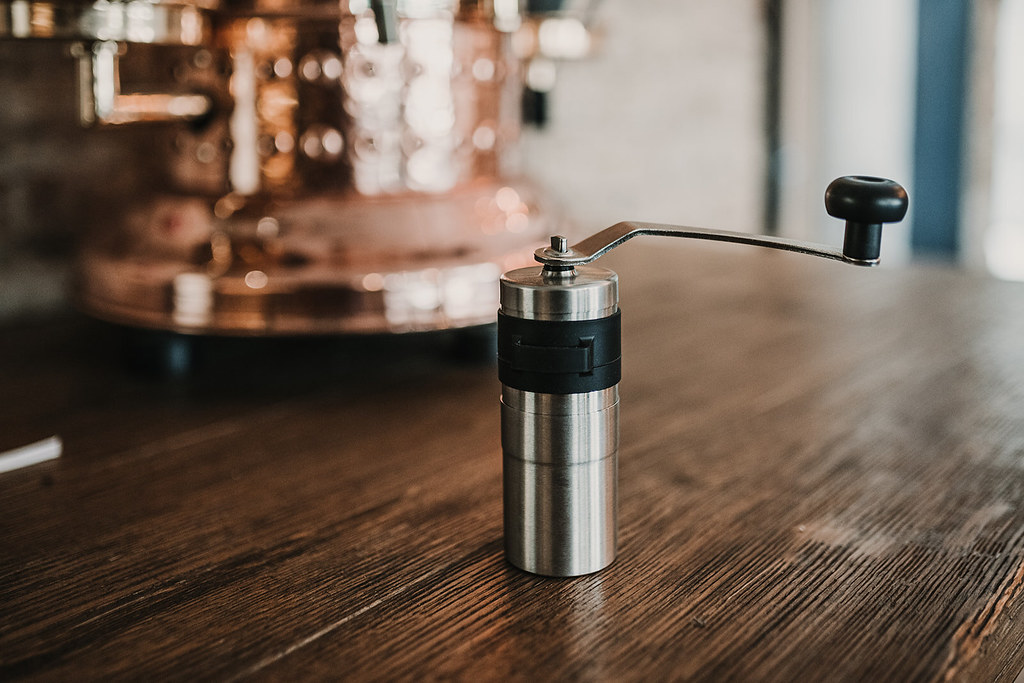
Hand grinders are the one corner of coffee gear where spending less can genuinely get you a better shot. An electric grinder puts most of its price into a motor, a housing, and a hopper. A hand grinder puts nearly all of its price into the burr set and the mechanism that moves it, and those two parts are what decide how espresso tastes. That is why a good manual grinder routinely out-grinds an electric at the same money for espresso, and it is why I keep recommending them to people setting up their first machine.
There is a second advantage that gets less attention. Hand grinders turn at roughly a hundred revolutions per minute, where electric grinders run several hundred or more, and slower grinding produces fewer fines. Fines are the dust that clogs a puck, causes water to channel through the path of least resistance, and gives you a shot that manages to taste sour and bitter simultaneously. Fewer fines is a real, tastable benefit, not a marketing line.
What separates a hand grinder that can pull espresso from one that cannot is narrower than most buyers expect, and it comes down to one number: how far the grind moves with each click of adjustment. I have ranked these eight on that number first, then on burr size, mechanism, and what owners report after a year of daily cranking. The grinder is only half the setup, though, so pair whichever you choose with the right espresso machine and freshly roasted espresso beans.
| Product | Price | Buy |
|---|---|---|
| 1Zpresso J-Ultra Manual Coffee GrinderBest Overall | $199.00 | View on Amazon |
| KINGrinder K2 Manual Coffee GrinderBudget Pick | $88.00 | View on Amazon |
| 1Zpresso K-Ultra Manual Coffee GrinderPremium Pick | $259.00 | View on Amazon |
| KINGrinder K6 Manual Coffee GrinderRunner-Up | $109.00 | View on Amazon |
| TIMEMORE C5 ESP Pro Manual Coffee GrinderRunner-Up | $92.00 | View on Amazon |
| TIMEMORE Chestnut C3 ESP Pro Manual Coffee GrinderRunner-Up | $79.08 | View on Amazon |
| 1Zpresso X-Ultra Manual Coffee GrinderRunner-Up | $159.00 | View on Amazon |
| TIMEMORE Chestnut C2S Manual Coffee GrinderRunner-Up | $75.00 | View on Amazon |
Find the Best Hand Espresso Grinder for Your Need
Different setups want different grinders. Jump to the case that matches how you actually pull shots:
- Overall best hand espresso grinders
- Best budget hand grinder for espresso
- Best hand grinder for espresso and pour over
- Best 1Zpresso for espresso
- The best hand espresso grinder from each brand
How I Chose and Evaluated These Grinders
Every grinder here was selected against the same criteria: a verified, currently-live Amazon listing sold new by the brand or an authorised seller; a real owner review pool rather than a handful of ratings; and genuine espresso capability, meaning it reaches a true espresso-fine grind with enough adjustment resolution to actually dial a shot in. I weighted published adjustment step size first, because that is the spec that decides whether you can correct a shot or only approximate one, then burr diameter and geometry, then the mechanism and bearing arrangement that determine whether a grinder holds its quality. I read owner feedback with a focus on thread wear, burr wobble, and how grinders behave after a year rather than a week, and I deliberately spread the picks across price tiers and adjustment styles so a first-time buyer and a light-roast obsessive each find a clear answer.
Two things got products excluded. Grinders with ceramic burrs did not make the list, because ceramic is too slow and too coarse in its particle distribution for a pressurised basket, regardless of what the listing claims. And I dropped one otherwise well-regarded grinder late in the process because its Amazon buy box was being served by a resale listing rather than new stock, which is not something I am willing to send a reader into.
Best Hand Espresso Grinders Overall
These are the eight I would recommend without hesitation in 2026, each reviewed once below with its full strengths and tradeoffs. The best overall pick leads because it fits the most espresso setups; the use-case sections further down regroup these same grinders by how you actually brew.
Best Overall: 1Zpresso J-Ultra Manual Coffee Grinder
The J-Ultra wins on a single number that matters more than any other on an espresso hand grinder: eight microns per click. That is the finest adjustment step on this list by a wide margin, and it is the difference between correcting a shot and guessing at it. When a shot runs two seconds fast, you want an adjustment small enough to fix exactly that much. With eight-micron steps you make that correction. With the twenty-three-micron steps at the bottom of this list, one click is bigger than the change you were trying to make, and you spend the morning oscillating between too fast and too slow.
The mechanism reinforces it. The adjustment ring sits on the outside of the body with printed numbers, so you change grind without taking anything apart and, more importantly, you can write your setting down and return to it exactly. That sounds trivial until you have lost a dialed-in setting because you counted clicks wrong reassembling an internal-adjustment grinder. And 1Zpresso coats the 48mm conical burr specifically for espresso rather than reusing their filter burr, which is genuine engineering rather than a badge — in the cup it reads as the rounder, sweeter mid-palate I look for in a shot.
The honest tradeoffs are money and muscle. The price buys no motor, so you are paying entirely for burr quality and adjustment resolution, which is the correct trade for espresso and a hard sell if you also wanted convenience. And the fine end takes work, noticeably more on a dense light roast. The espresso-coated burr is also tuned toward the fine end, so if you mostly brew filter and only occasionally pull shots, the K-Ultra below is the more sensible buy. But for someone whose main question is how to pull the best possible shot without buying a motor, this is the answer.

1Zpresso J-Ultra Manual Coffee Grinder
by 1Zpresso
The best hand espresso grinder for 2026 -- the finest adjustment step here at eight microns per click, an espresso-specific coated burr, and external numbered adjustment that makes a dialed-in setting genuinely repeatable.
Pros
- Eight microns per click is the finest adjustment step on this list, and that single number is why it wins: espresso lives in a grind band only a few dozen microns wide, so a grinder that moves in eight-micron increments lets you walk a shot from gushing to choking one deliberate click at a time instead of jumping past the setting you wanted
- The adjustment ring sits on the outside of the body with printed numbers, so you change grind without disassembling anything and you can write your setting down and return to it exactly -- internal-adjustment grinders make you pull the catch cup and count by feel, which is precisely how dial-in notes get lost
- 1Zpresso coats the 48mm conical burr specifically for espresso rather than reusing the filter burr, and in the cup that reads as the rounder, sweeter mid-palate I look for in a shot -- the burr geometry is doing flavor work here, not just size work
- The 40g magnetic catch cup snaps on and off in one motion and the handle folds flat against the body, so an eighteen-gram dose goes from beans to portafilter without the grinder tipping over or eating counter space between shots
Cons
- This is serious money for a grinder you power yourself, and it buys no motor -- you are paying entirely for burr quality and adjustment resolution, which is the right trade for espresso but a hard sell if you also want convenience
- The fine espresso end takes genuine effort: expect to work for an 18g dose, and noticeably harder on a light roast, because dense beans and a fine setting are the two things that make hand grinding a workout
- The espresso-coated burr is tuned toward the fine end, so if you mostly brew filter and only occasionally pull shots, the all-rounder burr in the K-Ultra is the more sensible buy
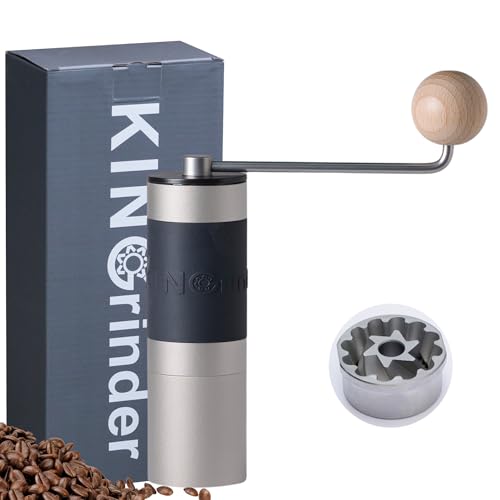
Budget Pick: KINGrinder K2 Manual Coffee Grinder
The K2 is the cheapest grinder here that steps under twenty microns per click, which is my threshold for trusting one with a portafilter, and the reason is that KINGrinder publishes a real number: eighteen microns per click across forty clicks per rotation. That is honest espresso resolution. Most grinders at this price offer a vague fine-to-coarse dial with no published step size, which is a reliable sign that nobody measured it, and it is why so many cheap hand grinders disappoint the moment you point them at a portafilter.
What makes the value work is where KINGrinder spent the money. The K2 carries a 48mm stainless burr set — the same burr diameter as the most expensive grinders here — inside an all-aluminium body with dual bearings holding the shaft true. Those are the parts that determine grind quality and how well the grinder ages. At 4.7 stars it is tied for the highest rating on this list, and it strips down by hand with no tools, which matters more on a manual grinder than an electric because you will be brushing burrs out constantly.
The corner that got cut is the adjustment location. It is internal, so you pull the catch cup and count clicks from a numbered nut inside rather than turning an external ring. It is workable and the numbering keeps it honest, but it is slower during dial-in than the external dials further up. Eighteen microns is also more than twice the J-Ultra’s step, so you land near your target rather than exactly on it — fine for most home machines, occasionally frustrating on a lever or a very light roast. And the 20g hopper is the smallest here, so grinding for two drinks means refilling. None of that changes the verdict: at the bottom of this list price range, this is a real espresso grinder.
KINGrinder K2 Manual Coffee Grinder
by KINGrinder
The best budget hand espresso grinder -- a 48mm burr set and genuine eighteen-micron adjustment steps for the least money of any grinder here that steps under twenty microns, with the internal adjustment being the only real corner cut.
Pros
- This is the cheapest grinder here that steps under twenty microns, which is my threshold for trusting one with a portafilter: KINGrinder lists it at eighteen microns per click across forty clicks per rotation, which is real espresso resolution rather than the vague fine-to-coarse dial that cheap hand grinders pass off as adjustment
- It carries a 48mm stainless burr set -- the same burr diameter as the most expensive grinders on this list -- because KINGrinder puts the money into the grinding parts and saves it on the adjustment mechanism and the handle
- The all-aluminium body and dual bearings keep the central shaft from wobbling under load, and shaft stability is what separates a consistent grind from a grinder that quietly widens its own particle spread as you crank
- At 4.7 stars it is tied for the highest rating on this list, and it strips down by hand with no tools for cleaning, which matters more on a hand grinder than an electric because you will be swapping beans in it constantly
Cons
- Adjustment is internal, so you pull the catch cup and count clicks from the numbered nut inside rather than turning an external ring -- workable, and the numbering keeps it honest, but slower than the external dials on the pricier picks
- Eighteen microns per click is more than twice the J-Ultra's step, so you land near your target grind rather than exactly on it -- for most home machines that is close enough, for a lever or a very light roast it can be frustrating
- The 20g hopper is the smallest here, which is fine for a single or double shot but means refilling if you grind for two drinks back to back
Premium Pick: 1Zpresso K-Ultra Manual Coffee Grinder
The K-Ultra is the grinder to buy if one hand grinder has to serve both a portafilter and a kettle, and its external dial is why. More than a hundred clicks in a single rotation means travelling from an espresso setting to a French press setting is one smooth turn, not a tedious count. That sounds like a convenience feature until you notice the behavioural effect: when switching is easy, you actually do it, and when it is a chore you quietly stop brewing filter and the versatility you paid for evaporates.
1Zpresso built this one around an all-round 48mm stainless conical burr rather than an espresso-coated one, and that geometry choice is deliberate. Filter brews get noticeably more clarity than they would through an espresso burr, while the grinder still reaches a true espresso fine. It ships with a hard carrying case, folds its handle flat, and takes the same 40g magnetic catch cup as the J-Ultra, so the grinder on your counter travels without rattling apart.
Be clear about what the premium buys. At twenty microns per click, the K-Ultra adjusts two and a half times more coarsely than the J-Ultra, so at the very fine end you have less room for a small correction. If you only ever pull shots, the J-Ultra dials in more precisely for less money, and I would not talk anyone out of that. It is also the heaviest and bulkiest grinder here, which is the price of the bigger burr and the case. What you are paying for is range and workflow, and for a household that pulls shots in the morning and brews filter in the afternoon, that is worth more than the last twelve microns of precision.

1Zpresso K-Ultra Manual Coffee Grinder
by 1Zpresso
The upgrade pick and the best one-grinder answer -- an all-round 48mm burr with the fastest coarse-to-fine dial here, for the household that pulls shots in the morning and brews filter in the afternoon.
Pros
- The external dial offers more than a hundred clicks in a single rotation, which is the fastest way on this list to travel from an espresso setting to a French press setting and back -- if one grinder has to serve both a portafilter and a kettle, this is the mechanism that makes switching painless rather than a chore you start avoiding
- 1Zpresso builds the K-Ultra around an all-round 48mm stainless conical burr rather than an espresso-coated one, and that geometry gives filter brews noticeably more clarity while still reaching a true espresso fine -- it is the honest one-grinder answer for a household that brews both
- It ships with a hard carrying case, folds its handle flat, and takes a 40g magnetic catch cup, so the grinder that lives on your counter is the same one that goes in a suitcase without rattling loose
- Twenty microns per click sounds coarse next to the J-Ultra until you notice how many clicks a single rotation gives you -- in practice you dial espresso quickly and land filter settings instantly, which is exactly the tradeoff an all-rounder should make
Cons
- It is the most expensive grinder here, and the premium buys range and workflow rather than a finer espresso step -- if you only ever pull shots, the J-Ultra dials in more precisely for less money
- Twenty microns per click is two and a half times the J-Ultra's increment, so at the very fine end you have less room to make a small correction without overshooting
- It is the heaviest and bulkiest of the 1Zpresso trio, which is the price of the bigger burr and the case -- a genuinely pocketable travel grinder this is not
KINGrinder K6 Manual Coffee Grinder
The K6 posts the best resolution-per-dollar figure on this list. Sixteen microns per click from an external adjustment nut, at a mid-list price, undercuts the J-Ultra’s step size by far less than the price gap between them would suggest. If you want the external-dial workflow and genuinely fine espresso adjustment but the top pick is more than you want to spend on something you crank by hand, this is the grinder.
The range is unusually generous too. Sixty clicks per rotation across four full rotations means the same grinder that pulls a ristretto also grinds coarse enough for cold brew, without fighting the mechanism at either extreme — a lot of espresso-focused grinders run out of usable adjustment before they get properly coarse. The 48mm seven-burr stainless set and dual bearings sit in an all-aluminium body, and the 25 to 35g hopper is generous enough to grind two drinks in one fill.
What gives me most confidence recommending it is the review depth. It has the largest feedback pool of any grinder here with external adjustment, and volume matters on a mechanical product: burr wobble, stripped threads, and misalignment are failures that only surface at scale, and they are not what owners are reporting. The tradeoffs are modest. The straight handle does not fold, so it packs less neatly and rolls around in a bag. Sixteen microns is fine but not the finest here, and on very light roasts you may wish for a smaller increment. And KINGrinder has no real service network, so a worn part likely means a new grinder rather than a repair.

KINGrinder K6 Manual Coffee Grinder
by KINGrinder
The value champion -- external sixteen-micron adjustment and a 48mm burr at a mid-list price, backed by a review pool approaching a thousand owners.
Pros
- Sixteen microns per click from an external adjustment nut, at a mid-list price, is the single best resolution-per-dollar figure here -- it undercuts the J-Ultra's step size by far less than the price gap between them would suggest
- Sixty clicks per rotation across four full rotations gives you an enormous usable range, so the same grinder that pulls a ristretto also grinds coarse enough for cold brew without you fighting the mechanism at either extreme
- It has the deepest feedback pool of any grinder here with external adjustment, and that volume matters on a mechanical product: wobble, thread stripping, and burr misalignment are failures that only surface at scale, and they are not what owners report
- The 48mm seven-burr stainless set and dual bearings sit in an all-aluminium body, and the 25 to 35g hopper is generous enough to grind for two drinks in one fill
Cons
- The handle is straight rather than folding, so it does not pack down as small as the 1Zpresso grinders and it will roll around in a bag
- Sixteen microns per click is fine resolution but not the finest here, and on very light roasts you may find yourself wishing for a smaller increment between two settings that both taste slightly wrong
- KINGrinder has no meaningful service network compared with the established names, so a worn part is more likely to mean a replacement grinder than a repair
TIMEMORE C5 ESP Pro Manual Coffee Grinder
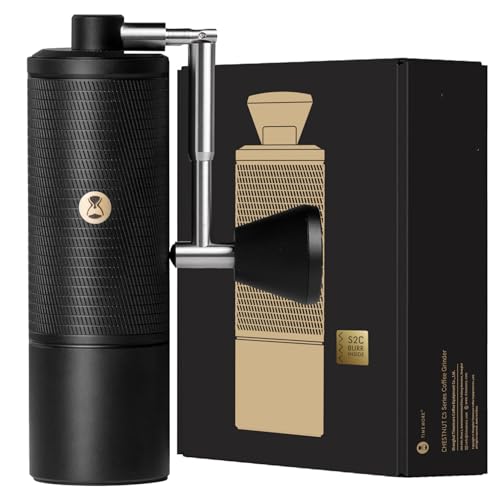
At fifteen microns per click, the C5 ESP Pro has the second-finest adjustment on this list, and the only grinder that beats it is the J-Ultra at more than twice the money. It exists because TIMEMORE recognised a real problem: the standard Chestnut grinders step too coarsely for shots, so they cut a dedicated ESP line to fix it rather than asking buyers to make do.
The burr is the substance behind that. The 42mm S2C-042-III is TIMEMORE’s patented espresso-specific set, not a rebadged filter burr, and the larger diameter over the 38mm burrs elsewhere in the Chestnut line means fewer turns of the handle for the same dose. Double-bearing central axis positioning keeps the burr running true under the load of a fine grind, and the flywheel effect — the handle keeps turning briefly after you let go — takes real work out of an espresso dose. TIMEMORE is also the most established of the value brands here, with a genuine warranty presence behind it and 302 reviews at 4.7 stars backing the spec sheet.
The catch is the adjustment location, and it is a real one. You unscrew the catch cup and turn a numbered nut to change grind, and with fifteen-micron steps you will be doing that a lot while dialing in a new coffee. Fine steps and internal adjustment is a slightly awkward pairing, because the grinder invites frequent small corrections and then makes each one a small disassembly. The handle also does not fold, and at 0.8kg it is heavy for its capacity. Buy it if precision matters more to you than workflow; buy the K6 if it is the other way around.
TIMEMORE C5 ESP Pro Manual Coffee Grinder
by TIMEMORE
The second-finest adjustment here for well under half the J-Ultra's price -- fifteen microns per click from an espresso-specific 42mm burr, if you can live with reaching inside the grinder to change it.
Pros
- Fifteen microns per click is the second-finest step on this list, and the only grinder here that adjusts more finely is the J-Ultra at more than twice the price -- TIMEMORE built the ESP models specifically to fix the coarse-stepping that made earlier Chestnut grinders frustrating for shots
- The 42mm S2C-042-III burr is TIMEMORE's espresso-specific patented set rather than a rebadged filter burr, and the larger diameter means fewer turns of the handle for the same dose than the 38mm burrs elsewhere in the Chestnut line
- Double-bearing central axis positioning keeps the burr running true under the load of a fine grind, and the flywheel effect means the handle keeps turning after you release it, which takes real work out of an espresso dose
- TIMEMORE is the most established of the value brands here with a genuine warranty presence, and at 4.7 stars across 302 reviews it has the review depth to back the spec sheet
Cons
- Adjustment is internal, so you unscrew the catch cup and turn a numbered nut to change grind -- with fifteen-micron steps you will be doing this often while dialing in a new coffee, and it is the one part of the workflow the external-dial grinders clearly beat
- The handle does not fold, so despite the compact body it packs less neatly than the foldable 1Zpresso and C3 ESP Pro grinders
- At 0.8kg it is on the heavy side for its capacity, which is comfortable on a counter and less so in a bag
TIMEMORE Chestnut C3 ESP Pro Manual Coffee Grinder
The C3 ESP Pro is the one I would actually pack. At 430 grams it is the lightest grinder here by a clear margin, the handle folds flat, and it still carries TIMEMORE’s patented S2C660 espresso burr rather than the standard filter set. Pair it with a portable espresso maker and you have a genuine travel espresso setup that fits in a corner of a bag, which is not something most grinders on this list can claim.
It also buys more grinder than the price suggests: an all-metal one-piece body, a CNC-machined stainless conical burr, and double bearings. TIMEMORE enlarged the body over the older C3, which makes it more comfortable to brace while cranking, and the 30g capacity is generous for the size, so a double shot fits in one fill with room to spare.
Now the honest part, because this is where the price shows. Twenty-three microns per click is the coarsest step of any espresso-branded grinder here, roughly three times the J-Ultra’s. You will get into the espresso range reliably, but landing on the precise setting a fussy light roast wants becomes as much luck as skill. Combine that with internal adjustment and you have the least pleasant dial-in experience among the espresso-specific picks on this list. The 38mm burr is also the smallest here, so an 18g dose takes more turns than the 42mm and 48mm grinders — the weight you save packing it, you spend cranking it. Buy this one for portability, and know that you are trading precision for it.

TIMEMORE Chestnut C3 ESP Pro Manual Coffee Grinder
by TIMEMORE
The lightest espresso-tuned grinder here at 430 grams with a folding handle -- the travel pick, provided you accept the coarsest adjustment steps of any espresso-branded grinder on this list.
Pros
- This is TIMEMORE's espresso-tuned Chestnut and the patented S2C660 burr set is the reason to buy it over the standard C3 -- the burr is cut for the fine end rather than adapted to it, which is why the same body produces a usable shot where the filter version struggles
- At 430 grams it is the lightest grinder on this list by a clear margin, and the handle folds, so this is the one I would actually pack for a trip with a portable espresso maker
- An all-metal one-piece body with a CNC-machined stainless conical burr and double bearings is a lot of grinder for the money, and the enlarged body over the older C3 makes it more comfortable to brace while cranking
- The 30g capacity is generous for the size, so a double shot fits in one fill with room to spare
Cons
- Twenty-three microns per click is the coarsest step of any espresso-branded grinder here, roughly three times the J-Ultra's -- you will get into the espresso range reliably, but landing on the exact setting a fussy light roast wants is a matter of luck as much as skill
- Adjustment is internal, and the combination of internal adjustment and coarse steps is the least pleasant dial-in experience among the espresso-specific picks
- The 38mm burr is the smallest here, so an 18g dose takes more turns of the handle than the 42mm and 48mm grinders -- the weight you save packing it, you spend cranking it
1Zpresso X-Ultra Manual Coffee Grinder
The X-Ultra is the sweet one. Its heptagonal burr uses seven cutting faces rather than the conventional conical geometry, and the profile it produces is smoother and sweeter — which is exactly what you want under milk. If your espresso mostly becomes a flat white or a cortado, this burr flatters that drink more than a burr optimised for bright single-origin clarity would.
It also brings the external-dial workflow down a price tier. Sixty steps per rotation from an external adjustment that 1Zpresso specifically redesigned to be easier to calibrate than their previous mechanism means you get K-Ultra-style convenience for meaningfully less. The slim body and folding crank make it the most genuinely portable of the three 1Zpresso grinders here, and 1Zpresso calibrates and fixes the burr in place at the factory, which is a real quality-control step — burr wobble developing over time is the most common way a hand grinder quietly degrades.
Two caveats keep it out of the top three. 1Zpresso positions the heptagonal burr toward pour-over and a light, sweet profile, so of their three grinders here this is the least espresso-focused; it pulls a good shot, but the J-Ultra’s coated burr is the one built for the job. And 1Zpresso publishes this one in steps per rotation rather than microns per click, which makes it genuinely harder to compare against the eight-micron J-Ultra or the fifteen-micron C5 ESP Pro. It sits between a cheaper grinder that adjusts more finely and a pricier one that is properly espresso-specific — a real pick for milk drinkers, an awkward one for anyone else.

1Zpresso X-Ultra Manual Coffee Grinder
by 1Zpresso
The sweet-profile all-rounder -- an external dial and a seven-faced burr that flatters medium roasts and milk drinks, for meaningfully less than the K-Ultra.
Pros
- The external adjustment gives sixty steps per rotation and 1Zpresso redesigned it specifically to be easier to calibrate than their previous external mechanism, so you get the external-dial workflow of the K-Ultra for meaningfully less
- The heptagonal burr is the distinctive part: seven cutting faces produce a smoother, sweeter profile that flatters medium roasts, and it is the burr I would choose if your espresso leans toward milk drinks rather than bright single-origin shots
- The slim body and folding crank make it the most genuinely portable of the three 1Zpresso grinders here, and the 25 to 30g magnetic catch cup covers any single or double dose
- 1Zpresso calibrates and fixes the burr in place at the factory, which is a real quality-control step -- burr wobble that develops over time is the most common way a hand grinder quietly degrades
Cons
- 1Zpresso positions the heptagonal burr toward pour-over and a light, sweet profile, so this is the least espresso-focused grinder of their three here -- it pulls a good shot, but the J-Ultra's coated burr is the one built for the job
- 1Zpresso publishes this one in steps per rotation rather than microns per click, which makes it harder to compare directly against the eight-micron J-Ultra or the fifteen-micron C5 ESP Pro
- It sits awkwardly between the cheaper K6 that adjusts more finely and the J-Ultra that is properly espresso-specific
TIMEMORE Chestnut C2S Manual Coffee Grinder
The C2S is the cheapest grinder here and the most thoroughly proven, and I want to be precise about what that does and does not mean. The lowest price here still buys a CNC-machined 38mm stainless conical burr with double-bearing positioning inside a full-metal unibody. Those are not corners cut in the places that matter, and 987 reviews at 4.6 stars is the deepest evidence base of any grinder on this list. TIMEMORE also fixed the one real complaint about the original C2 by moving to that metal unibody, so the plastic top cover that used to crack is simply gone.
What it is not is an espresso grinder. TIMEMORE does not market it as one, and its roughly 36 adjustment levels are far coarser than the ESP models. It will reach the espresso range — plenty of people pull shots with one — but expect to spend real time hunting the setting, and expect to land near your target rather than on it. There is no published micron figure, so you are counting levels by feel rather than dialing to a number you can write down and trust.
The other limit is throughput. A 25g capacity and a 38mm burr mean a double shot is a full hopper and a lot of turns. This is a grinder for one considered espresso a day, not a busy morning. I include it because it is the honest cheapest way into hand grinding, and because someone who mostly brews filter and occasionally pulls a shot is genuinely well served by it. Someone whose main use is espresso should spend a little more on the K2.

TIMEMORE Chestnut C2S Manual Coffee Grinder
by TIMEMORE
The cheapest and most-reviewed grinder here -- excellent build for the money, but a filter grinder pressed into espresso duty rather than one designed for it.
Pros
- This is the lowest price on this list and it still buys a CNC-machined 38mm stainless conical burr with double-bearing positioning -- the parts that actually cut coffee are not where TIMEMORE saved the money
- The C2S fixed the one real complaint about the original C2 by moving to a full-metal unibody, so the plastic top cover that used to crack is simply gone
- With 986 reviews at 4.7 stars it is the most thoroughly proven grinder here, and that matters at this price where corners usually do get cut somewhere structural
- The 52mm body is narrow enough to hold comfortably in a small hand, and the built-in bearing keeps the handle spinning after you release it, which takes some of the sting out of grinding fine
Cons
- TIMEMORE does not market the C2S as an espresso grinder and its roughly 36 adjustment levels are far coarser than the ESP models -- it will reach the espresso range, but expect to spend real time hunting the setting and to accept landing near your target rather than on it
- Adjustment is internal with no micron figure published, so you are counting levels by feel rather than dialing to a number you can write down
- The 25g capacity and 38mm burr mean a double shot is a full hopper and a lot of turns -- this is a grinder for one considered espresso a day, not a busy morning
Best Budget Hand Grinder for Espresso
You do not need to spend top-pick money to pull a good shot by hand, but you do need to spend it in the right place: a published adjustment step size fine enough to correct a shot, and a burr set large enough that grinding does not become a chore. These three are the best value at the bottom of the range, and they get progressively less espresso-specific as the price drops.
| Product | Price | Buy |
|---|---|---|
| KINGrinder K2 Manual Coffee GrinderBest budget overall A 48mm burr set and honest eighteen-micron adjustment -- the cheapest grinder here that steps under twenty microns | $88.00 | View on Amazon |
| TIMEMORE Chestnut C3 ESP Pro Manual Coffee GrinderBest budget for travel The lightest espresso-tuned grinder at 430 grams with a folding handle, if you accept coarser twenty-three-micron steps for the portability | $79.08 | View on Amazon |
| TIMEMORE Chestnut C2S Manual Coffee GrinderCheapest option Superb build and the deepest review pool at the lowest price here, but a filter grinder pressed into espresso duty rather than one designed for it | $75.00 | View on Amazon |
Best Hand Grinder for Espresso and Pour Over
If one grinder has to cover both a portafilter and a V60, the spec that matters shifts. You still need fine resolution at the espresso end, but now you also need to travel between espresso and filter settings quickly, and you want a burr geometry that does not sacrifice filter clarity to serve shots. All three of these adjust externally, which is what makes switching painless enough that you actually do it.
| Product | Price | Buy |
|---|---|---|
| 1Zpresso K-Ultra Manual Coffee GrinderBest dual-duty overall Over a hundred clicks per rotation makes espresso-to-French-press one smooth turn, and the all-round 48mm burr keeps filter clarity intact | $259.00 | View on Amazon |
| KINGrinder K6 Manual Coffee GrinderBest dual-duty value Sixteen-micron external adjustment across four full rotations of range covers ristretto through cold brew at a mid-list price | $109.00 | View on Amazon |
| 1Zpresso X-Ultra Manual Coffee GrinderBest for sweet, light profiles The heptagonal burr leans sweet and light, which flatters medium roasts on filter and milk drinks on espresso | $159.00 | View on Amazon |
Best 1Zpresso for Espresso
1Zpresso makes three grinders worth considering for espresso and they are genuinely different tools, which the shared Ultra naming obscures. The short version: the J is the espresso specialist, the K is the all-rounder, and the X is the sweet-profile portable. Buy on which burr matches your brewing, not on which model number is highest.
| Product | Price | Buy |
|---|---|---|
| 1Zpresso J-Ultra Manual Coffee GrinderBest 1Zpresso for espresso The espresso-coated 48mm burr and eight-micron clicks make this the most precise espresso grinder 1Zpresso sells | $199.00 | View on Amazon |
| 1Zpresso K-Ultra Manual Coffee GrinderBest 1Zpresso all-rounder The all-round K burr and a hundred-plus clicks per rotation for a household that brews espresso and filter equally | $259.00 | View on Amazon |
| 1Zpresso X-Ultra Manual Coffee GrinderBest 1Zpresso for portability A slim body, folding crank, and heptagonal burr tuned toward a light, sweet cup | $159.00 | View on Amazon |
The Best Hand Espresso Grinder From Each Brand
Plenty of people shop by brand, either because they already own something from the range or because a friend swears by one. Here is the grinder I would pick from each of the three brands on this list if espresso is your main use.
| Product | Price | Buy |
|---|---|---|
| 1Zpresso J-Ultra Manual Coffee GrinderBest 1Zpresso for espresso The finest adjustment step on this list at eight microns per click, with an espresso-specific coated burr | $199.00 | View on Amazon |
| TIMEMORE C5 ESP Pro Manual Coffee GrinderBest TIMEMORE for espresso Fifteen-micron steps from the patented 42mm espresso burr -- the finest adjustment TIMEMORE offers in a hand grinder | $92.00 | View on Amazon |
| KINGrinder K6 Manual Coffee GrinderBest KINGrinder for espresso Sixteen-micron external adjustment and a 48mm burr, backed by the deepest owner review pool of any grinder here with external adjustment | $109.00 | View on Amazon |
Hand Grinder or Electric for Espresso?
This is the question underneath every other one on this page, and it deserves a straight answer rather than a hedge. For the money, a hand grinder is frequently the better espresso grinder, for the structural reason that it spends nearly its whole budget on the burr set and adjustment mechanism while an electric spends much of its on a motor and housing. A hand grinder and an electric at the same price are not comparable machines, and the hand grinder usually wins on grind quality. The slower grinding speed helps too, producing fewer of the fines that cause a puck to channel.
What you trade is time and volume. An 18g dose takes thirty to ninety seconds of real effort, and light roasts are meaningfully harder than dark ones. You grind one or two shots at a time, and you cannot walk away mid-grind. That trade is easy to accept if you pull one or two considered shots a day and enjoy the ritual. It is a bad trade if you make several milk drinks in a rush before work, at which point the honest recommendation is an electric grinder and no guilt about it — our best espresso grinder guide covers that lane, and the best coffee grinder roundup is the place to start if you brew filter as well.
How to Dial In a Hand Grinder for Espresso
Find your zero point first: turn the adjustment fully closed until the burrs just touch, then back off. Every setting you record afterwards is measured from there, which is what makes a setting written in a notebook mean something. Espresso generally lives in the first fifteen to thirty percent of the range from zero, but do not chase a number you found online — burrs vary between individual grinders and beans vary far more.
Then dial in by taste rather than by spec. Pull a shot, time it, and use roughly a 1:2 ratio in 25 to 30 seconds as your starting frame. A shot that runs fast and tastes sour, thin, and sharp is under-extracted and wants a finer grind. A shot that crawls and tastes harsh, drying, and hollow is over-extracted and wants a coarser one. The skill worth building is separating those two, because they are opposite problems that both read as simply bad, and our coffee flavor wheel gives you the vocabulary to name what you are tasting instead of guessing. Our free coffee grind size chart shows the micron range espresso targets and how it compares with every other brew method.
One last practical trick. Fine grinds carry static and cling to the catch cup, then puff everywhere as you tip them into the portafilter. Stir a single drop of water into your beans before grinding — the Ross Droplet Technique — and the clinging largely stops. It costs nothing and it is the single biggest quality-of-life improvement available to a hand grinder owner.
How to Choose the Best Hand Espresso Grinder
Choosing a hand grinder for espresso is unusually rational, because with no motor or software in the way, the spec sheet genuinely predicts the cup. Below are the six factors I weigh, ordered the way they matter for shots specifically.
Buyer's Guide
I taste coffee for a living, and hand grinders are the one category where the spec sheet genuinely predicts what lands in the cup -- because there is no motor, no hopper, and no software in the way. What you are buying is a burr set, a mechanism to move it, and a bearing to hold it straight. That makes choosing one refreshingly rational, provided you weigh the right things in the right order. For espresso specifically, the ranking below is not the same one you would use for filter, and the factor most buyers lead with is the one I would put fourth.
Adjustment Step Size: The Spec That Decides Everything
This is the factor that separates an espresso hand grinder from a filter hand grinder, and it is the number I would buy on first. Espresso occupies a grind band only a few dozen microns wide, and inside that band a tiny change swings a shot from sour to bitter. So what you need is not a wide range but fine resolution at the fine end. Under roughly twenty microns per click you can make a real correction to a shot; above about thirty microns, a single click overshoots the adjustment you were trying to make and you end up oscillating. This is exactly why manufacturers now build espresso-specific variants -- TIMEMORE's ESP models exist because the standard Chestnut steps too coarsely for shots. One caution: brands publish this figure inconsistently, some in microns per click and some in steps per rotation, and independent testers have occasionally measured real step sizes finer or coarser than the marketing claim. Compare like with like, and treat a suspiciously precise number from an unknown brand with scepticism.
External vs. Internal Adjustment
External adjustment puts a numbered ring or dial on the outside of the grinder; internal adjustment hides a nut behind the catch cup. Neither is inherently more precise -- there are internal grinders here that adjust more finely than external ones -- so this is purely about how much friction sits between you and a grind change. That friction only bites during dial-in, which is when you are pulling several shots on a new coffee and adjusting between each one. An external dial makes that a two-second twist with the grinder assembled; internal adjustment makes it a small disassembly every time. If you rotate single-origins, external is worth real money. If you brew one blend for months, the setting gets written down once and you will barely notice.
Burr Size and Geometry
Burr diameter mostly buys you speed rather than quality on a hand grinder: a 48mm burr chews through an 18g espresso dose in appreciably fewer turns than a 38mm burr, which is why burr size is really an ergonomics spec in this category. Geometry is where flavor lives. A conical burr produces a slightly broader particle spread that reads as body and a forgiving, classic shot. Manufacturers increasingly cut espresso-specific burrs -- 1Zpresso coats the J-Ultra's, TIMEMORE cuts the S2C sets for the fine end -- and these genuinely taste different from a filter burr pushed fine, typically rounder and sweeter through the middle of the palate. The heptagonal and multi-face burrs in the X-Ultra and K-series lean sweeter and lighter, which flatters milk drinks and medium roasts. And steel over ceramic is not a close call for espresso: ceramic is slower and does not produce the uniform fine particles a pressurised puck demands.
Bearings and Shaft Stability
This is the factor almost nobody shops on and the one that determines whether your grinder still grinds well in three years. The burr shaft is under real side load when you crank at an espresso setting, and if it can wobble even slightly, the gap between the burrs varies as it turns -- which widens your particle distribution in exactly the way that causes channeling. Double or triple bearing arrangements, which every grinder on this list uses, are what keep the shaft true under that load. Factory burr calibration is the related quality signal: 1Zpresso fixes and calibrates the burr in place before shipping, which is a real manufacturing step and a reason their grinders hold their grind quality. When a cheap hand grinder degrades, this is almost always what degraded.
Grind Effort and Capacity
Espresso is the finest grind you will ever ask a grinder for, and on a hand grinder you supply the power, so effort is a genuine buying factor rather than an afterthought. An 18g dose runs somewhere between thirty and ninety seconds depending on burr size, roast density, and how fine you are grinding -- and a light roast at an espresso setting is the hardest combination there is. Bigger burrs cut that time meaningfully. So does a flywheel effect from good bearings, where the handle keeps turning after you release it. Capacity matters alongside it: a 20 or 25g hopper holds one double shot and no more, so if you routinely make two drinks you will be refilling mid-workflow. If effort is your main hesitation, prioritise burr diameter over adjustment fineness -- you will use the grinder more, which matters more than the last few microns of precision.
Retention, Static, and Cleaning
Hand grinders have a structural advantage here that no electric can match: with no chute, no hopper, and a burr assembly you can take apart with your fingers, retention is close to zero by design. That matters more for espresso than any other brew method, because doses are small and precise, so a couple of grams of yesterday's coffee hiding inside both stales your shot and throws your dose off by enough to change the extraction. Static is the remaining nuisance -- fine grinds cling to the catch cup and puff out when you tip them into the portafilter. The fix is free and takes a second: spritz or stir a single drop of water into your beans before grinding, a trick known as the Ross Droplet Technique, and the clinging largely stops. Look for a grinder that disassembles without tools, because you will be brushing the burrs out far more often than you would on an electric.
The Verdict: Which Hand Espresso Grinder Should You Buy?
After weighing all eight on the specs that actually shape a shot, the 1Zpresso J-Ultra is my best overall pick for 2026. Eight microns per click is the finest adjustment on this list by a wide margin, the external numbered ring means a dialed-in setting is genuinely repeatable, and the espresso-coated 48mm burr is engineered for the fine end rather than adapted to it. It is the hand grinder I would put behind most home machines. If your budget is tight, the KINGrinder K2 is the budget pick and a real espresso grinder, with a 48mm burr set and an honest eighteen-micron step that most grinders at its price cannot claim. And if one grinder has to do everything, the 1Zpresso K-Ultra is the upgrade worth making, trading twelve microns of precision for the fastest coarse-to-fine dial here.
Whichever you choose, remember that a hand grinder rewards patience more than any other piece of coffee gear. Find your zero point, write your settings down, and adjust by taste. Pair it with the right espresso machine and freshly roasted espresso beans, and use our free brewing tools and calculators to lock in your ratios. Browse the full coffee grinders category for more, because the best hand espresso grinder is the one whose adjustment step matches how precisely you want to chase a shot — and any of these eight, matched to the right buyer, will earn its place next to your machine.
Frequently Asked Questions
Can you actually use a hand grinder for espresso, or do you need an electric one?
How many microns per click do I actually need for espresso?
Should I get external or internal grind adjustment?
What grind setting should I start at on a hand grinder for espresso?
How long does hand-grinding an espresso dose take?
Related Articles
About the Reviewer

Clara Bennett, CQI Q Grader, SCA Roaster
B.S. Food Science, UC Davis
Clara Bennett is a Coffee Quality Institute (CQI) licensed Q Grader and SCA-certified roaster with over a decade in specialty coffee — from competition barista to production roaster and green-coffee buyer. She has cupped thousands of coffees to CQI protocol and dialed in espresso on everything from $90 entry machines to commercial three-group setups. She founded Brew Gazette in 2026 to turn cupping-table standards into plain-English buying advice.