AeroPress vs. French Press: A Q Grader Explains Which One Belongs on Your Counter
CQI Q Grader Clara Bennett compares AeroPress vs. French press with real numbers: 500-700 vs 1,000-1,400 micron grind, 90 seconds vs 4 minutes, 18-22% yield, and why paper filters change the chemistry.
Updated
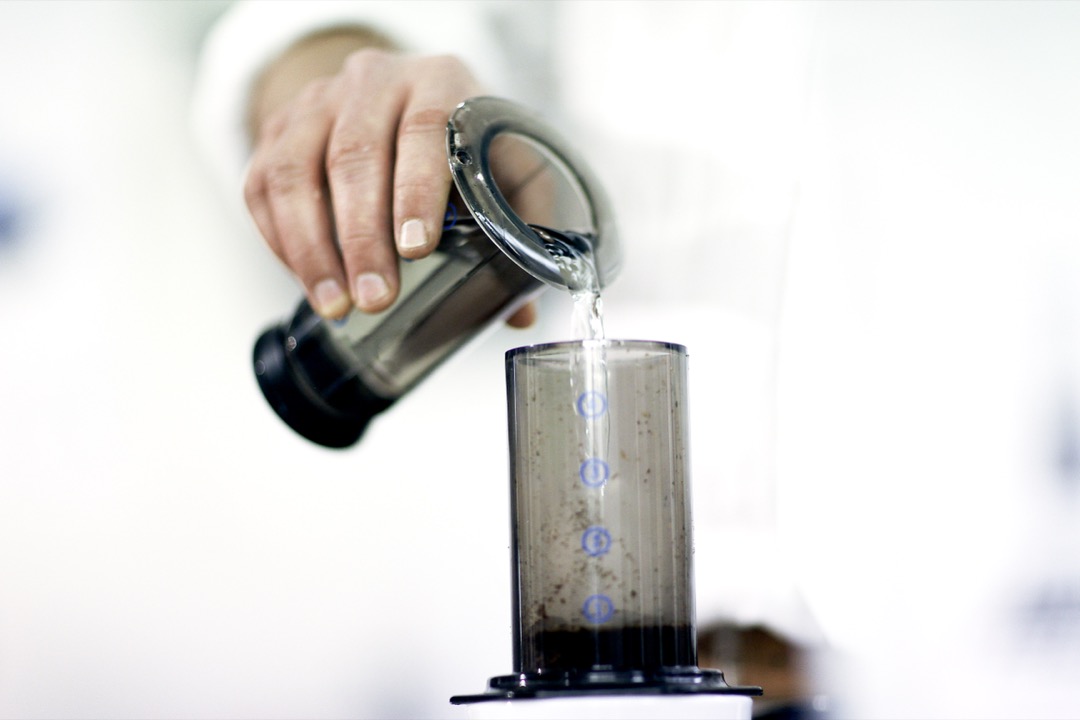
These two brewers sit at opposite ends of the same shelf in every coffee shop I walk into, and most people buy one for reasons that have nothing to do with how it works. The AeroPress gets bought because it is small and someone won a competition with it. The French press gets bought because it looks good on a counter and requires no instructions.
The real difference is mechanical. A French press is a full immersion brewer that separates coffee from water with a metal mesh, so every particle steeps in every drop for the same four minutes and the oils and finest particles end up in your cup. An AeroPress is a short-contact brewer finished with air pressure and a paper microfilter, so contact time compresses to a minute or two and the paper strips the oils and the fines on the way through. Everything you can taste follows from those two sentences.
I hold a CQI Q Grader credential and spend my working weeks scoring coffee on a cupping bench, which mostly means measuring what dissolved into the water and then arguing about what it tastes like. So I will answer this the way I would at the table: grind sizes in microns, extraction yields as percentages, filter pore sizes, and a straight account of what paper does to coffee chemistry that metal does not.
The Quick Answer
- The French press is an immersion brewer with a metal mesh. All the coffee steeps in all the water for about 4 minutes, and the mesh passes both oils and fine particles into the cup.
- The AeroPress is a short-contact brewer with a paper microfilter. Total brew time is typically 60 to 120 seconds, and the paper holds back oils and sub-100-micron fines.
- Grind size is a consequence, not a preference. French press wants coarse, roughly 1,000 to 1,400 microns. AeroPress wants medium-fine, roughly 500 to 700 microns.
- Both land in the same extraction band, 18 to 22% yield at roughly 1.15 to 1.35% TDS, the SCA Gold Cup target, by different routes.
- Filter chemistry is the whole flavor story. Paper traps the lipid fraction, including the diterpenes cafestol and kahweol. Metal mesh does not.
- Body vs. clarity. French press gives weight and a long finish. AeroPress gives transparency, brightness, and no grit.
- Capacity is the practical tiebreaker. An AeroPress brews about one cup per pass. An eight-cup French press brews about 34 oz at once.
- Both are entry-level purchases. The grinder costs more than either brewer and matters more than both.
AeroPress vs. French Press at a Glance
No dollar figures below, because prices move and the shape of the cost is what matters.
| Factor | AeroPress | French Press |
|---|---|---|
| Extraction method | Short immersion, then manual air pressure through the bed | Full immersion, separation by plunge |
| Grind size | Medium-fine, ~500–700 microns | Coarse, ~1,000–1,400 microns |
| Water temperature | 175–205°F (185–195°F is common) | 200–205°F, top of the range |
| Coffee-to-water ratio | ~1:12 to 1:16, or ~1:8 as a concentrate | ~1:15 to 1:17, commonly 60 g per litre |
| Brew time | 60–120 seconds, including a 20–30 second press | ~4 minutes steep plus the plunge |
| Typical TDS & extraction yield | ~1.3–1.8% TDS, 18–22% yield | ~1.2–1.5% measured TDS, 18–22% yield, inflated by fines |
| Filter type | Paper microfilter, ~20–30 micron pores (metal disc optional) | Woven stainless mesh, ~200–400 micron openings |
| Body & mouthfeel | Clean, light to medium, tea-like clarity | Heavy, rounded, syrupy, coats the palate |
| Sediment | Essentially none | Fine silt in the last inch of the cup |
| Capacity | ~1 cup per brew (chamber holds roughly 250 ml) | 12 oz, 34 oz, and 51 oz carafes |
| Cleanup | Eject the puck, rinse the seal, about 15 seconds | Scoop out sludge, disassemble and scrub the screen |
| Portability | Excellent. Light, unbreakable, packs into a mug | Poor. Glass breaks; steel travels better but is bulky |
| Equipment cost tier | Entry-level, filters a small recurring cost | Entry-level in glass, a step up for insulated steel |
One row explains most of the others. Filter type drives what reaches the cup, which drives body, sediment, and cleanup, and it sets the floor on how fine you can grind. Grind, time, and temperature are all downstream of the filter.
What Is an AeroPress?
An AeroPress is a polypropylene cylinder with a rubber-sealed plunger and a screw-on cap holding a paper filter disc. Grounds go in the chamber, hot water goes over them, you stir, wait, then push the plunger and force the brewed liquid through the paper into the cup below.
The part people misunderstand is the pressure. A firm press generates well under one bar of meaningful pressure against the nine bars a pump espresso machine holds. That pressure is not extracting the coffee, it is moving it. Extraction happens during the steep, exactly as in a French press, and the plunge is a separation step that happens to be fast and complete. For what nine bars actually does that this cannot, our espresso vs. coffee breakdown works through the pressure numbers.
What the press buys you is completeness. A pour-over drains at whatever rate the bed allows, and a French press leaves grounds sitting in residual liquid after the plunge. The AeroPress evacuates the chamber in twenty to thirty seconds and stops extraction cleanly, which is why the method is repeatable to the second.
What Is a French Press?
A French press is the simplest brewer in the kitchen. A cylindrical carafe holds coarse grounds and hot water together for about four minutes. Then you push a plunger fitted with fine woven stainless mesh down through the slurry, pinning the grounds at the bottom so you can pour the liquid off the top.
Full immersion is the defining feature. Every particle is surrounded by water for the entire steep, so extraction is even in a way pour-over methods have to work for. There is no bed to channel through, no pour technique, no flow rate to control. That is why it is so forgiving, and why it is the brewer I hand to people who tell me they cannot make good coffee. Our walkthrough is in how to use a French press, and the best French press roundup covers what actually separates a good one, which is mesh quality and heat retention rather than looks.
The mesh makes the cup. Those woven openings are wide enough that dissolved oils pass through untouched and the smallest coffee particles come with them. That is the source of the French press’s body, and also the source of the silt at the bottom of the cup. The two are not separable with this design, because they are the same hole.
Grind Size: Real Numbers, Not Sea-Salt Analogies
Every article you have read compares French press grind to sea salt and AeroPress grind to table salt, and neither comparison survives two different brands of salt. Here are actual numbers.
French press wants roughly 1,000 to 1,400 microns, genuinely coarse, with visible individual particles that feel gritty between your fingers. AeroPress wants roughly 500 to 700 microns, between a pour-over grind and an espresso grind, closer to coarse sand than to distinct grains.
Those numbers are not a matter of taste. Two mechanical constraints set them.
The first is contact time. Extraction is a surface-area problem: finer particles expose more surface and give up soluble material faster. A French press has four full minutes, so it can afford large particles that release slowly. An AeroPress has ninety seconds, so it needs the extra surface area of a finer grind to reach the same 18 to 22 percent yield. Grind a French press at AeroPress fineness and four minutes will drag out the late, bitter, astringent compounds. Grind an AeroPress at French press coarseness and the cup comes out sour, thin, and hollow.
The second is filter pore size, and this is the one nobody mentions. A French press mesh has openings a few hundred microns wide, and particles smaller than that walk straight through. Grind at 600 microns in a French press and you are not just over-extracting, you are pushing an enormous quantity of fines into the cup, which is why fine-ground French press coffee tastes like mud rather than merely like bitterness. The mesh cannot hold what it was never built to hold. The AeroPress paper, with pores an order of magnitude smaller, catches fines, and that is precisely what frees it to grind finer.
This is also why the grinder matters more than either brewer. A blade grinder does not produce a grind size, it produces a scatter of boulders and dust. In a French press that dust muddies the cup while the boulders under-extract. In an AeroPress it clogs the paper and makes the press hard to push. A burr grinder with a tight particle distribution solves both at once, which is why our best coffee grinder picks are the most consequential purchase in this comparison. To see where these methods sit against every other brewer on one scale, the coffee grind size chart lays out the micron ranges side by side.
Extraction Science: What a Refractometer Actually Shows
I measure two numbers that sound similar and mean different things. Extraction yield is the percentage of the coffee’s dry mass that dissolved into the water. TDS is the percentage of the finished drink that is dissolved coffee solids, read off a refractometer. The SCA Gold Cup target is roughly 18 to 22 percent yield at 1.15 to 1.35 percent TDS.
Here is the result that surprises people. A four-minute French press immersion and a ninety-second pressure-assisted AeroPress land in the same yield band by opposite routes. The French press gets there through time: large particles releasing slowly over four minutes. The AeroPress gets there through surface area: smaller particles releasing fast, with the press ensuring extraction stops cleanly rather than trailing off. Arguments about which brewer extracts “more” are usually arguments about nothing.
Then there is a measurement problem almost nobody discusses. A refractometer cannot tell a dissolved solid from a suspended one. It measures how the liquid bends light, and a cup carrying a load of sub-100-micron particles bends light more than a clean cup with the same dissolved content. French press readings are therefore inflated, typically by a tenth to two tenths of a percentage point, by fines the instrument counts as if they had dissolved. Serious brewers push a French press sample through a syringe filter before reading it for exactly this reason. So a French press at 1.45 percent TDS against an AeroPress at 1.35 percent is not necessarily a stronger cup. It may be an equally strong one with more grit in it. Dialling either brewer in starts with the ratio, and the coffee to water ratio calculator beats guessing.
The Real Reason They Taste Different: Filter Chemistry
Every comparison says French press is heavy and AeroPress is clean. That is the effect. Here is the cause.
Paper Filters and the Oils They Hold Back
Coffee contains a lipid fraction, roughly 15 to 17 percent of the bean’s mass in arabica, and brewing puts a portion of it into suspension. Those oils carry fat-soluble aromatics and they are what makes a cup feel round and viscous rather than thin.
Cellulose paper is hydrophilic, and its pore structure is fine enough, on the order of twenty to thirty microns, to trap most of that lipid fraction on the way through. It also catches the fines, the sub-100-micron particles every grind produces. An AeroPress cup arrives stripped of both at once.
What you get in exchange is clarity. Without oils and fines blurring the picture, individual flavor compounds separate on the palate instead of blending together. A washed Ethiopian through paper gives you distinct jasmine and citrus rather than a general pleasant fruitiness. That is the same mechanism behind a great pour-over, and the best pour over coffee maker guide covers the gravity side of the idea.
Paper also removes something specific: the diterpenes cafestol and kahweol, which ride in the lipid fraction. That has consequences beyond flavor.
Metal Mesh, Body, and Fines
Woven stainless mesh has openings a few hundred microns across. Oils pass through without resistance. Fines pass through too, because they are smaller than the holes and the mesh has no mechanism to catch them.
That is French press body in one sentence: suspended oils plus suspended particulate, both of which a refractometer and a tongue register as weight. Neither brewer adds anything. One subtracts and the other does not.
The trade runs both ways. Those oils and fines blur flavor separation, so the distinctions in a high-scoring single origin get muddied into general richness. And because the fines keep extracting after the plunge, a French press left in the carafe continues to develop, which is why the second cup is always harsher than the first. Decant immediately into a second vessel or a travel coffee mug and that disappears.
Is AeroPress Coffee Healthier?
This is where the filter difference stops being about flavor, and I want to handle it carefully.
Cafestol and kahweol are diterpenes found in coffee oil, and they are well established to raise LDL cholesterol. Paper filtration removes most of them. A metal mesh does not, so unfiltered methods, French press among them, deliver substantially more of both.
Large long-term cohort research in Scandinavia, where filtered and boiled unfiltered coffee have both been widely consumed for decades, has linked unfiltered brewing to higher cholesterol and modestly higher cardiovascular mortality than filtered coffee. The relationship is dose-dependent: it scales with cups per day, and it matters most to heavy daily drinkers and to people already managing their cholesterol. That finding comes from a body of work rather than a single headline paper, which is why I am describing what it consistently shows instead of pinning it to one study.
Three qualifications.
The effect is modest. Coffee’s overall record in the epidemiological literature is broadly favorable. This is a difference between two ways of preparing a beverage, not a warning about the beverage.
The AeroPress is only filtered if you filter it. The optional metal disc filter many owners buy for more body does exactly what a French press mesh does. The paper is the mechanism, not the plastic.
I am not your clinician. I am a Q Grader and a roaster. If your cholesterol is something you actively manage, take it to your doctor rather than to a coffee site. What I can tell you accurately is which brewer does what to the oils.
Why the Inverted Method Exists
Half of all AeroPress recipes tell you to assemble the thing upside down, and almost none explain why. The reason is a genuine mechanical flaw in the standard orientation.
Brewed upright, the filter cap sits at the bottom and the paper is already wet and already the lowest point in the system. The moment water hits the grounds, liquid begins dripping through into the cup. It is slow, but it is continuous, and it means two things. Contact time is uncontrolled: the coffee that leaves in the first ten seconds steeped for ten seconds, and the coffee that leaves at the press steeped for ninety. And because the liquid level drops while the grounds are still extracting, the bed is prone to channelling, with water finding low-resistance paths instead of saturating evenly.
Inverted, the plunger sits at the bottom and the open chamber faces up. The vessel is sealed. Nothing escapes until you screw on the cap, flip the assembly, and press. Every gram of coffee steeps in every gram of water for exactly the time you choose, and full saturation is guaranteed because the water has nowhere to go.
Two caveats keep me from recommending it universally. The flip is the failure point. You are inverting a chamber of near-boiling water over a cup, held together by a screw cap and a rubber seal, and people do scald themselves. And the standard method has closed most of the gap: the liquid that escapes before the press is a small fraction, and a decent recipe with a proper bloom and a firm stir reaches even saturation anyway. I brew upright most mornings and invert only for a competition-style recipe with a long, precisely controlled steep.
The 2-Minute vs. 4-Minute Steep Debate
The steep-time argument is a grind-size argument in disguise, because the two variables are locked together and neither means anything alone.
The short route, roughly 60 to 90 seconds at a finer grind near 500 microns, favors clarity and acidity. Fine particles extract fast, the brew stops before the late bitter and astringent compounds come out, and what reaches the cup is the early, sweet, aromatic material. Competition recipes cluster here, and it is the better route for light roasts and for any coffee you bought because of its tasting notes.
The long route, roughly three to four minutes at a coarser grind near 700 or 800 microns, favors body and sweetness. Larger particles release slowly, the extended contact pulls a fuller spectrum, and the cup arrives rounder and heavier, closer to a French press in character. The risk is real: push the time without coarsening the grind and you sail past 22 percent yield into over-extraction, which tastes bitter, drying, and hollow at the finish.
The World AeroPress Championship is why this debate has any public temperature. Competitors work from a fixed dose of a supplied coffee and are otherwise free to choose grind, time, temperature, and technique, then a blind panel picks the winner. Because the format leaves everything but the dose open, winning recipes vary wildly year to year, and each gets circulated online as though it were the correct AeroPress method. It is one brewer’s answer for one coffee on one day. The lesson worth keeping is that the same dose can be steered toward clarity or toward body by moving grind and time together.
To test it yourself, brew three cups at 500, 650, and 800 microns with matched steep times and taste them side by side. Start from good beans, because none of this is visible in a stale coffee: our best coffee beans picks are chosen on cupping attributes, and how to store coffee beans covers keeping them that way.
Sediment, and Why It Is Not the Same as Body
The search results conflate these two constantly, and that conflation makes people buy the wrong brewer.
Body is mouthfeel: the perceived weight, viscosity, and texture of the liquid. It comes primarily from dissolved and emulsified material, the oils above all. A heavy-bodied cup feels substantial, coats the palate, and carries a long finish.
Sediment is undissolved particulate in suspension, eventually settling. It is the grit in the last inch of a French press cup. It contributes a little to perceived weight, but mostly it contributes texture in the wrong sense, a chalky silt on the tongue, plus a lingering astringency because those particles never stopped extracting.
The French press delivers both because its mesh cannot distinguish between them. Paper removes both. That is the actual trade: you cannot get French press body through paper, and you cannot get AeroPress cleanliness through metal.
What you can do is cut sediment without losing body. Grind coarser and more uniformly. Break and skim the crust at four minutes rather than stirring it down. Plunge gently and stop just above the grounds. Decant immediately and leave the last ounce behind. Those four habits cut silt substantially while leaving the oils, and therefore the body, intact.
Which One Should You Buy?
Choose the AeroPress If…
- You brew one cup at a time, which covers most weekday mornings.
- You drink light and medium roast single origins and want to taste what the roaster’s notes describe.
- You want clarity and zero grit, and silt in the last sip bothers you.
- You want repeatability. The press removes drain rate as a variable.
- You travel, brew at an office, or camp. It is light, unbreakable, and packs inside a mug.
- You care about the filtered-coffee cholesterol question and want paper doing the work.
Choose the French Press If…
- You brew for two or more people, or want a full carafe. This is the biggest practical difference between them.
- You want body: a heavy, rounded, syrupy cup with real weight.
- You drink medium to dark roasts and comfort coffee rather than delicate florals.
- You want no technique to learn. Coarse grind, hot water, four minutes, gentle plunge.
- You never want to buy filters again.
- You do not mind a little silt, or will adopt the habits above to reduce it.
The Honest “Own Both” Note
These two cost less together than most single pieces of coffee gear, and they do genuinely different jobs. Plenty of people I know keep an AeroPress for weekday single cups and a French press for weekend mornings when two people want coffee. What I would not do is buy both before buying a proper grinder.
The Honest Verdict
The AeroPress makes a cleaner, brighter, more repeatable cup, faster, and cleans up in seconds. The French press makes a heavier, rounder, more forgiving cup, and makes four at once. Both reach the same 18 to 22 percent extraction yield when brewed properly, so this was never a question of one being better extracted. It is a question of what the filter lets through.
If I had to send one brewer home with someone who had never made coffee and told me nothing else about themselves, I would send the French press, because it is nearly impossible to fail with. If that person mentioned they had just bought a washed Ethiopian because the notes said jasmine and bergamot, I would swap it for the AeroPress without hesitating, because the mesh will blur exactly the thing they paid for.
Whichever goes home, the advice that follows is the same. Buy whole beans with a roast date, grind on a burr grinder immediately before brewing, use water between 195 and 205°F, and weigh your dose. Those four habits do more for your coffee than any brewer comparison ever written, this one included. Start with the coffee water temperature guide if you have been pouring straight off a rolling boil, and dial in your dose with the French press coffee ratio calculator if you have been eyeballing scoops.
Frequently Asked Questions
Does an AeroPress make better coffee than a French press?
Is AeroPress coffee healthier than French press coffee?
Does an AeroPress leach microplastics into your coffee?
What's the ideal AeroPress steep time, 2 minutes or 4 minutes?
Can you make two cups of coffee with an AeroPress?
Related Articles
About the Reviewer

Clara Bennett, CQI Q Grader, SCA Roaster
B.S. Food Science, UC Davis
Clara Bennett is a Coffee Quality Institute (CQI) licensed Q Grader and SCA-certified roaster with over a decade in specialty coffee — from competition barista to production roaster and green-coffee buyer. She has cupped thousands of coffees to CQI protocol and dialed in espresso on everything from $90 entry machines to commercial three-group setups. She founded Brew Gazette in 2026 to turn cupping-table standards into plain-English buying advice.