12 Best Camping Coffee Makers of 2026
By Clara Bennett, CQI Q Grader, SCA Roaster Updated
Jump to our top picks ↓
Camp coffee has a reputation it mostly earned. A dented pot left on a roaring fire, pre-ground coffee from a can, and a cup that tastes of smoke and boiled tannin. I have cupped coffee professionally for years as a CQI Q Grader and roasted it as an SCA-certified roaster, and I still drink my best outdoor coffee from a campsite. The difference is almost never the location. It is choosing the best camping coffee maker for how you actually travel, then running it with the same care you would give a brewer at home.
The outdoors changes the problem in three ways. You are limited by weight and space, so a brewer that is perfect on a kitchen counter can be absurd in a pack. You are limited by heat, which might be a campfire, a two-burner propane stove, a tiny canister burner, or nothing but a kettle someone else boiled. And you are brewing at altitude more often than you think. Water boils at roughly 203 degrees Fahrenheit at 5,000 feet and about 194 at 10,000, which quietly shifts extraction for every method on this page. A percolator that tends to overcook the coffee at sea level behaves better up high. A pour-over that was dialled in at home tastes thin and sour on a mountain unless you grind a little finer.
So I built this 2026 guide around those constraints rather than around a single product type. There are stovetop percolators for a campfire or a family camp stove, collapsible and ultralight pour-over cones, a backpacking coffee press, a stovetop French press, and an insulated brew-and-drink press. If you are mainly after a pot for the kitchen, our best percolator roundup covers the electric and stovetop models that suit home use better.
| Product | Price | Buy |
|---|---|---|
| COLETTI Bozeman Percolator Coffee Pot, 9 CupBest Overall | $37.68 | View on Amazon |
| Primula Today Aluminum Stove Top Percolator, 9 CupBudget Pick | $22.62 | View on Amazon |
| COLETTI Scoutmaster Coffee Percolator, 24 CupUpgrade Pick | $63.02 | View on Amazon |
| AeroPress Go Extra Small Portable Coffee Maker KitRunner-Up | $49.95 | View on Amazon |
| GSI Outdoors Collapsible Java Drip Pour-OverRunner-Up | $16.95 | View on Amazon |
| GSI Outdoors Glacier Stainless Percolator, 6 CupRunner-Up | $44.95 | View on Amazon |
| Farberware Classic Stainless Steel Yosemite Coffee Percolator, 8 CupRunner-Up | $23.99 | View on Amazon |
| GSI Outdoors Ultralight JavaDrip Pour-Over Coffee ConeRunner-Up | $10.95 | View on Amazon |
| Bodum Travel Press, Vacuum Insulated, 15 ozRunner-Up | $29.99 | View on Amazon |
| GSI Outdoors Glacier Stovetop JavaPress, 20 fl ozRunner-Up | $34.95 | View on Amazon |
| GSI Outdoors Enamelware Percolator Coffee Pot, 8 Cup (Blue)Runner-Up | $34.95 | View on Amazon |
| Coleman Stainless Steel Coffee Percolator, 12 CupRunner-Up | $70.73 | View on Amazon |
Find the Best Camping Coffee Maker for Your Trip
The right pick depends on how many people you are brewing for, what heat you will have, and how far you are carrying it. Jump to your situation:
- Best camping coffee makers overall
- Best camping percolator
- Best camping pour over coffee maker
- Best backpacking coffee maker
- More use cases: enamel pots, camp stoves, groups, and kits
How We Chose These Camping Coffee Makers
I judged these brewers the way I judge coffee on a cupping table: on what ends up in the cup, and on what the design does to extraction. A percolator’s defining habit is recirculating hot water through the same grounds, so I looked hard at how easy each pot makes it to stop that cycle on time. For filter brewers I looked at what the filter lets through, because a mesh filter and a paper filter produce two different drinks from the same coffee.
Then I read each listing for what actually touches the water. Amazon’s Material field describes the shell, so a pot sold as stainless can still carry a plastic knob in the steam path. Where a manufacturer published a component breakdown, as GSI does for its Glacier percolator, I used it. Where a listing went quiet, I did not fill the gap with a guess. I also weighed heat source (campfire, stove, both, or none), pack weight, and the failure points owners report most, which in this category are glass knobs, enamel chips, and leaking lids.
Every product here was a live listing with a new offer available when I checked it. One casualty is worth naming. The Coleman propane drip coffee maker that many older camping guides still recommend is no longer realistically buyable new on Amazon, so it is not here. Coleman’s stainless percolator is.
Best Camping Coffee Makers Overall
Here are the twelve camp brewers I would recommend in 2026, each reviewed once below. The best overall pick leads, followed by the budget and upgrade choices.
Best Overall: COLETTI Bozeman 9-Cup Percolator
The Bozeman is the camping coffee maker I would hand most people first, because it gets the three things a camp percolator must get right without asking you to compromise on any of them. It is built for a fire, with a stainless bail handle you can hang from a tripod or lift off a grate with a stick. It is sized for a real group at nine five-ounce cups, enough for two to four people to get a proper mug each. And Coletti makes its no-aluminum, no-plastic construction an explicit claim, with a glass view knob in place of the plastic one that most rivals put right in the steam path.
That knob is also the instrument you brew with. The moment coffee starts bouncing into it, drop the heat or pull the pot to the edge of the coals so it perks gently rather than boiling. Then watch the colour. Six to eight minutes of gentle perking is usually enough. Leave it longer and you are cycling water through grounds that have nothing left to give, which is where the burnt-bitter camp coffee people remember comes from.
The honest limits are two. The glass top is the part owners report breaking, and most breakages happen in transit, so wrap it or stow the lid in a sock. And it will not work on induction. Coletti sells a separate induction model, which matters if the pot is going to double as your RV or kitchen percolator. The review record is pooled with the Bozeman’s other sizes, so I read it as a signal about the line.

COLETTI Bozeman Percolator Coffee Pot, 9 Cup
by COLETTI
The camp percolator I would hand most people first: all stainless in the water path, a bail handle built for a fire, and a nine-cup size that brews a proper pot for a small group.
Pros
- Coletti states no aluminum and no plastic as a product claim, and the glass view knob replaces the plastic one that sits in the steam path on most camp percolators
- A stainless bail handle lets you hang it over a fire or lift it off a grate with a stick, which is what separates a real camp pot from a kitchen pot with an outdoor photo
- Nine five-ounce cups is the useful size for two to four people at a campsite, and the basket loads properly at that volume instead of leaving water channelling through a thin bed
- It is dishwasher safe and carries a one-year brand warranty from a veteran-owned company, so the pot that comes home dirty from a trip goes straight in the machine
Cons
- The glass top is the part owners report breaking, and it breaks most often in a pack or a crate rather than on the fire
- It does not work on induction; Coletti sells a separate induction model, so check before you use it at home or in an RV with an induction hob
- The owner reviews are pooled with the sibling sizes, so read the rating as a signal about the Bozeman line rather than this exact pot
Best Budget: Primula Today 9-Cup Aluminum Percolator
The Primula is the budget camp percolator, and at twelve ounces it is also the lightest percolator on this page, which is a genuine reason to choose it even if price were no object. Aluminum conducts heat far better than stainless steel, so this pot comes up to the perk quickly on a small canister stove that struggles to heat a heavy steel base. For a car-camping bin, a cabin shelf, or a camper you leave packed all season, it is the pot you do not have to worry about.
Two cautions come with the material and the build. First, the thin body scorches coffee if you leave it on high heat after it starts perking. Turn the flame right down the moment the knob starts bouncing, and keep the burner smaller than the base. Second, the handle is black plastic, and owners report it softening or melting when the pot sits directly in a fire. Use a grate and keep the handle turned away from the flames.
On aluminum itself, there is no need for alarm. The FDA treats aluminum cookware as safe, and the leaching studies on aluminum coffee pots found small amounts relative to tolerable intake. Aluminum does react with coffee acids over time, which is why these pots darken inside. If you would simply rather avoid it, the Bozeman above is the stainless alternative.

Primula Today Aluminum Stove Top Percolator, 9 Cup
by Primula
The budget camp percolator: light, quick to heat on a small stove, and cheap enough to live in the gear bin, as long as you keep the handle out of the flames and the heat low once it perks.
Pros
- At twelve ounces it is the lightest percolator on this page, so it earns a place in a car-camping bin that a two-pound stainless pot would not
- Aluminum spreads heat fast and evenly, so it comes up to the perk quickly on a small backpacking burner that struggles to heat a heavy steel base
- It works on gas, electric, ceramic, and a campfire grate, which covers every heat source a campsite realistically offers
- The low price makes it the pot you can leave in the camper or the cabin permanently without worrying about it
Cons
- The black plastic handle sits close to the flame, and owners report it softening or melting when the pot is set directly into a fire
- Thin aluminum scorches the coffee if the pot is left on high heat after it starts perking, so it needs more attention than a heavy pot
- It is aluminum in the water path, which is safe by the evidence but is the material some buyers want to avoid
Best Upgrade: COLETTI Scoutmaster 24-Cup Percolator
The Scoutmaster is the Bozeman’s construction scaled up for a whole camp. It is 18/8 stainless steel with no aluminum and no plastic, it carries the same glass preview knob, and it adds a rosewood handle that stays cooler than bare steel. It is three pounds empty and considerably heavier full, so this is a basecamp pot. It is the one I would bring for a scout troop, a hunting camp, or a family reunion, where brewing three rounds in a small pot means the first people served are drinking cold coffee by the time the last get theirs.
The wide base is the design detail I care about most. A tall, narrow percolator full of boiling water on an uneven grate is a real burn hazard, and a wide footprint sits flat on a bed of coals or across the bars of a fire grate.
Treat the 24-cup rating the way you treat every percolator cup count. It uses small cups, and owners find that when you brew it properly, with a full basket and a sensible water line, the practical yield runs well below the printed number. It is still a lot of coffee. Like the Bozeman, the glass top is the reported weak point.

COLETTI Scoutmaster Coffee Percolator, 24 Cup
by COLETTI
The upgrade for groups: all stainless, a wide stable base for the fire, and enough capacity for a basecamp, with the caveat that its cup count runs optimistic.
Pros
- It is 18/8 stainless with no aluminum and no plastic, the same clean water path as the Bozeman, scaled up for a whole camp
- The wide base sits flat on a grate or a bed of coals, which matters on a pot this size because a tall narrow percolator full of boiling water is a tipping hazard
- The rosewood handle stays cooler than bare steel and gives you a proper grip when the pot is full and heavy
- It is the one pot here sized for a scout troop, a hunting camp, or a family reunion, where refilling a small pot three times means the first cups go cold
Cons
- The 24-cup figure uses small percolator cups and owners find the practical yield runs well below it when the coffee is brewed properly rather than stretched
- Owners report the glass top breaking, the same weak point as the smaller Coletti
- At three pounds empty it is a basecamp pot, not something you carry any distance
Best for Backpacking: AeroPress Go Portable Coffee Maker
The AeroPress Go is the brewer I carry when I care most about the cup and least about volume. The brewer, scoop, stirrer, and filter cap all pack inside its own microwavable travel mug with a silicone lid, so the whole system is one closed cylinder in a pack. It makes about eight ounces at a time in one to two minutes, using a short immersion and gentle pressure through a paper micro-filter.
From a cupping perspective, that combination is why it works so well outdoors. A short steep and a paper filter give a clean, low-sediment cup, and the method is forgiving of the things camping gets wrong: an uneven hand-grinder grind, water a few degrees off, a rushed morning. It needs no heat source of its own, only hot water from whatever pot or kettle you carry.
The trade-offs are the design itself. It is single-serve, so a group queues at the kettle. The chamber is polypropylene and the seal is silicone, which is BPA-free but is plastic in the water path by design. And you carry paper filters and pack out the spent puck.

AeroPress Go Extra Small Portable Coffee Maker Kit
by AeroPress
The best single-serve camp brewer for anyone who cares how the cup tastes: fast, clean, forgiving, and packed inside its own mug.
Pros
- The whole brewer, scoop, stirrer, and filter cap pack inside its own microwavable travel mug with a silicone lid, so the kit is one closed cylinder in a pack
- A one-to-two-minute brew with a paper micro-filter gives a clean, low-sediment cup that tastes like careful home coffee rather than camp coffee
- It works with water from any kettle or pot, so it adds nothing to your heat setup beyond what you already carry to boil water
- The short immersion time and paper filter make it forgiving of the imperfect grind and imprecise water temperature you get at a campsite
Cons
- It makes one cup at a time, so brewing for a group means a queue at the kettle
- The brew chamber is polypropylene and the seal is silicone, which is BPA-free but is plastic in the water path by design
- You need to carry paper micro-filters and pack out the used puck
Best Camping Pour-Over: GSI Outdoors Collapsible Java Drip
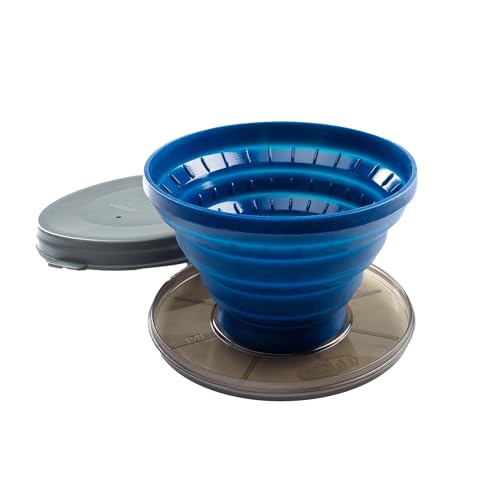
The Collapsible Java Drip is a proper pour-over cone that folds flat. The silicone cone collapses to a disc about an inch high, then pops back open to sit on a mug or a wide-mouth bottle over a clear polypropylene base that lets you see the water level. It takes standard #4 paper filters, which is its real advantage: paper strips out the oils and fines that make camp coffee muddy, and you get the cleanest, brightest cup any brewer on this page can make.
It asks for technique. Pour-over rewards a slow, controlled pour, and a camp pot is not a gooseneck kettle, so pour in several small additions rather than one flood. A medium grind, roughly like sand, suits it. GSI warranties its gear to the original owner, a comfort on a part designed to fold thousands of times. For a deeper dive into cone brewing at home, our best pour-over coffee maker guide covers the kitchen versions.
GSI Outdoors Collapsible Java Drip Pour-Over
by GSI Outdoors
The camp pour-over for people who like a clean, bright cup: a real paper-filter cone that collapses flat, sits on your mug, and asks only for hot water and a steady hand.
Pros
- The silicone cone collapses to a disc about one inch high, so a full-size pour-over brewer packs into a space that holds a paperback
- It takes standard #4 paper filters, which give the cleanest, brightest cup any camp brewer on this page can make
- The clear base sits on a mug or a wide-mouth bottle and lets you see the level, so you stop pouring before it overflows
- GSI warranties its gear to the original owner against defects, which is reassuring on a part made to fold thousands of times
Cons
- Filters are not included, and a wet filter is one more thing to carry and pack out
- Pour-over needs a controlled pour, which is harder from a camp pot than from a gooseneck kettle
Best Compact Percolator: GSI Outdoors Glacier Stainless 6-Cup
The Glacier is the stainless percolator for two people. It weighs 1.1 pounds, so it is light for a steel pot, and six cups gives a couple two good mugs without underfilling the basket. The heavy-gauge stainless body survives being packed, dropped, and set on a grill in a way that thin aluminum does not, and the silicone handle lets you pour without reaching for a glove.
One detail matters if you are shopping for a plastic-free pot. GSI’s own technical specification lists the clear PercView knob as copolyester, which is a plastic. The body, basket, and stem are stainless, so the plastic is limited to the knob in the lid, but this is not an all-metal water path, and I would rather tell you that than let the stainless title imply otherwise.
Owners also note that the brewed yield comes in under the cup count, because the basket and stem displace some of the water. That is normal for small percolators. GSI makes the same pot in larger sizes if your group grows, and warranties it to the original owner.

GSI Outdoors Glacier Stainless Percolator, 6 Cup
by GSI Outdoors
The compact stainless percolator for two: light enough to carry, tough enough to throw in a crate, with a plastic knob as the one compromise.
Pros
- At 1.1 pounds it is light for a stainless percolator, and six cups is the right size for two people rather than a pot sized for a crowd
- The body is heavy-gauge stainless steel that survives being packed, dropped, and set on a grill without denting the way thin aluminum does
- The silicone handle is heat resistant and comfortable, so you can pour without a glove or a rag
- GSI warranties it to the original owner against defects, and the same pot comes in 3, 9, and 12-cup sizes if your group changes
Cons
- GSI's own tech spec lists the clear PercView knob as copolyester, so this pot is not plastic-free even though the body is stainless
- Owners find the brewed yield smaller than the cup count suggests once the basket and stem displace their share of the water
Best for a Camp Stove: Farberware Classic Yosemite 8-Cup
The Farberware Yosemite is a kitchen percolator, and I include it because it is excellent on a two-burner camp stove. Its flat, stable base sits squarely on a stove grate where a narrow campfire pot can rock, and the mirror-polished stainless body is the classic shape that essentially all stovetop percolator technique advice is written for. If you learned to perk coffee at home, this pot behaves exactly the way you expect.
The permanent filter basket means no paper to carry or run out of, and the whole pot is immersible and dishwasher safe, so the perk tube gets properly cleaned when you get home. That matters, because coffee oils go rancid inside a perk tube and make every later pot taste stale.
What it is not is a campfire pot. There is no bail handle, and the design assumes a burner, so keep it on the stove. The listing describes a clear knob, and owners report that knob breaking, which is worth guarding against in a gear bin. The reviews are pooled with Farberware’s 12-cup sibling.

Farberware Classic Stainless Steel Yosemite Coffee Percolator, 8 Cup
by Farberware
The kitchen classic that happens to be excellent on a camp stove: a stable base, a permanent basket, and the shape every percolator technique guide assumes.
Pros
- It is the classic mirror-polished stainless percolator, and essentially every piece of stovetop percolator technique advice is written for a pot shaped exactly like it
- The permanent filter basket means no paper to carry, which on a camping trip is one less thing to run out of
- It is fully immersible and dishwasher safe, so the perk tube can be cleaned properly when you get home
- The flat base sits steadily on a two-burner camp stove, where a narrow campfire pot can wobble on the grate
Cons
- It has no bail handle and was not designed for an open fire, so it belongs on a burner, not in the coals
- Owners report the clear knob breaking, and on a stovetop pot the knob is how you read the brew
- The owner reviews are pooled with the 12-cup sibling, so treat the rating as a signal about the line
Best Ultralight: GSI Outdoors Ultralight JavaDrip
The Ultralight JavaDrip weighs about a third of an ounce, which makes it the lightest brewer on this page by a very wide margin. It is a folding nylon mesh cone on polypropylene legs that clip onto most mugs and wide-mouth bottles, and it folds nearly flat to nest under a standard fuel canister. For a thru-hiker or anyone counting grams, it is essentially free weight.
The mesh is a permanent filter, so there is no paper to carry, though GSI says it will also take #2 or #4 paper filters if you want a cleaner cup on a trip where the extra weight does not matter. Used alone, the mesh lets some fines through. The cup has a little sediment and a lighter body than a paper-filtered pour-over, closer in texture to a French press. Grind on the coarse side of medium to keep the fines down, and pour in stages, because the cone has no reservoir.

GSI Outdoors Ultralight JavaDrip Pour-Over Coffee Cone
by GSI Outdoors
The ultralight pick: a folding mesh cone that weighs next to nothing, needs no paper, and makes a respectable cup for anyone counting grams.
Pros
- It weighs about a third of an ounce, which makes it the lightest brewer on this page by a wide margin and a rounding error in a backpacking kit
- The nylon mesh filter is permanent, so you carry no paper, though it also accepts #2 or #4 paper filters when you want a cleaner cup
- It folds nearly flat and nests under a standard fuel canister, so it takes no dedicated space in a cook kit
- The polypropylene legs clip onto most mugs and wide-mouth bottles, holding the cone steady while you pour
Cons
- The mesh lets some fines through, so the cup has a little sediment and a lighter body than a paper-filtered pour-over
- It is a single-cup cone with no reservoir, so you pour in stages and stand over it
Best Brew-and-Drink: Bodum Travel Press 15 oz
The Bodum Travel Press collapses the whole coffee setup into one vessel. You add coarse grounds and hot water, wait four minutes, press the built-in plunger, and drink from the same insulated steel cup. Double-wall vacuum insulation keeps it hot through a cold campsite morning, which a thin steel camp mug cannot manage. The silicone grip and spill-resistant lid make it easy to hold in cold hands.
The limits are real. Owners report it leaking when tilted or packed on its side, so it should ride upright in a cup holder rather than loose in a pack. The plunger seal can wear and let grounds past. And because the grounds stay in the cup under the plunger, the coffee keeps extracting as you drink, so a slow sip over an hour turns bitter. Drink it promptly, or brew a little lighter than you would in a jug. For a mug that only carries coffee, our best travel coffee mug roundup has the leak-proof options.

Bodum Travel Press, Vacuum Insulated, 15 oz
by Bodum
A French press that is also your insulated mug: the simplest single-cup camp setup there is, provided it rides upright.
Pros
- You brew and drink from the same vessel, so there is no separate brewer, mug, or filter to carry
- Double-wall vacuum insulation keeps the coffee hot through a cold morning at camp, which a thin steel mug cannot do
- The French press method needs only coarse grounds and hot water, and a coarse grind is the most forgiving grind for a hand grinder
- The silicone grip and spill-resistant lid make it easy to hold with cold hands or gloves
Cons
- Owners report it leaking when tilted or packed on its side, so it travels upright in a cup holder, not loose in a pack
- The plunger seal can wear and let grounds past, and the coffee keeps steeping on the grounds if you do not drink it promptly
Best Stovetop French Press: GSI Outdoors Glacier Stovetop JavaPress
The Glacier Stovetop JavaPress fixes the main problem with a French press at camp: you normally need a separate kettle. This one is an all-stainless pot with a French press plunger and wood knob, so it sits directly on a stove, a grill, or a fire, heats its own water, then brews in the same vessel. The silicone-sleeved handles fold in for packing, GSI includes a silicone trivet and gripper, and it doubles as a small camp pot for tea or a quick meal.
The technique point is simple but important. Take it off the heat before you add the coffee and steep. A French press kept on the flame keeps pushing hot water through the grounds and over-extracts fast. Our guide to how to use a French press covers dose and timing, which apply just the same outdoors.
The caution is about evidence, not design. This is a new listing with very few owner reviews so far, so I cannot call it proven the way I can the percolators above. The design is sound and GSI’s warranty backs it, but its long-term durability is not yet established.

GSI Outdoors Glacier Stovetop JavaPress, 20 fl oz
by GSI Outdoors
A French press you can put on the fire: all stainless, it heats its own water and doubles as a camp pot, though it is too new to call proven.
Pros
- The pot, plunger, and screen are all stainless, so it can sit directly on a stove or a fire, which a glass French press can never do
- It heats its own water, so a French press setup no longer needs a separate kettle
- Silicone-sleeved handles fold in for packing, and GSI includes a silicone trivet and gripper for handling it hot
- It doubles as a camp pot for boiling water, making tea, or cooking a small meal
Cons
- It is a new listing with very few owner reviews so far, so its long-term durability is not yet established
- Leaving the grounds in the pot while it sits on the heat will over-extract the coffee quickly, so it needs to come off the fire before you plunge
Best Enamel Campfire Pot: GSI Outdoors Enamelware 8-Cup Percolator
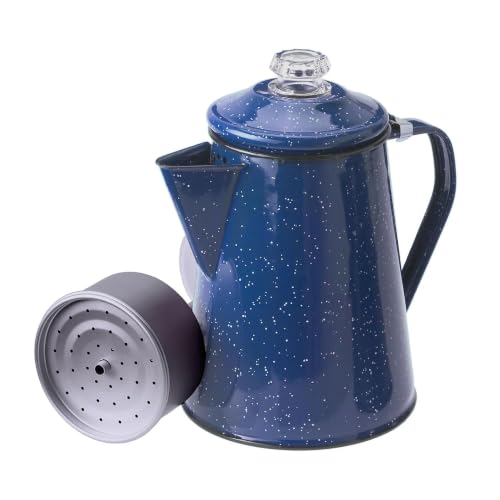
The GSI Enamelware percolator is the blue speckled pot everyone pictures when they think of campfire coffee, and it is a working brewer rather than a prop. Enamel over steel is glassy and inert, so it adds no flavour and does not stain the way bare aluminum does. It goes on a fire, a stove, or a grill, and the silicone handle and clear PercView knob make it easy to pour and to read.
Enamelware has one well-known failure: it chips when knocked against rocks or other gear, and the exposed steel underneath then rusts. Pack it in a stuff sack or wrap it in a towel. Owners also describe the basket and lid as the flimsier parts of an otherwise tough pot. GSI warranties it to the original owner, which is unusual for enamelware.
GSI Outdoors Enamelware Percolator Coffee Pot, 8 Cup (Blue)
by GSI Outdoors
The enamel campfire percolator: the classic speckled pot, fine on an open fire, as long as you pack it where it will not chip.
Pros
- The blue speckled enamel is the classic campfire coffee pot look, and it is a working pot rather than a decoration
- Enamel is glassy and inert, so it adds no flavour and does not stain the way bare aluminum does
- It goes on a campfire, a stove, or a grill, and the silicone handle and clear PercView knob make it easy to pour and read
- GSI warranties it to the original owner against defects, which is unusual for enamelware
Cons
- Enamel chips if the pot is dropped or knocked against rocks, and the exposed steel underneath then rusts
- Owners describe the basket and lid as flimsy compared with the pot itself
Best 12-Cup Camp Percolator: Coleman Stainless Steel 12-Cup
The Coleman 12-cup is the big stainless percolator for a family camp stove, and it is the Coleman coffee maker you can still reliably buy new. It brews twelve cups on a two-burner stove or a grill, the stainless body resists corrosion in a damp gear bin, and it needs no filters. The base, tube, basket, and basket lid are all included.
The listing does not describe a viewing knob, so reading the brew means lifting the lid and checking the colour rather than watching a knob. That is a small inconvenience, and it means paying attention. Turn the heat down as soon as you hear it perk, and time it. At 2.2 pounds and nearly a foot long with its handle, this is a car-camping pot.

Coleman Stainless Steel Coffee Percolator, 12 Cup
by Coleman
The large stainless percolator for a family camp stove, and the Coleman coffee maker that is still easy to buy new.
Pros
- It brews twelve cups on a two-burner camp stove or a grill, the right size for a family or a group of four to six
- The stainless body resists corrosion and wipes clean, which matters on a pot that lives in a damp gear bin
- It needs no filters: the base, tube, basket, and basket lid are all included
- It is from Coleman, the brand most people associate with camp stoves, and it is the Coleman coffee maker you can still reliably buy
Cons
- The listing does not describe a viewing knob, so reading the brew means lifting the lid rather than watching a knob
- At 2.2 pounds and nearly a foot long with the handle, it is a car-camping pot, not one you hike with
Best Camping Percolator
A camping coffee percolator is still the best way to brew a big pot straight over a fire or a camp stove. It needs no kettle and no filters, and it has almost nothing to break. The skill is stopping it on time: drop the heat the moment the knob starts bouncing and pull it once the colour is right. Among the percolator coffee pots for camping here, the Bozeman is my pick for its clean stainless water path and bail handle. The Glacier is the lighter choice for two. The Coleman is the one for a family on a camp stove. For kitchen percolators, see our best percolator guide.
| Product | Price | Buy |
|---|---|---|
| COLETTI Bozeman Percolator Coffee Pot, 9 CupBest camping percolator overall All stainless with a glass knob and a bail handle made for hanging over a fire | $37.68 | View on Amazon |
| GSI Outdoors Glacier Stainless Percolator, 6 CupBest compact camping percolator Light for a steel pot and sized for two, with a copolyester knob as the one plastic part | $44.95 | View on Amazon |
| Coleman Stainless Steel Coffee Percolator, 12 CupBest large camp-stove percolator Twelve cups on a two-burner camp stove, and the Coleman coffee maker you can still buy new | $70.73 | View on Amazon |
Best Camping Pour Over Coffee Maker
Pour-over is manual drip. If you want camping drip coffee, a cone on your mug is the modern answer. Coleman’s old propane drip coffee maker is no longer realistically buyable on Amazon, and a cone does the same job with nothing to break. A camping drip coffee maker of this kind needs only hot water and a steady pour, and a medium grind suits it. The choice is between paper and mesh. Paper gives the cleanest cup. Mesh saves carrying filters and weighs almost nothing. Our guide to how to make pour-over coffee covers the pour itself.
| Product | Price | Buy |
|---|---|---|
| GSI Outdoors Collapsible Java Drip Pour-OverBest camping pour-over overall A full paper-filter cone that collapses to a one-inch disc and shows the level through its clear base | $16.95 | View on Amazon |
| GSI Outdoors Ultralight JavaDrip Pour-Over Coffee ConeBest ultralight pour-over A folding mesh cone that weighs about a third of an ounce and needs no paper at all | $10.95 | View on Amazon |
Best Backpacking Coffee Maker
On a backpacking trip, weight and packed size come before everything else, and the brewer has to work with water from a small canister stove. The AeroPress Go is the best backpacking coffee press for flavour, and it packs inside its own mug. For backpacking pour over coffee, the Ultralight JavaDrip weighs next to nothing. The Bodum Travel Press is the choice when you want your brewer and your insulated mug to be the same object. If you would rather skip brewing, our instant coffee for camping and backpacking picks are a real option.
| Product | Price | Buy |
|---|---|---|
| AeroPress Go Extra Small Portable Coffee Maker KitBest backpacking coffee press A clean, forgiving single cup in about two minutes, with the whole kit packed inside its mug | $49.95 | View on Amazon |
| GSI Outdoors Ultralight JavaDrip Pour-Over Coffee ConeBest ultralight backpacking brewer The lightest brewer here, folding flat under a fuel canister with a permanent mesh filter | $10.95 | View on Amazon |
| Bodum Travel Press, Vacuum Insulated, 15 ozBest brew-and-drink for the trail Brews and keeps coffee hot in one insulated cup, provided it rides upright | $29.99 | View on Amazon |
Best Camping Coffee Makers by Use Case
A few more situations do not need a full section but do change which camping coffee maker is right. For a vintage camping coffee pot look, the enamelware percolator is the classic. For a camping French press there is more choice in our French press for camping and travel picks.
| Product | Price | Buy |
|---|---|---|
| GSI Outdoors Enamelware Percolator Coffee Pot, 8 Cup (Blue)Best enamel camping coffee pot The blue speckled enamel percolator with the vintage camping coffee pot look, fine on an open fire | $34.95 | View on Amazon |
| GSI Outdoors Glacier Stovetop JavaPress, 20 fl ozBest coffee press for camping An all-stainless French press that sits on the stove or fire and heats its own water | $34.95 | View on Amazon |
| Farberware Classic Stainless Steel Yosemite Coffee Percolator, 8 CupBest coffee maker for camping stove A flat, stable stainless base that sits squarely on a two-burner camp stove | $23.99 | View on Amazon |
| AeroPress Go Extra Small Portable Coffee Maker KitBest camping coffee kit Brewer, scoop, stirrer, and filters packed inside one microwavable travel mug | $49.95 | View on Amazon |
| Bodum Travel Press, Vacuum Insulated, 15 ozBest portable camping coffee maker Brew and drink from one vacuum-insulated cup with nothing else to carry | $29.99 | View on Amazon |
| COLETTI Scoutmaster Coffee Percolator, 24 CupBest camping coffee maker for large groups Wide, stable, all stainless, and sized for a whole basecamp | $63.02 | View on Amazon |
Buyer's Guide
Camping strips coffee brewing back to its variables: a heat source, a vessel, a filter, and whatever you are willing to carry. Most of the choices below are trade-offs between cup quality, weight, and group size, and they are worth settling in this order before you look at any single product.
Brew method, the decision that sets everything else
Pick the method first, because it decides what else you have to carry. A percolator brews a large pot directly on the fire or stove and needs no filters or kettle, but it recirculates near-boiling water through the grounds and turns bitter if you let it run. A French press gives a heavier, full-bodied cup with control over steep time. A pour-over cone gives the cleanest and brightest cup but needs hot water and a steady pour. An AeroPress makes one fast, clean cup that is very forgiving of rough technique. For a group, a percolator or a large stovetop press. For one or two people, anything on the list.
Weight and packed size
If you are carrying it on your back, weight decides the shortlist before flavour does. A folding mesh cone weighs a fraction of an ounce, a collapsible silicone cone packs to a disc, and an AeroPress Go packs into its own mug. Percolators run from about twelve ounces for thin aluminum to two or three pounds for heavy stainless, which is fine in a car and a real burden on a trail. Also look at shape: a pot with a long handle or a bail handle is awkward to pack, while a cone that nests under a fuel canister takes no extra space at all.
Capacity, and why a percolator cup is five ounces
Percolator capacity is quoted in small cups of roughly five to six ounces, not mugs, so a nine-cup pot makes about forty-five ounces, around three large camp mugs. Large group pots count cups even more generously, and owners consistently find the practical yield below the printed number. Single-serve brewers like the AeroPress and pour-over cones make one mug at a time, which is ideal alone and slow for a group. Size for the number of people you normally camp with, and remember that a percolator brews poorly when it is badly under-filled.
Heat source: campfire, stove, induction, or none
Check what the brewer actually needs. Campfire-rated pots have metal handles or bail handles and no plastic near the base, and they belong over coals or on a grate rather than in open flame. Kitchen-style percolators with flat bases are better on a camp stove, where they sit steadily. Pour-over cones, the AeroPress, and travel presses need no heat at all, only hot water from whatever pot or kettle you carry. If you also plan to use the pot at home or in an RV with an induction hob, confirm it is induction compatible, because many stainless camp percolators and all aluminum ones are not.
What touches the water: stainless, aluminum, enamel, or plastic
Amazon's Material field describes the housing, not every part, so a stainless steel coffee pot can still have a plastic viewing knob or a plastic lid. Read the listing for the knob, basket, stem, and lid. Stainless is inert, tough, and easy to clean. Aluminum is lighter and heats fast, and the FDA treats aluminum cookware as safe, but it stains over time and some buyers prefer to avoid it. Enamel over steel is inert until it chips. Plastic and silicone are inherent to the AeroPress and collapsible cones and are BPA-free on the brands here. If a fully metal water path matters to you, look for a manufacturer that states it component by component.
Durability: knobs, glass tops, and enamel chips
Camp coffee gear fails in predictable places. On percolators, the viewing knob is the weak point: glass tops break in a crate and plastic ones crack from heat cycling. Enamelware chips when knocked against rocks, and the exposed steel then rusts. Plastic handles on cheap aluminum pots can soften if they sit near a flame. Travel presses leak when packed on their side. Pack glass-topped pots with the knob wrapped or stowed separately, keep enamelware away from hard gear, and check whether the brand offers a warranty, as GSI and Coletti both do.
How to Choose the Best Camping Coffee Maker
Start with how you travel, because it rules out half the list at once. If you drive to the site and brew for a group, choose a percolator or a large stovetop press and let weight go. If you carry everything on your back, choose between the AeroPress Go, a pour-over cone, and a travel press, and let capacity go. Then match the heat source. Campfire pots need metal handles and no plastic near the base, kitchen-style percolators belong on a stove, and cones and presses only need hot water.
Next, decide what you want touching the water, and read the listing for the knob, lid, and basket rather than trusting the headline material. If you want a fully metal water path, the Coletti pots are the ones that state it plainly. Finally, look at what breaks. Glass knobs, enamel chips, and leaky lids account for most complaints in this category, and a little care in how you pack prevents most of them.
Whatever you buy, three habits matter more than the brewer. Grind close to brewing and match the grind to the method: coarse for percolators and presses, medium for paper cones, medium-fine for an AeroPress. Keep water just off a rolling boil, and remember it boils cooler at altitude. And stop the brew when it is done. That last habit is the entire difference between good camp coffee and the kind people apologise for.
Final Verdict
The COLETTI Bozeman 9-Cup is the best camping coffee maker for most people. It is all stainless in the water path, built for a campfire with a proper bail handle, and sized to brew a real pot for a small group. If you want to spend less, the Primula 9-Cup is the budget percolator: light and quick to heat, provided you keep its plastic handle out of the flames. For a whole camp, the COLETTI Scoutmaster is the upgrade.
If you are carrying your coffee on your back, the AeroPress Go makes the best single cup here, and the GSI Ultralight JavaDrip is the choice when every gram counts. Pair any of them with fresh beans, a sensible grind, and the discipline to pull the pot on time. If you want a stronger, espresso-style cup from the same camp stove, a moka pot is worth a look. For keeping that coffee hot on the trail, see our best travel coffee mug picks.
Frequently Asked Questions
What is the best coffee maker for RV camping?
How do you make coffee while camping?
What is the best camping coffee setup?
Can you still buy the Coleman camping coffee maker?
What grind size should I use for camping coffee?
How do you dispose of coffee grounds when camping?
Is a percolator or French press better for camping?
Related Articles
About the Reviewer

Clara Bennett, CQI Q Grader, SCA Roaster
B.S. Food Science, UC Davis
Clara Bennett is a Coffee Quality Institute (CQI) licensed Q Grader and SCA-certified roaster with over a decade in specialty coffee — from competition barista to production roaster and green-coffee buyer. She has cupped thousands of coffees to CQI protocol and dialed in espresso on everything from $90 entry machines to commercial three-group setups. She founded Brew Gazette in 2026 to turn cupping-table standards into plain-English buying advice.