Burr vs. Blade Grinder: A Q Grader Explains What Actually Changes in the Cup
By Clara Bennett, CQI Q Grader, SCA Roaster Updated
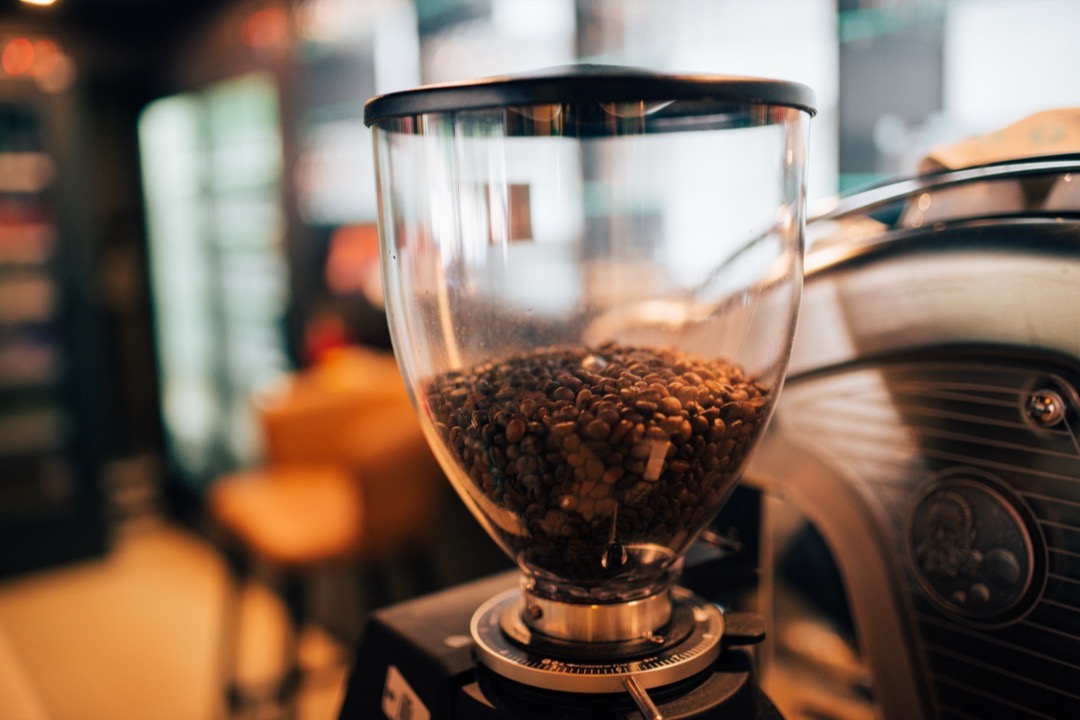
Almost every explanation of this comparison reaches for the same sentence: blades chop, burrs crush. It is a tidy line and it misses the thing that actually matters, which is not how the machine attacks the bean but whether you are allowed to choose a size at all.
A burr grinder has a gap. Two abrasive surfaces sit a set distance apart, and a fragment of coffee only escapes when it has been reduced enough to fit through that distance. You set the gap, the gap sets the grind, and tomorrow the same gap gives you the same grind. A blade grinder has no gap. It is a propeller sealed in a cup, spinning at speeds in the tens of thousands of rpm, hitting whatever drifts into its arc. Nothing in that design has any opinion about how big the pieces should end up. The only lever you hold is time.
I hold a CQI Q Grader credential, which mostly means I spend my working weeks measuring what dissolved out of coffee and then arguing about how it tastes. So I want to do this comparison with numbers: rotation speeds, particle sizes in microns, what a laser diffraction analyzer actually reports, and what a thermocouple says about the heat myth that follows blade grinders everywhere.
The Quick Answer
- A burr grinder sets a size. A blade grinder sets a duration. That single distinction drives every other difference on this page.
- Blade grinders spin at roughly 20,000 to 30,000 rpm unloaded, and the speed drops sharply under load. One documented mixer-grinder runs 23,500 rpm with nothing in the cup and 11,500 rpm with the cup full.
- Burr grinders run far slower. Home conical burrs commonly sit in the hundreds of rpm, and flat burr espresso grinders typically run somewhere around 1,400 to 1,800 rpm.
- Burr grinders are not “uniform.” Laser diffraction on a Mahlkonig EK 43 found particles from about 0.1 to 1,000 microns in one grind, with a distinctly bimodal surface-area distribution. The advantage is a controllable, repeatable peak, not a single particle size.
- The “blades burn your coffee” claim does not hold up. Thermocouples in commercial burr grinders under sustained load topped out near 96 degrees Fahrenheit, roughly a 10 degree Fahrenheit rise per shot. Roasting starts around 400.
- Fines are not the villain either. A 2024 espresso study found added fines mostly changed bed permeability and extraction time, with no sensory penalty, and two high-fines samples scored among the best.
- The real cost of a blade grinder is unrepeatability. You cannot dial in a recipe you cannot reproduce, which means you can never diagnose anything else in your setup.
- How much it matters depends on the brewer. Catastrophic for espresso, bad for drip and pour-over, ugly for French press, and genuinely survivable for cold brew.
- A hand burr grinder beats every blade grinder on the shelf, usually at a similar spend.
Burr vs. Blade at a Glance
No prices below, because they move constantly and the shape of the difference is what matters.
| Factor | Burr Grinder | Blade Grinder |
|---|---|---|
| Mechanism | Two abrasive surfaces with a set gap; particles exit when small enough to pass | A propeller impacting beans in a sealed chamber; nothing regulates exit size |
| What you control | Particle size, directly, via the gap | Elapsed seconds, indirectly, and that is all |
| Typical speed | Hundreds of rpm for home conicals; roughly 1,400 to 1,800 rpm for flat burr espresso grinders | Roughly 20,000 to 30,000 rpm unloaded, dropping by half or more under load |
| Particle distribution | Bimodal with a defined, movable main peak | Very wide spread of boulders and dust with no controllable peak |
| Repeatability | High. Same setting, same grind, next week | Low. Batch-to-batch variation even at identical timing |
| Espresso capable | Yes, with a grinder built for it | No |
| Pour-over and drip | Yes, comfortably | Poor, and inconsistent brew to brew |
| French press | Yes, coarse setting | Poor. Dust passes the mesh as silt |
| Cold brew | Yes | Acceptable. Long contact time hides most of the damage |
| Noise | Lower pitch, longer duration | High-pitched shriek, short duration |
| Static and retention | Some retention in the chute and burr chamber | Minimal retention, grounds clump to the lid |
| Cleaning | Periodic burr removal and brushing | Wipe the cup |
| Also grinds spices | Not recommended; oils and hard seeds foul burrs | Yes, and this is its best use |
One row explains the rest. What you control is the whole argument. Everything below is a consequence of it.
What a Blade Grinder Actually Does
Open one up and it is a small universal motor, a stainless propeller, and a cup. Common home units are rated somewhere around 150 to 200 watts with a capacity near 75 grams. Commercial versions of the same idea exist, and a well-known 3-cup spice grinder advertises a 1 horsepower motor at 20,000 rpm.
The propeller does not cut cleanly. It shatters. A bean struck near its edge breaks along whatever fault the roast left in it, and the pieces scatter, and some of them are hit again immediately while others sit against the wall untouched for the rest of the run. Nothing removes a particle from the chamber once it is small enough, so the fine material you made in the first two seconds spends the next ten seconds being pulverized further. That is why longer grinding does not shift the whole distribution finer so much as stretch it in both directions at once: more dust at the bottom, with survivors still sitting near the top.
The rpm figure is worth sitting with. Reference figures put blade grinders in the 20,000 to 30,000 rpm range, and a documented example shows the practical gap between spec and reality: 23,500 rpm with an empty cup, 11,500 rpm with a full one. Your grind therefore depends on how much coffee you loaded, because the load changes the speed, which changes how hard each impact lands. Two batches, same ten seconds, different doses, different results.
There is one more mechanical detail people miss. The propeller sits at a fixed height. Coffee below the blade’s sweep gets processed constantly, coffee above it circulates only if the chamber’s airflow happens to move it down. This is why every blade grinder instruction sheet tells you to shake the thing, and the advice is real, but it is also a confession about the design.
What a Burr Grinder Actually Does
Burrs work by exclusion rather than by impact. A conical burr is a toothed cone rotating inside a matching toothed ring; a flat burr is a pair of ridged discs facing each other. In both cases the coffee enters at the coarse outer teeth, gets progressively broken down as it travels inward or downward, and is discharged only when it is small enough to clear the final gap. Adjusting the grinder physically moves one burr closer to or further from the other.
That is a genuinely different relationship with the bean. A blade grinder asks “how long shall I hit this?” A burr grinder asks “how small must this be before I let it leave?” The second question has an answer you can write down and use again.
The trade-offs inside the burr world are real but much smaller than the gulf between burr and blade. Conical burrs are gravity-assisted, so they run slower, quieter, and cooler. Flat burrs run faster and shove coffee out horizontally. Our best coffee grinder roundup covers which mechanism suits which brewer, and the best espresso grinder picks are separated out because espresso needs a finer, more precisely stepped adjustment than filter brewing ever will.
The Measurement Nobody Shows You
The diagrams in most articles show a burr grinder producing a neat row of identical cubes. That is not what a particle size analyzer reports, and I would rather show you the real data than the cartoon.
A 2016 paper in Scientific Reports ground several specialty coffees on a Mahlkonig EK 43 and measured the output by laser diffraction on a Beckman Coulter analyzer. The EK 43 produced particles ranging from roughly 0.1 micron to 1,000 microns in a single grind. The most common particle size by count was around 13 microns, with a fine particulate cutoff near 70 microns across the coffees tested. Weighted by surface area rather than by count, the distribution came out clearly bimodal: one hump of fine material carrying most of the accessible surface area, and a second hump of coarse particles one to two orders of magnitude larger.
Two results from that study are worth carrying with you. First, the bean’s origin, variety, and processing method made effectively no difference to the distribution, so the grinder, not the coffee, owns this variable. Second, grinding cold produced a narrower distribution and a smaller mean particle size, which is the one piece of real evidence behind the trick of chilling beans before grinding.
Burr Grinders Are Not “Uniform”
I want to be blunt about this, because overselling it is how the argument gets discredited. An EK 43 is a grinder that professionals plan their workflow around, and it still produces a two-humped distribution spanning four orders of magnitude. Every burr grinder does. The larger independent dataset I trust most, an analysis of roughly 300 particle size distributions across 24 espresso grinders, concluded that grinders differ meaningfully in how much fine material they generate and how narrow their main peak is, that conical burrs were on average less unimodal and less uniform than flats, and that burr diameter did not systematically improve either measure.
So the honest claim is comparative. A burr grinder gives you a distribution with a main peak you can aim, and it gives you the same one next time. That is the product. Anyone selling you identical particles is selling a diagram.
What Blades Do Differently
A blade grinder’s output is not a distribution with a movable peak. It is a spread with no peak you can steer. You get very fine dust, you get fragments that were never properly broken, and you get everything in between, in proportions that depend on dose, chamber shape, how long you held the button, and whether you shook it. The coffee grind size chart lists target micron ranges for every brew method, and the reason a blade grinder cannot use that chart is not that it grinds badly. It is that it does not grind to a number at all.
I should also tell you what the literature does not contain, because I went looking. Every instrument-based particle size dataset I could find, the 2016 Scientific Reports paper, the 300-distribution survey, the published grinder comparisons run on laser diffraction and dynamic image analysis, tests burr grinders against other burr grinders. No peer-reviewed study puts a blade grinder in the same dataset. So when a page quotes you a tidy figure for “blade grinder standard deviation,” ask where it came from, because as far as I can establish nobody has measured it. What follows from here is mechanism and professional experience, clearly labelled as such, rather than a number I cannot show you the instrument for.
There Is a Real Standard, and a Blade Grinder Cannot Meet It
This is the part where the Q Grader credential earns its keep, because the grind for professional cupping is not a matter of taste. It is written down.
The SCA’s cupping protocol specifies that the grind should be slightly coarser than a typical paper-filter drip grind, with 70 to 75 percent of the particles passing through a U.S. Standard size 20 mesh sieve, which has openings of 850 microns. That is the standard every score I have ever submitted was ground to, and it is enforced with an actual sieve, not an opinion.
Read it again and notice its shape. It is not “most particles should be about 850 microns.” It is a specified fraction passing a specified opening, which is a description of a distribution, and it tolerates a quarter to a third of the mass sitting coarser. Even the profession’s own reference standard assumes an uneven grind. What it demands is that the unevenness be known and consistent.
A burr grinder can be adjusted until it meets that spec and then held there. A blade grinder cannot be adjusted at all, so it cannot be brought to the spec, and it could not stay there if it arrived by accident. That is the cleanest way I can put the entire comparison: one of these machines can be held to a standard, and the other has no input by which you could hold it to one.
The Myth I Want to Kill: “Blade Grinders Burn Your Coffee”
This one is everywhere, and a thermometer disposes of it.
The most careful home measurement I know of came out of the Home-Barista Titan Grinder Project, where a tester ran half a pound of coffee through commercial grinders with type K thermocouples suspended in the grind chute and above the burrs. A Mazzer Kony, a conical grinder working under sustained load, topped out at 96.1 degrees Fahrenheit in the chute. A faster flat burr grinder transferred somewhat more heat, and the working estimate for one shot’s worth of grinding was a rise of about 10 degrees Fahrenheit. The thermocouple above the burrs actually recorded a drop during the session, because the grinder drew cooler room air down through the bean hopper.
Those are commercial machines doing far more work than a home blade grinder ever does, and they hardly moved the needle. Roasting, for reference, happens somewhere north of 400 degrees Fahrenheit. Nothing in a kitchen blade grinder is anywhere near that neighborhood.
Blade grinders do get warm, the grounds do feel warm, and people reasonably connect the warmth to the disappointing cup. But the warmth is not the cause. The cause is that the distribution was a mess, and every minute spent arguing about heat is a minute not spent on the problem that is actually degrading the coffee. It is a myth that flatters the blade grinder, oddly enough, because it points at a fixable-sounding side effect instead of an unfixable design limit.
The companion belief, that a faster grinder must be a hotter one, is not reliable either. In a 2015 Barista Camp talk, Christian Klatt made the point that raising a grinder’s rpm can actually reduce how much heat reaches the coffee, because the beans spend less time inside the chamber absorbing it and the motor runs for fewer seconds per dose. Speed and heat are not the same axis. That should make anyone suspicious of an argument against blade grinders built on rpm alone, which is most of the arguments you will read.
Fines Are Not the Villain Either
The companion folklore says the dust from a blade grinder over-extracts, tastes bitter, and poisons the cup. The evidence is more interesting than that.
A 2024 study on the role of fines in espresso extraction deliberately added measured amounts of fine material to ground coffee and tracked what happened. The dominant effect was mechanical. Extra fines reduced the permeability of the coffee bed and lengthened extraction time, exactly as a plumber would predict. What the trained sensory panel did not find was a penalty. Two of the samples with added fines scored among the highest in the entire set.
That result does not rehabilitate blade grinders, and I want to be precise about why. Fines are a variable, and in skilled hands a deliberate one. The problem with a blade grinder is not that it makes fines. It is that it makes an unknown quantity of them, different every time, alongside an unknown quantity of boulders, so nothing you learn from one batch transfers to the next. A brewer can work with a lot of fines or with few. No brewer can work with “some unspecified amount, reshuffled daily.”
In immersion brewing the fines question changes shape again. A French press screen has openings several hundred microns across, so fine material does not get filtered at all, it gets served. That is why blade-ground French press coffee has silt in the bottom inch and a muddy body, and why our best French press picks lean on mesh quality. Our AeroPress vs. French press comparison works through what paper filtration does that metal cannot.
The Real Cost: You Cannot Repeat Anything
Here is the argument that convinced me years before I ever saw a particle analyzer.
Good coffee at home is an iterative process. You brew, you taste, you change one variable, you brew again. That loop only works if everything you did not intend to change actually stayed the same. A burr grinder holds grind constant while you test water temperature, ratio, or bloom time. Our coffee-to-water ratio calculator is useful precisely because ratio is a variable worth isolating, and you cannot isolate it if the grind underneath is wandering.
With a blade grinder, grind is a random input on every single brew. If the cup is sour you cannot tell whether you under-extracted or simply got a coarser scatter. If it is bitter you cannot tell whether the water was too hot or you happened to produce more dust. The feedback loop is severed, and with it every other improvement you might make. This is the real reason a blade grinder caps your whole setup: it does not just make worse coffee, it makes the coffee uninformative.
The same logic applies to your beans. Storage, freshness, and roast date are worth attending to, and how to store coffee beans covers what actually preserves them, but none of that care is measurable through a grinder that changes the experiment every morning.
How Much It Matters Depends on Your Brewer
Blade grinder damage is not uniform across methods. It scales with how harshly the brewing process punishes uneven particles. Ranked from worst to most forgiving:
Espresso is non-negotiable. Nine bars of pressure through a compressed bed in twenty-five to thirty seconds means bed resistance is nearly everything, and bed resistance is set by particle size and packing. A blade grinder’s output either chokes the machine or lets water channel straight through, and the failure is not consistent enough to learn from. If you are building an espresso setup, the grinder is the first purchase, not the last. Our best espresso machine roundup makes the same point, and how to make espresso at home walks the full sequence. If budget is tight, a good hand grinder paired with a modest machine beats the reverse, which is why the best hand espresso grinder picks exist as a category at all.
Moka pot is close behind. Pressure is lower than espresso, but the basket still has to resist water evenly, and dust migrating into the boiler is a real nuisance. Our best moka pot guide assumes a settable grind.
Pour-over and drip are very sensitive. Both rely on water percolating evenly through a bed, and a wide distribution creates fast channels and dead zones at once. Drip machines are the most common place people notice the upgrade immediately, and a coffee maker with grinder is a reasonable single-appliance answer provided the built-in mechanism is burrs and not a blade. A fair number of “grind and brew” machines hide a blade in the hopper; check before you buy. For separate-brewer setups, the best drip coffee maker and best pour-over coffee maker picks both assume you control grind.
French press is bad in a specific way. Four minutes of immersion is forgiving about extraction timing, so boulders get a genuine chance. The failure mode is texture: dust passes the mesh and lands in the cup.
Cold brew is the one survivable case. Twelve to eighteen hours of contact time flattens most of the surface-area differences that a three-minute brew would expose, and the final filtration through a bag or paper catches the worst of the sediment. If you own a blade grinder right now, this is the brew to make with it while you save. Our best cold brew coffee maker roundup covers the filtration that makes this work.
Conical vs. Flat: The Question After You’ve Chosen Burrs
Once you are buying burrs, the next debate you will meet is conical versus flat, and the honest summary is that it matters far less than the internet suggests.
The largest independent comparison I know of, covering roughly 300 particle size distributions across 24 espresso grinders, found that conicals were on average somewhat less unimodal and less uniform than flats, that unimodality and uniformity move together rather than trading off, and that neither burr rpm nor burr diameter reliably predicted either measure. Burr tooth geometry and coating appeared to matter more than size. Meanwhile, evidence that adjustable rpm meaningfully improves a grind is thin: raising rpm mostly just makes the grind finer, an effect you could have got by closing the gap.
In practice, conical burrs are quieter and cooler and forgiving to dial in, flat burrs tend toward a cleaner separation of flavors in espresso, and either will outperform any blade grinder by a margin that makes this whole paragraph a rounding error. If you want one machine for both filter and espresso, the best coffee and espresso grinder picks cover the compromise honestly.
If You Already Own a Blade Grinder
You do not have to throw it away today, and there are a few genuine mitigations. None of them are solutions.
Pulse, do not hold. Short bursts of two to three seconds let the chamber redistribute between hits, which narrows the spread compared with one long run. It also keeps things cooler, though as covered above that was never the real problem.
Shake between pulses. Lift the grinder and shake it sideways. You are physically moving untouched material into the blade’s sweep, doing by hand what the design failed to do.
Fill it properly. Too little coffee and the fragments scatter without being hit again; too much and the speed collapses and the top never moves. Somewhere near half to two-thirds full behaves best on most units.
Sieve if you are serious. A cheap kitchen sieve will let you discard the finest dust. You will lose a noticeable fraction of your coffee and you will resent doing it by the third morning, but it works.
Keep it for spices. This is genuinely the blade grinder’s best job. Whole cumin, coriander, peppercorns, and dried chilies want exactly the violent, non-uniform pulverization that ruins coffee. Do not run spices through burrs, where the oils and hard seeds cause real problems. Keeping the blade grinder for the spice drawer is the right retirement for it.
Hand Grinder or Electric?
The budget objection to burr grinders is mostly out of date. A decent hand grinder has steel or ceramic burrs, a real adjustment mechanism, and a repeatable setting, and it typically lands in the same spend as a mid-range blade grinder. The cost is roughly thirty to sixty seconds of cranking per cup, and for espresso doses more effort than that, since finer grinds resist more.
My actual advice: if you make one or two cups a day, a hand grinder is the best value in coffee, full stop. If you make four cups every morning while getting people out the door, buy an electric burr grinder and be honest with yourself about the arm work you will not do. Either path clears the bar the blade grinder cannot. Good coffee beans deserve a grinder that can actually present them.
Which One Should You Buy?
Choose a burr grinder if you brew espresso or moka pot at all, if you want to improve at anything else in your setup, if you drink single origins and want to taste what distinguishes them, or if you have ever wondered why the same coffee tastes different day to day. This is nearly everyone. The best coffee grinder roundup is where to start.
A blade grinder is defensible only if coffee is a background utility for you rather than something you want to get better at, you brew cold brew or long immersion almost exclusively, or you need one small appliance that will mostly grind spices. Those are real situations. They are just narrower than the blade grinder’s shelf space suggests.
The Honest Verdict
Buy the burr grinder. Not because blades scorch your coffee, because they do not, and not because fines are toxic, because the evidence says otherwise. Buy it because a burr grinder lets you pick a number and hit it again, and a blade grinder does not offer you a number to pick.
Every other improvement you might make, better beans, better water, better technique, a better brewer, is only visible through a grind that stays put while you change something else. That is what the gap between two burrs is really selling: not uniformity, which no grinder achieves, but a distribution you can aim and reproduce. It is the least glamorous upgrade in coffee and comfortably the most consequential, and it is the one piece of gear I would tell anyone to buy before the brewer it feeds.
Frequently Asked Questions
Is a burr grinder really worth it over a blade grinder?
Do blade grinders burn your coffee?
Are fines from a blade grinder what makes the coffee bitter?
Are burr grinders actually uniform?
Can I use a blade grinder for espresso or French press?
Related Articles
8 Best Coffee Grinders of 2026
coffee-grinders
9 Best Espresso Grinders of 2026
coffee-grinders
8 Best Hand Espresso Grinders of 2026
coffee-grinders
AeroPress vs. French Press: A Q Grader Explains Which One Belongs on Your Counter
manual-brewers
How to Store Coffee Beans: What the Research Actually Says About Freshness
coffee-beans
About the Reviewer

Clara Bennett, CQI Q Grader, SCA Roaster
B.S. Food Science, UC Davis
Clara Bennett is a Coffee Quality Institute (CQI) licensed Q Grader and SCA-certified roaster with over a decade in specialty coffee — from competition barista to production roaster and green-coffee buyer. She has cupped thousands of coffees to CQI protocol and dialed in espresso on everything from $90 entry machines to commercial three-group setups. She founded Brew Gazette in 2026 to turn cupping-table standards into plain-English buying advice.